pastorjohnb

Thoughts and musings on faith and our mighty God!


Leave a comment

Difficult but Necessary

Readings: Ezra 7, Ezra 8, Ezra 9, Ezra 10

Ezra 10:4 – “Get up, for it is your duty to deal with this matter; we will support you. Be strong and act.”

Ezra the priest and scribe enters the story. The opening verses serve as a sneak preview or overview. King Artaxerxes supports Ezra’s trip with a letter that recognizes the purpose of the trip and provides the needed financial resources. Ezra’s main goal is to teach the Torah to the Israelites, forming them once again into the people of God. Ezra then gathers and organizes those ready to return. There are 12 lay families and 2 priestly families present. But he finds that there are no Levites present. They are needed for the daily operations of the temple. Ezra rounds up some Levites. He then calls for fasting and prayer – to submit to God and to seek safe travels.

Upon a safe arrival and a few days rest, the gold and other items are transferred to the temple. Offerings are given and then the king’s letter is given to the local Persian authorities. Ezra then learns of the peoples’ latest sin. Upon hearing of their marriages to non-Israelites he tears his clothing, pulls out hairs, and sits in shock. This will be a serious roadblock to reestablishing the people of God. In the charge, Canaanites, Moabites, Ammonites… are named. There is much negative symbolism and actual negative experiences attached to these names. As Ezra sits in shock, others gather around him, joining his weeping. Ezra prays to God, acknowledging past sins and this sin. He leans into God’s grace and mercy.

Shecaniah steps forward from the crowd. He too acknowledges their sin. And he speaks of hope. He suggests a covenant to send away these foreign wives and their children. He turns to Ezra and says, “Get up, for it is your duty to deal with this matter; we will support you. Be strong and act.” Emboldened by these words, Ezra gathers all Israel. They make a solemn pledge in accordance with Shecaniah’s words. A plan is made to deal with this sin. They hold one another accountable. The matter is resolved.

This was a difficult but necessary step at this time. It was necessary to establish a singular ethnic and cultural identity for Israel. Through the teaching of the Torah, the people understood this was a necessary step that had to be taken to become the people of God, holy and set apart.

Prayer: Lord God, help us to see the necessary but hard steps that we need to take at times to be wholly yours. Send a voice to encourage us, to speak truth and love and hope and grace to empower our steps. And, as Ezra did, lead us to trust that your love and grace will lead the way. Amen.



1 Comment

God’s Faithfulness

Readings: 2nd Chronicles 10, 2nd Chronicles 11, 2nd Chronicles 12, 2nd Chronicles 13

2nd Chronicles 12:12 – “Total destruction was avoided. There were, after all, some good things still in Judah.”

Leaving behind the ideal kings David and Solomon – at least according to the chronicler – we turn today to the reigns of Rehoboam and Abijah. Jeroboam of Israel is also a minor part of the story. Rehoboam’s reign begins poorly. He allows the pride of youth to lead him to a bad decision and God’s people are split into two nations. Jeroboam rules over ten tribes in the northern kingdom. Rehoboam rules over two in the southern kingdom of Judah. In comparison, Rehoboam is a good king. Through Shemaiah the prophet, war is avoided. Rehoboam strengthens his defenses. The Levites flee the idolatry of the northern kingdom and support Rehoboam.

But Rehoboam was not faithful to God. So God sends Egypt to bring divine punishment. But God sends Shemaiah and Rehoboam and Israel’s elders submit to God. God relents – somewhat. Egypt attacks and is victorious, hauling away the treasures of the temple and the palace. We find a silver lining in verse 12:12 – “Total destruction was avoided. There were, after all, some good things still in Judah.” Warfare with Jeroboam marks the rest of Rehoboam’s monarchy.

Abijah becomes the next king of Judah. Jeroboam and 800,000 soldiers march out against Abijah and 400,000 soldiers. Abijah first calls out Israel’s unfaithfulness and reminds them of Judah’s faithfulness. He claims that God is on Judah’s side. This proves to be true as Judah wins a stunning victory, killing 500,000 soldiers from Israel. This blow weakens Jeroboam, who soon dies, struck down by the Lord.

In today’s readings we see a truth that flows throughout the scriptures: God is merciful to those who are faithful or who turn back to God with changed hearts. When we falter or doubt or sin – which we will more surely do – may we remember God’s faithfulness, turning once again to the one who is always merciful and loving.

Prayer: Lord God, thank you for the reminder of your great love and mercy. Draw us back to you again and again when we turn from you over and over. God, you are so good and so faithful. Thank you. Amen.


Leave a comment

God as the Center

Readings: 1st Chronicles 13, 1st Chronicles 14, 1st Chronicles 15, 1st Chronicles 16

1st Chronicles 14:16-17 – “David followed God’s orders exactly… David’s fame spread… the LORD made all the nations fear him.”

Today’s four chapters focus on David’s efforts to establish Jerusalem as the center of worship in Israel. This effort in chapter 13 begins with his first attempt to move the ark of the covenant to Jerusalem. It seems and feels like a good idea, so off they go! Part way tragedy strikes and the ark is left there with Oded-edom.

King Hiram of Tyre then builds David a palace and David marries more secondary wives, which leads to more children. The Philistines test David’s kingship twice. Both times David seeks God’s direction. Both times Israel is victorious. In verses 16 and 16 we read, “David followed God’s orders exactly… David’s fame spread… the LORD made all the nations fear him.”

This same approach guides David’s second attempt to bring the ark to Jerusalem. He prepares a place for the ark to reside. David appoints the proper Levites to their proper roles. All is done according to what is written in the instruction scroll of Moses. With great joy and celebration, the ark enters Jerusalem. David dances joyfully, but Michal, his wife, loses all respect for him. She thinks this is not how Kings should act. Sacrifices are offered and gifts are given, all in celebration, thanksgiving, and worship. David’s prayer reflects these three things.

In chapter 16 we find David continuing to follow God’s instructions. Priests are assigned and instructed to carry out the daily requirements of the Law – both before the ark and at the tabernacle in Gibeon. David returns home to bless his house. He has led well, moving to establish God as the center of his life and of the nation Israel.

Prayer: Lord God, today we see the outcomes of choices to follow your will and way. When David is faithful and obedient, you are present and you offer the right way to go. By the power and presence of your Holy Spirit, lead us to seek and to listen to your voice. Guide us to walk faithfully and obediently in the ways that you reveal. Strengthen us to live with you at the center of our lives. Amen.


Leave a comment

In Those Days…

Readings: Judges 17, Judges 18, Judges 19, Judges 20, Judges 21

Judges 21:25 – “In those days there was no king in Israel; each person did what they thought to be right.”

Photo credit: Nick Fewings

I got done reading today’s five chapters and just thought, “Wow…” Could Israel’s downward spiral get any worse? I read the last verse in Judges and thought, “How true.” Yes, God is consulted and at times God is actually present, but overall their actions are about as far from righteous and holy as they could be.

We begin with Micah setting up his own sanctuary, finding a wandering Levites priest to be his priest. Dan’s search for land brings spies into contact with this Levite. They end up abducting him and they take all of Micah’s sanctuary things for themselves. They find Laish – a happy little community living in their own little corner of the world. They totally wipe Laish out and take the area as their own. They set up their own sanctuary there.

That same Levite marries a secondary wife from his hometown of Bethlehem. Traveling home from retrieving this wayward wife, they stay in Gibeah. In a scene reminiscent of Lot’s experience in Sodom, the secondary wife is given to the depraived Benjamites, who leave her for dead. The Levite takes her body home, cuts it into 12 pieces, and sends it to the 12 tribes, basically asking, ‘What are you going to do about this?’ Benjamin refuses to give up the men of Gibeah and civil war ensues. 50,000 Benjamites die and 40,000 Israelites die. The Israelites burn down all the Benjamite cities, killing everything. The 600 men who escaped to the rock in the desert are all that is left of the tribe of Benjamin. Sitting in the brink of eliminating one of the 12 tribes, the rest of Israel pledges to not let any of their women marry a Benjamite. Their solution to saving Benjamin is to massacre the one community that didn’t participate in all of this horrid violence, except the virgins. These are given to the men of Benjamin. But they’re not enough. So they steal a few more wives from the unsuspecting Israelite community of Shiloh – while they are worshipping the Lord.

Indeed, “In those days there was no king in Israel; each person did what they thought to be right.”

Prayer: Lord God, what total and utter depravity. It makes me shudder. It is hard to fathom how far the people of God have fallen. You have a presence – allowing just enough guidance to one day work good out of all this horrid history. I am thankful that you always have a plan, even in the midst of such as this. Amen.


Leave a comment

As for Me and My House…

Readings: Joshua 18, Joshua 19, Joshua 20, Joshua 21, Joshua 22, Joshua 23, Joshua 24

Joshua 24:15 – “But my family and I will serve the LORD.”

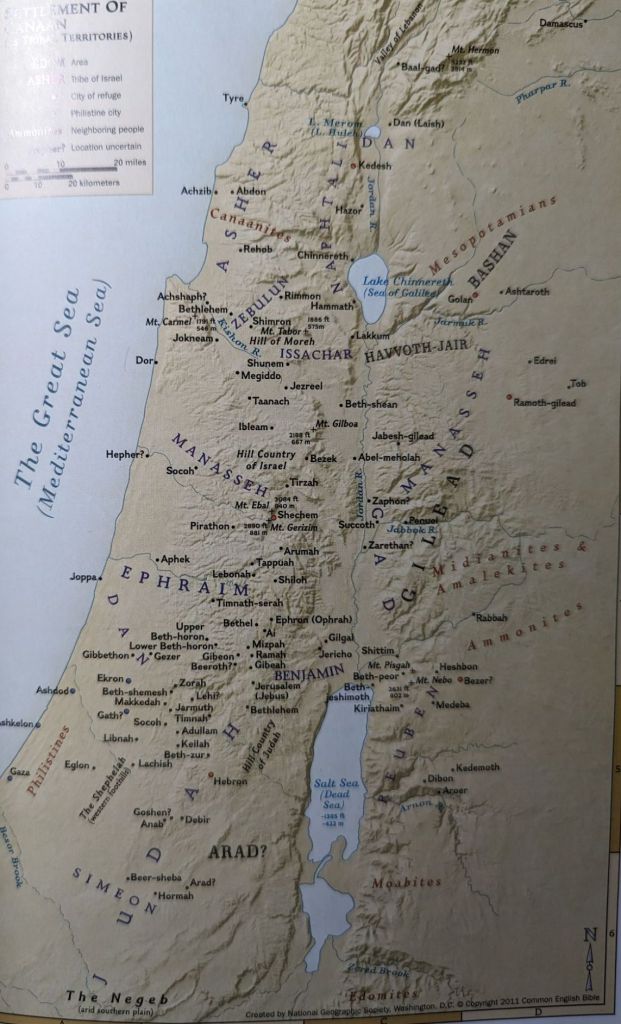
Today’s seven chapters close out the story about inheriting the Promised Land. It begins with a way to divide up the remaining land west of the Jordan. Lots are cast and land is allotted to the tribes of Benjamin, Simeon, Zebulun, Issachar, Asher, Nephtali, and Dan. Joshua also receives a legacy. Then, in chapters 20 and 21, the Levites are given cities and their surrounding pastureland. These 48 cities are spread out amongst the twelve tribes and they include the six refuge cities. God is preparing here for a day yet to come. God is good.

Now that the land legacies have been given and now that peace has come, Joshua summons the Reubenites, Gadites, and the half tribe of Manasseh. He thanks them for their faithful service and sends them home with a charge to be obedient and faithful to the Lord. At the Jordan these tribes build an altar as a witness to their belonging to the people of Israel west of the Jordan. It is a standing reminder.

Chapter 23 holds Joshua’s final words of warning. He first reminds the Israelites of all that God has done and then implores them to be faithful and obedient. Joshua warns them about mixing with the locals. They will be “a snare and a trap.” Joshua warns Israel that they will “vanish quickly” if they violate the covenant.

Chapter 24 closes Joshua’s story. He begins with a great review that takes Israel from Abram to this very moment. Joshua challenges Israel to decide “whom you will serve.” Joshua declares that he and his house will serve the Lord. So too will the people of Israel. May it be so for you and for me and for our households.

Prayer: Lord God, the story of another great leader and a meaningful period in Israel’s history comes to a close. Yet the choice at the end of Joshua remains our choice today. It’s a choice we make every day. So each day, O Lord our God, empower us to choose you. Amen.


Leave a comment

Theological Concerns

Readings: Deuteronomy 17, Deuteronomy 18, Deuteronomy 19, Deuteronomy 20

Deuteronomy 18:15 – “The LORD your God will raise up a prophet like me from your community… He’s the one you must listen to.”

Chapter 17 deals with a variety of topics: capital punishment, legal disputes, and future kings. In capital punishment cases, multiple witnesses are necessary. If these cases or other legal disputes are too hard, they are to be brought to the priests and judges in the city God will choose. These decisions must be followed exactly. Then God gives guidelines for future kings. They will be different from other earthly kings – not too many horses or wives. And they will personally make a copy of the Law that they must read daily. God’s theological concern is for a theocracy.

Chapter 18 ensures that the basic needs of the Levites are cared for. It lays out what portions of what offerings belong to the priests. This chapter concludes with God’s concern about future religious leaders. God says, “The LORD your God will raise up a prophet like me from your community… He’s the one you must listen to.” Of all the voices that can speak into people’s lives, God’s prophet is the one that they need to listen to.

As we turn to chapters 19 and 20 the underlying focus shifts to the sixth of the Ten Commandments: do not kill. Chapter 19 focuses mostly on the cities of refuge. Three are to be established in the Promised Land. They are places for those who “kill a neighbor accidentally.” These cuties will prevent the shedding of more innocent blood. The end of the chapter, “life for life, eye for eye…” also limits revenge. The punishment must fit the crime.

Chapter 20 deals with a theological concern too – the command not to kill during times of war. The chapter begins with the priest’s role to remind the troops that God goes before them and that God will fight for them. Then it defines the official’s role next. Permissions are given to leave the battle front. Then we get two sets of guidelines for war in the Promised Land and for war outside the Promised Land. Close to home, no peace terms are offered, and all living things are killed. This is all about the theological threat of idolatry. “The ban” removes even the possibility of influences that could lead to the sin of idolatry.

Prayer: Lord God, there are many ways that we can honor those who are older and those in power. They all involve justice, integrity, and obedience to you. Guide us in these situations and also teach us how to be people in these places. We see that these same principles apply to our living in community. Lead us here too. Amen.


Leave a comment

Arise, Lord!

Readings : Numbers 8, Numbers 9, Numbers 10

Numbers 10:35 – “When the chest set out, Moses would say, ‘Arise, LORD, let your enemies scatter, and those who hate you flee.’”

Today’s reading begins with the construction of the menorah (or lamp stand) followed by the dedication of the Levites. Moses sprinkles them with water to purify them and then they shave, wash their clothes, and cleanse themselves. The whole community gathers and lays hands on the Levites, blessing them. Two bulls are offered – one for purification and one as an entirely burned offering. God reminds them that the oldest males were dedicated to God when the firstborn males died in Egypt. Terms of service are set for the Levites. They serve from age 25 to 50.

The Israelite community then celebrates the Passover. This is the first remembrance of this event. A concern is raised by those who are unclean. This is the group that cares for the dead. With a population of well over a million, death was a daily occurrence. Moses goes to God and God allows for them (and the immigrants among the Israelites) to celebrate the Passover.

The cloud that has descended in the tent of meeting when it was dedicated now gives direction for when to travel. Trumpets are made. They are used to gather the community or the leaders, to announce when to march, to lead them into battle, and to announce the start of festivals and months. After 11 months at Sinai the cloud lifts, the trumpet blasts, and Israel marches. They travel in the order laid out in Numbers 2 with the three Levite clans interspersed. The chest of the covenant leads the way. As they depart, Moses invited Hobab the Midianite to stay with them. He knows the land. Offered God’s blessings, he decides to stay.

Our reading closes with Moses’ words of blessing for their journeys. At departure he offers these words: “Arise, LORD, let your enemies scatter, and those who hate you flee.” When they would camp, Moses invited the Lord to be with them. At all times, God was with Israel. And sonit can be with us too – when we go out and when we rest. Thanks be to God!

Prayer: Lord God, you ordered the lives of Israel and the Levites. Your plans and purposes were good. Open our hearts to the ways that you desire to order our lives. Guide us to walk according to your plans for us. Go before us to lead and protect us. Arise, O Lord, and be with us at all times and in all situations. Amen.


Leave a comment

A Living Expression

Ezra and the Levites not only read the Word of God to the people, but they also explain the meaning.  In doing so, the people can do more than simply hear the Word read; they can gain an understanding of them and apply them to their lives.  In today’s passage, they were reading from the law.  Through the priests’ explanations, the people came to see that they were falling short and they mourned.

At times we too read the Bible or hear a sermon or read a devotional book and we experience conviction or motivation.  Maybe the passage is about loving our neighbor and we realize we have been less than loving to a coworker.  Maybe the message is about forgiveness and it leads us to reconcile with a friend.  Maybe the devotional for the day speaks of an act of generosity and we are inspired to clean out the closets so that we can donate some warm clothing to the local mission.  God’s Word is active and living.  When we spend time in the Word, reading or hearing it, it has to affect how we live our life as it builds our love for God.  Through the Word, we also come to know God’s love for us.

Ezra does not leave the people mourning though.  Instead he reminds them of the holiness of their gathering and of their ability to live out the Word.  He helps them to see that when they are together, it is a time of blessing.  The blessing is both from the time spent with God and from the time spent with each other as both build up their strength.  As he sends them out to the feast to celebrate, he reminds them to continue to care for one another and to be in community.  If a brother or sister is lacking, he reminds the people to provide for them so that they too can celebrate God’s presence and strength in their lives and in the community.

We too are called to hear and then doers of the Word.  May our lives each day be a living expression of all that God places upon our hearts and then calls us to do as we continue on our journey of faith.

Scripture reference: Nehemiah 8: 8-10