pastorjohnb

Thoughts and musings on faith and our mighty God!


Leave a comment

He Is the Lord

Readings: 1st Samuel 1, 1st Samuel 2, 1st Samuel 3

1st Samuel 3:18 – “He is the LORD. He will do as he pleases.”

Photo credit: Nathan Lemon

As we turn to 1st Samuel we see that much of the feeling of Judges carries over. Israel is still a place of suffering, pain, and sin. God feels silent. Our reading opens with the birth story of Samuel. Elkanah has two wives. Hannah is barren and Peninnah, the secondary wife, has many children. There is great tension. On one of the yearly pilgrimages, Hannah pours out her heart to God. She is so distraught, Eli the priest assumes she is drunk. But after hearing her heart, Eli blesses her. God does too. After he is weaned, Hannah brings an offering and gives Samuel to the Lord. They worship and Hannah lifts a song to God.

We then learn that Eli’s son’s are “despicable.” They steal from the Lord’s sacrifices (by force if necessary) and they have sex with the women serving at the meeting tent’s entrance. Eli confronts them but they don’t change. God has a change already in the works. Samuel continues to grow up, becoming “more and more liked by God and by the people.” Then a “man of God” visits Eli, telling him of the utter downfall of his house. His sons will die and God will establish a “trustworthy priest.” Eli seems to simply accept this.

In chapter 3 we read about Samuel’s call. God’s word and visions were rare at that time. God was mostly silent. While lying down in the temple, God calls out to Samuel. He thinks it is Eli calling. After the third time, Eli realizes that it is God calling Samuel. He responds as instructed: “Speak Lord. Your servant is listening.” God reveals the downfall of Eli’s house. Samuel does not want to share this news, but does, showing his metal as a prophet. Eli knows what is happening. His response to this news: “He is the LORD. He will do as he pleases.” Eli knows his own failures. He knows the depravity of his sons. And he knows the truth that the chapter closes with: “All Israel… knew that Samuel was trustworthy.”

Prayer: Lord God, we continue today with the good and the bad: Hannah and Peninnah, Samuel and Eli’s sons. Your presence is revealed in the good. There we find faithfulness and obedience to you. Guide us to walk in your ways too. There we will experience your presence and your goodness. Amen.


Leave a comment

Imperfect But Usable

Readings: Joshua 6, Joshua 7, Joshua 8

Joshua 6:38 – “Don’t be angry with me… Please let me make just one more test.”

Today’s chapters focus on Gideon. In Gideon we see faithfulness to God right alongside his battles with doubt, fear, anger, and pride. We experience these things in our walks of faith. Like Gideon, we want to obey God, but often stumble over our own will and ways. More than anything, though, in these chapters we see that God can use Gideon’s flaws to ultimately work out God’s plans for Israel. God can and will do the same for you and for me.

The people have sinned and God allows the Midianites to cruelly oppress Israel. They cry out. God sends a prophet who reminds them, “You have not obeyed me.” Then God’s messenger calls Gideon. He is reluctant. He has excuses. He tries God’s patience. At one point Gideon says to God, “Don’t be angry with me… Please let me make just one more test.” God works through all of his tests. Satisfied for now, Gideon calls for an army. Yet fear persists. God allows him to overhear a dream which restored his courage. God then tests Gideon, whittling his army of 32,000 down to 300. Credit must go to God. Pride rises up in Gideon as he gives the battle cry: “For God and for Gideon.” Following a wild plan of God, similar to Jericho, victory is won. God’s plan is complete. Yet Gideon chooses to pursue the enemy kings.

In Gideon’s pursuit he asks the people of Succoth and Penuel for bread. They deny Gideon and his army any bread. He threatens them. Soon he captures these two enemy kings and executes them – revenge for killing Israelites. He returns to Succoth and Penuel, exacting violent revenge here too. Pride and anger rule in his heart. Yet when asked later to be Israel’s ruler, he states, “The Lord rules over you.” Apparently he is not part of this “you” though as he collects gold earrings and makes a priestly vest. This trap leads straight to idolatry and the continuing downward spiral of Israel. More on that tomorrow.

Prayer: Lord God, help us to learn both from the good and the bad that we see in Gideon. Help us to be faithful and to follow your plans. Help us to see, though, when it becomes about us and our plans. Keep us from the perils of sin. Guide us to walk in your ways. Amen.


Leave a comment

As for Me and My House…

Readings: Joshua 18, Joshua 19, Joshua 20, Joshua 21, Joshua 22, Joshua 23, Joshua 24

Joshua 24:15 – “But my family and I will serve the LORD.”

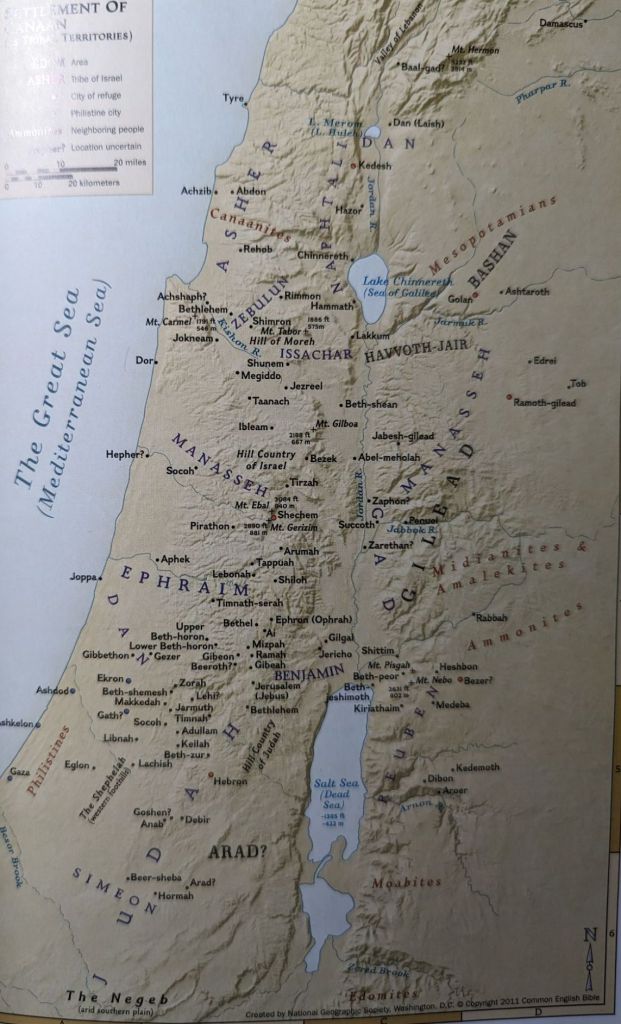
Today’s seven chapters close out the story about inheriting the Promised Land. It begins with a way to divide up the remaining land west of the Jordan. Lots are cast and land is allotted to the tribes of Benjamin, Simeon, Zebulun, Issachar, Asher, Nephtali, and Dan. Joshua also receives a legacy. Then, in chapters 20 and 21, the Levites are given cities and their surrounding pastureland. These 48 cities are spread out amongst the twelve tribes and they include the six refuge cities. God is preparing here for a day yet to come. God is good.

Now that the land legacies have been given and now that peace has come, Joshua summons the Reubenites, Gadites, and the half tribe of Manasseh. He thanks them for their faithful service and sends them home with a charge to be obedient and faithful to the Lord. At the Jordan these tribes build an altar as a witness to their belonging to the people of Israel west of the Jordan. It is a standing reminder.

Chapter 23 holds Joshua’s final words of warning. He first reminds the Israelites of all that God has done and then implores them to be faithful and obedient. Joshua warns them about mixing with the locals. They will be “a snare and a trap.” Joshua warns Israel that they will “vanish quickly” if they violate the covenant.

Chapter 24 closes Joshua’s story. He begins with a great review that takes Israel from Abram to this very moment. Joshua challenges Israel to decide “whom you will serve.” Joshua declares that he and his house will serve the Lord. So too will the people of Israel. May it be so for you and for me and for our households.

Prayer: Lord God, the story of another great leader and a meaningful period in Israel’s history comes to a close. Yet the choice at the end of Joshua remains our choice today. It’s a choice we make every day. So each day, O Lord our God, empower us to choose you. Amen.


Leave a comment

Speaking and Living Truth

Readings: Numbers 22, Numbers 23, Numbers 24, Numbers 25

Numbers 22:38 – “I’ve now come to you. But I’m only able to speak whatever word God gives me to say. That is what I will speak.”

Most of today’s readings cover the story of Balaam. He is an Aramean seer. As Israel camps across the Jordan from Jericho, the Moabites are filled with fear. They are aware of what Israel just did to Arad, Sihon, and Og, seizing control of the lands east of the Jordan. So Moab’s king Balak hires Balaam to come and curse Israel. While traveling to Moab, Balaam has an encounter with his donkey and with the messenger of the Lord. Three times his trip is interrupted. God reiterates the command to speak for God. Upon meeting Balak, Balaam says, “I’ve now come to you. But I’m only able to speak whatever word God gives me to say. That is what I will speak.” Three times Balak tries to get Balaam to curse Israel. Three times Balaam blesses Israel and responds to an angry Balak by reiterating his command to speak the Lord’s words.

The blessings become greater as the story unfolds. It begins with ‘how can I curse what God doesn’t curse?’ Then the words speak of how Israel will rise like a lioness, devouring its prey. The blessing culminates as the Spirit of the Lord comes upon Balaam. He speaks three oracles that foreshadow Israel devouring specific Canaanite tribes. Clearly God is with Israel. Placed in a very difficult situation and tempted with wealth and status, Balaam remains faithful to speaking God’s words. We will find ourselves in situations where we feel pressure to go along with the crowd or to bow to the powers on hand. We’ll be tempted by what we can gain by not speaking God’s word. In those hard places may we remember Balaam and the trust and faith he displayed in the midst of worldly powers.

Our reading closes with a story that illustrates the dangers of succumbing to the ways of the world around us. Israelite men have sex with Moabite women. This leads to idolatry, to death, and to a plague. An Israelite man then brings a Midianite woman into camp to have sex. Phinehas responds violently. He is jealous for the Lord. The plagues ends. 24,000 have died. God instructs Moses to destroy the Midianites. Allowing ourselves to be negatively influenced by the world can pull us away from our faith too. But, is the trouble not really within us?

Prayer: Lord God, what stark contrasts we have today. Alone in the midst of the world, Balaam speaks truth. Intermingling with the world around them, Israel fails to live truth. Guide us, Lord, and empower us, O Spirit, to speak and to live the ways of truth. Amen.


Leave a comment

Moving Forward

Readings: Numbers 15, Numbers 16, Numbers 17, Numbers 18

Numbers 18:29 – “You will present each gift offering to the LORD from all your gifts, from its best portions and its holiest parts.”

On the heels of choosing fear over faith and being doomed to wander the wilderness for 40 years, in chapter 15 God details the offerings to be given when they do enter the Promised Land. The wander is clearly a detour. God has a plan. So God reviews the offerings required for unintentional sins. God is clear that there is no reconciliation offering for deliberate or intentional sin. They are cut off. In the next chapter we will see what that looks like. The chapter closes with instructions to place blue fringes on all of their clothing. Blue represents holy. The fringes will remind them of the commitment to their holy God.

Chapter 16 contains challenges to Moses and to Aaron. Korah and his Levite clan want more power. Dathan and Abiram think Moses has too much power. Korah and his family are gathered. God plans to consume Korah’s entire household. Moses intercedes for the innocents. God relents. Dathan and Abiram refuse to appear before Moses. They and their families are swallowed up by the earth. Korah and his 250 followers are consumed by God’s fire. The community grumbles against these deaths and therefore against Moses and God. God sends a plague. Moses sends Aaron out into the community to stop the plague. Aaron stands between the dead and the living, halting the plague.

To reiterate God’s call on Aaron, the staffs of the 12 tribal leaders are gathered and placed with Aaron’s staff before the chest. Aaron’s staff buds, revealing God’s choice. The people lament. For now they fail to see the humility required to be in God’s presence. Today’s readings close with priestly duties and their compensation. It mostly reiterates earlier instructions but also adds a requirement of the priests. Since they belong to the Lord they will not be given a land inheritance. Instead they will receive the tenth of the crops and herds given to the Lord. In turn God will require them to give 1/10 of this to the Lord as their gift offering. It is to be “from its best portions.” May we too return to the Lord a portion from the best of our blessings.

Prayer: Lord God, in spite of the Israelites’ disobedience and rebellion and sin you keep the plan moving forward. You see and know the end results. In our lives we disobey and rebel and sin. You continue to work in our lives as well, leading and guiding, shaping and forming us into who and what you call us to be. In response, may we gratefully give our best to you in all situations. Amen.


Leave a comment

Arise, Lord!

Readings : Numbers 8, Numbers 9, Numbers 10

Numbers 10:35 – “When the chest set out, Moses would say, ‘Arise, LORD, let your enemies scatter, and those who hate you flee.’”

Today’s reading begins with the construction of the menorah (or lamp stand) followed by the dedication of the Levites. Moses sprinkles them with water to purify them and then they shave, wash their clothes, and cleanse themselves. The whole community gathers and lays hands on the Levites, blessing them. Two bulls are offered – one for purification and one as an entirely burned offering. God reminds them that the oldest males were dedicated to God when the firstborn males died in Egypt. Terms of service are set for the Levites. They serve from age 25 to 50.

The Israelite community then celebrates the Passover. This is the first remembrance of this event. A concern is raised by those who are unclean. This is the group that cares for the dead. With a population of well over a million, death was a daily occurrence. Moses goes to God and God allows for them (and the immigrants among the Israelites) to celebrate the Passover.

The cloud that has descended in the tent of meeting when it was dedicated now gives direction for when to travel. Trumpets are made. They are used to gather the community or the leaders, to announce when to march, to lead them into battle, and to announce the start of festivals and months. After 11 months at Sinai the cloud lifts, the trumpet blasts, and Israel marches. They travel in the order laid out in Numbers 2 with the three Levite clans interspersed. The chest of the covenant leads the way. As they depart, Moses invited Hobab the Midianite to stay with them. He knows the land. Offered God’s blessings, he decides to stay.

Our reading closes with Moses’ words of blessing for their journeys. At departure he offers these words: “Arise, LORD, let your enemies scatter, and those who hate you flee.” When they would camp, Moses invited the Lord to be with them. At all times, God was with Israel. And sonit can be with us too – when we go out and when we rest. Thanks be to God!

Prayer: Lord God, you ordered the lives of Israel and the Levites. Your plans and purposes were good. Open our hearts to the ways that you desire to order our lives. Guide us to walk according to your plans for us. Go before us to lead and protect us. Arise, O Lord, and be with us at all times and in all situations. Amen.


Leave a comment

Set Apart

Readings: Numbers 5, Numbers 6, Numbers 7

Numbers 6:24-25 – “The LORD make his face shine on you and be gracious to you. The LORD lift up his face to you and grant you peace.”

Chapter 5 begins with how to keep the camp from becoming unclean and with how to restore relationships in the camp. These simple provisions hold them accountable to one another. The jealous husband case found in verses 11-31 is hard to relate to our world today. John Wesley saw the purpose of this law as twofold. First, it was a deterrent to a woman tempted by adultery. Second, it offered wives protection from the jealousy of hard-hearted husbands. No provision is made anywhere in the Law for a woman who suspected her husband of adultery.

Chapter 6 gives instructions for nazarites. These were non-Levites who wanted to commit a portion of their lives to serving the Lord. Because they were not Levites they could not perform tabernacle duties. They were set apart by following a strict behavioral code. Samson and Samuel are two examples of nazarites who served for life. Most nazarites would serve for a designated period of time. At the end of their service they would offer the standard cycle of offerings to the Lord.

Chapter 7 is a flashback. It recounts the gifts brought to the dedication of the tabernacle written about in Exodus 40. Oxen and wagons are given to enable the Levites to transport the structure of the tabernacle. Then one representative from each tribe brings the same set of gifts to dedicate the altar. The gifts are brought in the order established in Numbers 2.

Our reading closes with Moses entering the tent of meeting to talk with God. This scene connects back to God’s promise made in Exodus 25. Tucked in at the end of chapter 6 is a priestly blessing. We close with a portion today: “The LORD make his face shine on you and be gracious to you. The LORD lift up his face to you and grant you peace.”

Prayer: Lord God, we, like the nazarites, are called to be set apart from the world. Instead of physical practices we are called to spiritual practices that reflect your love, grace, mercy… thereby setting ourselves apart from the world. Empower us to live in your ways. Grant us peace as we seek to live as your disciples. Amen.


1 Comment

A Heart for Relationship

Readings: Leviticus 15, Leviticus 16, Leviticus 17, Leviticus 18

Leviticus 18:4 – “My regulations and my rules are the ones you must keep by following them: I am the LORD your God.”

Chapter 15 deals with genital emissions. Didn’t ever think I’d ever start a journal entry or blog with those words! These laws deal with becoming unclean via contact with emissions from the body. The concern and the remedy are the same as we read about in recent chapters. Wash the affected items and bathe the body. Contact with male emissions rendered one unclean until evening. Contact with a woman’s emissions made one unclean seven days – because of contact with blood. Two birds were sacrificed in both cases. One was a purification offering; the second was as a wholly burned offering.

Chapter 16 establishes the Day of Reconciliation (or Atonement.) Aaron bathes in the holy of holies and then wears special, set apart clothing. A bull, a ram, and two goats are gathered. The bull is sacrificed first to purify Aaron and his household. Lots are cast over the goats. One becomes “the Lord’s” and one becomes “Azazel’s.” Incense is then burned in the holy of holies. The smoke represents the prayers of the people. The first goat is sacrificed. Blood is sprinkled, making reconciliation for the peoples’ sin. Aaron then does the same for the tent and the altar, reconciling them to God’s holiness. Azazel’s goat, the scapegoat, is brought to the entrance and Aaron presses his hands onto its head, confessing all the sins of the people. It is led away and released into the wilderness. Aaron bathes and changes back into his normal priestly clothing. This day of self-denial and Sabbath will be observed annually on the 10th day of the 7th month.

Chapter 17 and 18 begin the “Holiness Code” that runs through chapter 26. All animals slaughtered are to be killed at the entrance to the tent of meeting because it involves the shedding of blood. Blood is life, it is sacred. Blood is not to be consumed. Chapter 18 deals with sexual actions. It begins with a warning: don’t be like the Egyptians or Canaanites. God demands better, holier behavior: “My regulations and my rules are the ones you must keep by following them: I am the LORD your God.” Within the great detail of this chapter we find a simple truth: God is prohibiting sexual sin. This is sex that only gratifies self. Sex for personal gain or sex outside of covenant relationship makes one unclean or unholy. Such perversion will “cause the land to vomit you out.” PS – don’t offer up your children to that Canaanite god Molech!

Prayer: Lord God, sandwiched between the health codes we began today with and the personal conduct codes we ended with we find your heart for relationship. We see your desire to provide a way for your children to be reconciled to you. Eventually you’ll send Jesus as the final atoning sacrifice. For your heart bent on relationship with us, your children, we rejoice and offer our thanks and praise. Amen!


Leave a comment

God Is So Faithful

Readings: Genesis 24, Genesis 25:1-18

Genesis 25:27: “Bless the LORD, God of my master Abraham, who hasn’t given up his loyalty and his faithfulness to my master.”

Photo credit: Shane Rounce

The bulk of today’s reading covers finding a suitable wife for Isaac. In the culture of the day, that meant finding a wife from within one’s kinship group. This would insure continuity of religious and cultural norms and beliefs. Abram has married from within his kinship group and knew that was essential for his son Isaac too. Living as “temporary immigrants” in a foreign land, Abraham knew how important this would be for Isaac and for his future descendants. What follows is an amazing story of our faithful God at work.

The story begins with the oldest servant swearing an oath to Abraham to try to carry out his wishes for Isaac’s wife. Abraham is sure that God will go before and will guide this process, providing the right wife for Isaac. Arriving at the well outside of Nahor’s city, the servant prays to God for a woman who will give him a drink and then will water his ten camels. Rebekah does exactly that. The servant gazes in awe and wonder as this scene unfolds. He praises God, saying, “Bless the LORD, God of my master Abraham, who hasn’t given up his loyalty and his faithfulness to my master.” Once at the family home, he recounts the whole story. Essentially asking to take Rebekah back home with him to marry Isaac, both dad and brother respond, “This is all the Lord’s doing.” The next day the journey home begins. On arrival, Isaac and Rebekah meet each other and are married.

All set in order, Abraham makes final arrangements. He wills everything to his son Isaac and sends his second wife and their children far away. Abraham dies at 175. Isaac and Ishmael bury their father with Sarah. It is beautiful that both “first sons” are a part of this. Our reading closes with another example of God’s love and faithfulness. Ishmael dies at 137, leaving a line of 12 sons/princes to build his “great nation,” as promised by God to Hagar and Abraham. Our God is so faithful and true. Thanks be to God!

Prayer: Lord God, what a powerful witness to who and what you are! All unfolds exactly as you had it planned and we, like the servant, stand in awe and wonder. From that posture, Lord, may we step forward in faith each day, trusting in you to guide and lead our steps as we seek to do your will. Amen.


Leave a comment

Into the Community

Reading: Luke 2:22-40

Verse 22: “Joseph and Mary took him to Jerusalem to present him to the Lord.”

The context for today’s passage is Mary and Joseph doing what all devout parents did – they brought Jesus to the temple to be redeemed. This ritual reminds me of our practice of baptism. As is the case with these parents, I can see Mary and Joseph beaming as they bring Jesus before the Lord. They offer the set amount to redeem their son – a sacrifice of two birds, the price required for a poor couple to bring their son back home.

On Sundays when parents present their child for baptism or for dedication, there is a special feeling, a sense of joy really, that covers the sacrament. It is contagious too – the smiles on the faces of the congregation are a little brighter as the child is made a part of the family of God and a part of our faith community. There is a joy in claiming the child and in committing to help that child walk in the way of the Lord.

There is a joy that we find today in Simeon and Anna. Both are devout, Holy Spirit filled Jews that are awaiting “the consolation of Israel” – the Messiah, the Savior. Both speak of the God-driven life that Jesus will lead. Both rejoice in the gift that Jesus is to them and to the world. Both are now at peace in their hearts. It is a beautiful scene.

As I think of baptism and this passage, I can’t quite imagine doing another baptism without incorporating verse 40: “And the child grew and became strong; he was filled with wisdom, and the grace of God was on him.” May it be so for each that we welcome into our community of faith.

Prayer: Lord God, there is such joy in dedicating a child to you. It brings happiness to our hearts to welcome them into the body of Christ. Lord, help us all to keep our commitments to these children. Amen.