pastorjohnb

Thoughts and musings on faith and our mighty God!


Leave a comment

What a Tale!

Readings: Genesis 28:10-22, Genesis 29, Genesis 30

Genesis 29:30 – “Jacob slept with Rachel, and he loved Rachel more than Leah. He worked for Laban seven more years.”

Photo credit: Patrick Schneider

As we wrap up chapter 28 Jacob has a dream. He sees a stairway connecting earth and heaven. The Lord appears to Jacob and reiterates the covenant promises made to Abraham and to Isaac: many descendants and the promised land. The Lord also adds promises of presence, protection, and guidance. Jacob recognizes the sacredness of this place and of this encounter. He sets up a sacred pillar and names the place “Bethel” – the house of God. And, yet, Jacob’s faith is still immature. In verse 20 he begins, “If God…” The relationship is still very conditional.

In chapter 29 Jacob arrives in Haran and soon meets Rachel and then Laban, her dad. Laban welcomes Jacob. After a month, Laban asks Jacob’s price for his labor. Jacob offers 7 years of labor in exchange for marrying Rachel. After 7 years, the night comes. There is a great banquet and much celebration. Jacob awakens in the morning to find Leah in his tent. He must work 7 more years for Rachel. Older before the younger, you know – customs!

What follows next would put the best ever soap opera to great shame. Leah is unloved so God opens her womb. She thought sons would make Jacob love her. After son 4, she instead praises God for the gift of another son. To get in the game Rachel gives her servant girl to Jacob. This produces 2 sons. To try to again win his favor (or to compete with her sister), Leah gives her servant girl to Jacob. 2 more sons. Then God “responds” to Leah again – 2 more sons and a daughter! Finally God “remembers” Rachel and she bears Jacob a son, taking away her shame.

In Genesis 30:25 Jacob declares his desire to go back home. But he has no wealth. He worked 14 years to pay the customary bride price. He had left home with nothing. Laban sees Jacob’s presence has blessed him, so he agrees to an arrangement to build Jacob’s flocks – the only measure of wealth at this time. Both men try to trick and outwit the other. Laban steals livestock and Jacob manipulates the mating. Jacob ends up “very, very rich.” What a tale we are weaving! The story continues tomorrow.

Prayer: Lord God, blessing, competition, jealousy, the gift of children, trickery and theft. Phew! Promises, a God who sees, provides, loves. Ah… Today we turn pages and read an almost unfathomable tale. And then we pause and realize that this is still our world, still our lives today. Lord, when we are tempted by status or power or possessions, remind us of where we find our true identity and worth – in our relationship with you. Amen.


1 Comment

A Twisted Tale!

Readings: Genesis 25:19-34, Genesis 26, Genesis 27, Genesis 28:1-9

Genesis 27:27: “So he came close and kissed him. When Isaac smelled the scent of his clothes, he blessed him.”

Continuing with the rest of chapter 25 today, Jacob and Esau are about to be born. The violent fighting in the womb leads Rebekah to seek the Lord. God reveals to her two truths: the twins will be two nations and the older will serve the younger. This revelation drives the story going forward. Esau loves the outdoors, Jacob the indoors. Esau is loved by Isaac, Jacob by Rebekah. As the chapter ends, the heel-grabber takes advantage of Esau’s hunger, stealing the birthright for some stew. Esau is short-sighted. Jacob is calculating.

In chapter 26 a famine forces a move. Once in Gerar, Isaac lies about Rebekah: “She’s my sister.” Same lie, one generation later. King Abimelech discovers the rouse and prevents any curses. God blessed Isaac and the Philistines get very jealous, forcing Isaac to move away. There’s some fighting over wells but finally Isaac finds space and good water – signs of God’s blessing. Abimelech realizes this and comes and makes a treaty with Isaac.

Isaac has grown old as chapter 27 begins. As death nears, it is time to bless Esau, the oldest and his favorite. Going against cultural norms, Isaac invites only Esau to the blessing. But Rebekah overhears and schemes to steal the blessing for Jacob. Or is she just trying to make sure God’s revelation comes true…? The planning and execution are thorough – food, animal skins, clothing. It all works only after Isaac smells “Esau.” In verse 27 we read, “So he came close and kissed him. When Isaac smelled the scent of his clothes, he blessed him.” Afterwards, both Esau and Isaac are furious. Esau plots to murder Jacob. In response, Rebekah tricks Isaac into sending Jacob away to find a wife from their kin. In spite, Esau married yet another Canaanite woman, this time it is Ishmael’s daughter.

What a twisted tale we weave! Lies, deception, theft, anger, revenge. Or… is it all just God’s plan working itself out?… Before we dismiss these evil actions, let us realize that we too can go down these roads (or make similar evil choices.) As was the case long ago, in the midst of poor choices and evil actions God can and will work to accomplish God’s plans. For this unending grace and love that we too experience, we say thanks be to God!

Prayer: Lord God, as it was with our ancestors, so it is with us. These evil traits displayed long ago are certainly alive and well in our world and even in our lives. Lord, first help us to see this in ourselves. Then bend us towards the good. Give us the patience to trust into your plans. Grant us the courage to be grace and love when others are unkind to or are deceitful with us. Lead us in the way that we should go. Amen.


Leave a comment

God Is So Faithful

Readings: Genesis 24, Genesis 25:1-18

Genesis 25:27: “Bless the LORD, God of my master Abraham, who hasn’t given up his loyalty and his faithfulness to my master.”

Photo credit: Shane Rounce

The bulk of today’s reading covers finding a suitable wife for Isaac. In the culture of the day, that meant finding a wife from within one’s kinship group. This would insure continuity of religious and cultural norms and beliefs. Abram has married from within his kinship group and knew that was essential for his son Isaac too. Living as “temporary immigrants” in a foreign land, Abraham knew how important this would be for Isaac and for his future descendants. What follows is an amazing story of our faithful God at work.

The story begins with the oldest servant swearing an oath to Abraham to try to carry out his wishes for Isaac’s wife. Abraham is sure that God will go before and will guide this process, providing the right wife for Isaac. Arriving at the well outside of Nahor’s city, the servant prays to God for a woman who will give him a drink and then will water his ten camels. Rebekah does exactly that. The servant gazes in awe and wonder as this scene unfolds. He praises God, saying, “Bless the LORD, God of my master Abraham, who hasn’t given up his loyalty and his faithfulness to my master.” Once at the family home, he recounts the whole story. Essentially asking to take Rebekah back home with him to marry Isaac, both dad and brother respond, “This is all the Lord’s doing.” The next day the journey home begins. On arrival, Isaac and Rebekah meet each other and are married.

All set in order, Abraham makes final arrangements. He wills everything to his son Isaac and sends his second wife and their children far away. Abraham dies at 175. Isaac and Ishmael bury their father with Sarah. It is beautiful that both “first sons” are a part of this. Our reading closes with another example of God’s love and faithfulness. Ishmael dies at 137, leaving a line of 12 sons/princes to build his “great nation,” as promised by God to Hagar and Abraham. Our God is so faithful and true. Thanks be to God!

Prayer: Lord God, what a powerful witness to who and what you are! All unfolds exactly as you had it planned and we, like the servant, stand in awe and wonder. From that posture, Lord, may we step forward in faith each day, trusting in you to guide and lead our steps as we seek to do your will. Amen.


Leave a comment

Connection, Belonging, Faith

Readings: Genesis 21, Genesis 22, Genesis 23

Genesis 22:7 – “Isaac said, ‘Here is the fire and the wood, but where is the lamb for the entirely burned offering?’”

Chapter 21 brings a shift in the family dynamics. Sarah gives birth to Isaac. Her laughter of doubt and shame turns to the laughter of joy and celebration. As Isaac grows so too does the tension over the inheritance. This leads to Hagar and Ishmael being sent away. God assures Abraham of their future too, so he is able to send his firstborn son away. Death soon feels near and Hagar and Ishmael cry out to God. Once again God sees her and hears their cries. God promises to make him into a “great nation.” The chapter closes with Abraham making a treaty with Abimelech. This secures water rights for an immigrant living in a foreign land. This reality comes up again in chapter 23.

In chapter 22 God tests Abraham. He is instructed to sacrifice Isaac – his one and only son, again in a place that God will reveal. Showing radical obedience once more, Abraham rises early, chops the wood, and heads out – the fire, the knife, and also Isaac in tow. Leaving the two servants behind, Abraham says to them, “The boy and I will walk up there, worship, and then come back to you.” Carrying the wood himself and seeing the fire, Isaac asks, “But where is the lamb for the entirely burned offering?” Abraham’s response – “God will see to it” – demonstrates his faith. Going so far as to raise the knife over Isaac then demonstrates his trust. God intervenes, providing a ram. Then God reiterates the covenant promise of many, many descendants.

Sarah dies at the beginning of chapter 23. After grieving for her, Abraham goes to the Hittites – the locals – to buy land to bury Sarah. He is at their mercy. Abraham is a temporary immigrant. After some culturally necessary back and forth, he buys land at a very high price. It provides a burial space and it begins a social relationship with the Hittites. To a small degree, they have now become “family.” There is connection and there is belonging, something we all need.

Prayer: Lord God, as the story progresses we see that you do not change. You are faithful, you provide, you are grace. Abraham experiences all of these things again and again as he walks faithfully and obediently with you. Encourage and guide us as we seek to walk this same walk. As we do, Lord, bless us too with your care, your provision, your grace. Amen.


Leave a comment

God’s Love, Justice, Mercy, and Care

Readings: Genesis 18, Genesis 19, Genesis 20

Genesis 18:24 – “Abraham approached and said, ‘Will you really sweep away the innocent with the guilty?'”

Genesis 18 begins with 3 men visiting Abraham. He graciously welcomes them, giving them water and shade, then food. One tells Abraham that he will return next year and that by then Sarah will have a son. Sarah laughs at this notion. She “was no longer menstruating.” In the end, God responds, “Is anything too difficult with the Lord?”

One visitor remains (the Lord) and the other 2 head to Sodom. The Lord shares the depravity of Sodom with Abraham. He learns of God’s justice. Abraham then negotiates with God to spare the city. God agrees to save the city for 50 innocent people. Then for 45… 40… 30… 20… and finally for 10. Abraham learns of the depth of God’s mercy. The 2 men who went to Sodom meet Lot and are welcomed into his home. Very soon, though, the depth of Sodom’s sin is revealed. Lot and his wife and daughters escape the city just before it is destroyed. Lot’s wife, however, looks back and is turned to a pillar of salt. Chapter 19 ends with Lot’s daughters sleeping with a drunk Lot to preserve the family line.

In chapter 20 Abraham returns to his old ways as he again lies about Sarah’s identity to save his own skin. That same fear returns. But this time God intervenes sooner, keeping Abimelech innocent. The king confronts Abraham, who admits his fear. To make things right, Abimelech blessed Abraham with flocks and servants and money and an offer of land. All is set right. Abraham then blessed Abimelech and his household. Good health returns to them all.

In today’s chapters we are reminded once again of the depth of God’s love for humanity, of God’s great justice and mercy, and of God’s abundant care for each of God’s children. We are recipients of all this and more. In response, we say, thanks be to God!

Prayer: Lord God, through these challenging stories we see your love, your grace, your mercy, your care. What was true long ago remains true for us today. We rejoice in and celebrate today who you are, O God. Amen.


1 Comment

Covenant Faithfulness

Readings: Genesis 15, Genesis 16, Genesis 17

Genesis 17:7-8 – “I will be your God and your descendants’ God after you. I will give you… the whole land of Canaan.”

Today we begin with God’s promise to Abram of a biological heir. To illustrate the abundance of God’s promise, Abram is invited to look to the stars – “this is how many children you will have.” A sacrifice seals the covenant promise. As fire, God passes through the sacrifice, sealing God’s commitment to the covenant. Within this section God also reiterates and ties in the promise of this land for Abram’s descendants.

In chapter 16 we see Abram and Sarai taking matters into their own hands. It has been about 15 years since God first promised them descendants. Abram sleeps with Hagar, Sarai’s slave girl. Her pregnancy creates a rift in the family. Treated harshly by Sarai, Hagar runs away. God meets her there and promises Ishmael a large family, land… Hagar names God “El Roi” – the God who sees me. She returns to Sarai and Abram with God’s assurances of blessings.

Chapter 17 brings a reaffirmation of the covenant promises. “El Shaddai” – the God of power and might – invites Abram to walk with God. Abram becomes Abraham and Sarai becomes Sarah. This name change signals a new era and status for them. God initiates circumcision on the 8th day of life as a symbol of the covenant, saying, “Your flesh will embody my covenant as an enduring covenant.” That very day Abraham will circumcise his entire household, including himself at 99 years old. God assures Abraham and Sarah that the covenant will be fulfilled through their son Isaac. God tells them that Ishmael will be blessed too, but the covenant will run through Isaac’s descendants.

Reflecting on Abraham’s actions in these chapters, I wonder which Abraham I am most often like. Am I more often like the one who takes things into his own hands? Or am I more often like the one that acts on God’s word right then and now?

Prayer: Lord God, most of the time Abram/Abraham was a great example of faith. Guide me to be so obedient and faithful. At times, though, he stumbled and failed. At times, I do too. As you did with Abraham, continue to walk with me. Amen.


Leave a comment

Abram – A Model Faith

Readings: Genesis 12, Genesis 13, Genesis 14

‭Genesis‬ ‭12:4-5 – “Abram left just as the LORD told him… Abram took his wife Sarai, his nephew Lot, all of their possessions.”

As we begin chapter 12 the stories become more personal. We explore the relationships between God and Abram and between various human characters. The relationship between Abram and God reveals the ideal human relationship with the divine. All of the relationships between the human characters run the gamut from faithful and true to selfish and power-hungry. In many ways these human relationships mirror our relationships today.

Chapter 12 begins with God directing Abram to leave Haran to go to “the land that I will show you.” Abram doesn’t know the destination or the time frame. Yet in verses 4-5 we read, “Abram left just as the LORD told him… Abram took his wife Sarai, his nephew Lot, all of their possessions.” Living out a radical faith and obedience, Abram heads out. Abram leaves everything to follow God’s word. He is the model of faith in the Old Testament and beyond.

But Abram isn’t perfect. That’s another thing that character after character reveals in the Bible. Famine forced Abram and family to Egypt. He lies about who Sarai is to save his own life. She becomes part of Pharaoh’s house. This brings plagues on Pharaoh and his house. Abram is figured out and expelled from Egypt. While living there, however, God has abundantly blessed both Abram and Lot. This becomes a problem when they get back to Canaan. Splitting up is necessary and Abram graciously gives Lot the first choice. He greedily chooses the best land. It is near Sodom, a place of sin and evil.

Lot then becomes a victim of a local war. He and all he has is taken away as plunder. A survivor tells Abram who goes and rescues Lot. On the way home they meet Melchizedek, who blessed them in the name of El Elyon – the God of heaven and earth. Abram returns the blessing by giving the priest a tenth of the plunder.

The question I’m left with today is this: Do my relationships with God and others seek to emulate the relationships modeled by the good and faithful Abram?

Prayer: Lord God, were I to be as obedient and faithful as Abram, how my life and faith would change! When I lean towards being selfish or sinful, bend me back to your will and ways. When you bless me, O God, turn me to others so that I may bless them in turn. Amen.


Leave a comment

Center Stage

Readings: Genesis 9:18-39, Genesis 10, Genesis 11

Genesis 11:4 – “Come, let’s build for ourselves a city and a tower with its top in the sky, and let’s make a name for ourselves.”

Continuing in chapter 9 today we see that sin hasn’t left the world with the flood. Noah grows grapes and makes wine. He gets drunk then naked. Ham sees his father naked and instead of covering him up, he tells Shem and Japheth about it. They do the right thing and later receive Noah’s blessings. Ham, by contrast, is cursed because he did not honor his father.

Chapter 10 details the most of the descendants of Shem, Ham, and Japheth. They are listed a variety of ways – names, families, languages, lands, nations. This creates a kind of early ethnic map of the ancient world. Shem’s genealogy is found again in chapter 11. But it diverges in verse 18 as it follows Peleg’s branch of the family tree. This branch ends with Abram and family in the land of Haran. Sarai and her barrenness is also mentioned. This is a sharp contrast to the long list of children and descendants found in chapters 10-11.

In the middle of these genealogical lists we find the story of the Tower of Babel. In this story we see that the human tendency towards pride and arrogance survived the flood. At Shinar the people begin to scheme, saying to one another, Come, let’s build for ourselves a city and a tower with its top in the sky, and let’s make a name for ourselves.” They want to build a tower that reaches to heaven. It could be to connect with God or it could be to be like God. It’s likely the second as they also desire to be famous, to be recognized for their skill. As a means to counter this pride and sin, God confuses or jumbles their languages and then dispersing this prideful bunch all over the earth.

When we try to take center stage for ourselves, how does this affect our relationship with God and with one another? How does God normally respond?

Prayer: Lord God, in my thoughts, my words, my actions, may I honor you and bring all the glory to you. When I’m tempted to bring the focus to me, remind my heart of you, my audience of one. Amen.


Leave a comment

In Love and in Grace

Readings: Genesis 6, Genesis 7, Genesis 8, Genesis 9:1-17

Genesis 6:9b: “Noah was a moral and exemplary man; he walked with God.”

Today’s readings center on the great flood. God sees that humanity has become “thoroughly evil.” Every thought was “completely evil.” The world was so bad that God even regrets making human beings. This situation leaves God “heartbroken.” Things are almost as bad as they can get. Almost. There is Noah. In Genesis 6:9b we read, “Noah was a moral and exemplary man; he walked with God.” At least there is Noah. At least there is one person that is worth saving.

Today our world is not perfect. It is far from it. Noah was an Old Testament example of piety. I wonder, as God looks down on the earth today, who are the Noahs? Specifically, are you and I modern day examples of an exemplary relationship with God?

In obedience to God, Noah builds an ark and gathers up his family and the animals – a pair of some, seven pairs of others. This gathering up insures not just Noah’s salvation, but the salvation of all of creation. God then shuts the hatch and the rains come down and the “springs of the deep sea” open up. In 7:22 we read, “Everything on dry land with life’s breath in its nostrils died.” The loss of all life is catastrophic, horrific, complete.

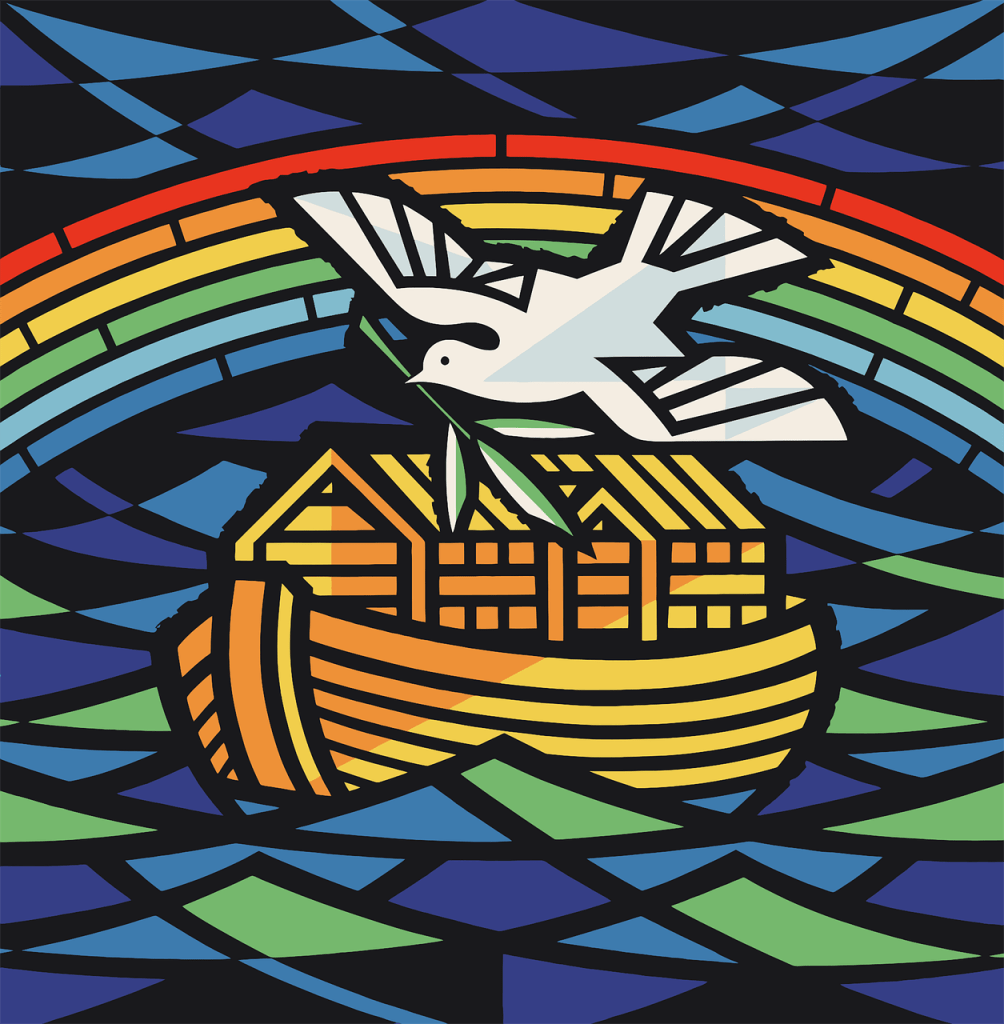
Eventually the waters recede. Noah sends out a dove to test the earth’s readiness for life. The third time the dove does not return. God tells Noah to exit the ark. Noah’s first acts on dry land are to build an altar and then to offer a sacrifice to God. This pleases God and moves God to make a covenant. There will never be another flood “to destroy the earth.” God placed “his bow” in the sky – it will be a frequent reminder to God of God’s commitment to stay in relationship with humanity. This is a gift that we rejoice in yet today.

Prayer: Lord God, what a horrible place the world became. Humanity broke your heart. Things deteriorated to the point that your justice required action. Thanks be to you, O God, that we had Noah – an example of faithful living. In your love you provided a way for the world to continue. In your grace you committed to us and to creation forever. Thank you, God. Amen.


Leave a comment

God with Us

Reading: Genesis 4, Genesis 5

Genesis 4:10: “The Lord said, ‘What have you done? Listen! Your brother’s blood cries out to me from the ground.'”

Chapter 4 contains the story of Cain and Abel – Adam and Eve’s first two sons. Living outside of the garden because of their parents’ sin, Abel works as a shepherd and Cain as a farmer. These two brothers bring an offering to God. Cain brings some of his crops and Abel brings the firstborn, including their fat portions. God sees Abel’s offering as “favorable,” angering Cain. At times we all come to this place that Cain came to – realizing that our offering to God was less than what it could or should have been. Maybe it was a half-hearted effort with that neighbor. Maybe we came to worship with a really poor attitude. When the realization comes that we fell short, we too can get angry. It’s always harder to look within.

Even though God warns Cain – “sin will be waiting at your door ready to strike” – Cain still allows his anger to smolder, leading him to murder Abel. God knows yet asks, “What have you done? Listen! Your brother’s blood cries out to me from the ground.” God is not searching for the answer but for remorse and repentance. None is found. Cain even doubles down, denying any knowledge of what has happened to Abel. As a result, Cain is moved further from community. He is to be a wandering nomad. Punishment at least brings a hint of remorse. Even here, God’s grace remains present. Isolated, alone, vulnerable, God marks Cain with a sign, protecting him from harm. Like Cain, as bad as we can become, God remains with us.

Chapter 5 brings a list of descendants. Many are just names. They lived a long time before the flood – 930, 912, 962… All but Enoch died. He was “taken up,” presumably because he walked faithfully with God. As sin continues to grow, this rapidly becomes less common. The list of singular descendants branches out at Noah. Each of his three sons will have a role in the ongoing story of God.

Prayer: Lord God, thank you for always being with us, even in our sin. Thank you for not giving up on us and for always trying to work us towards your good plans. Please forgive us when we go astray, pursuing other things. Thank you for your love and grace. Amen.