pastorjohnb

Thoughts and musings on faith and our mighty God!


Leave a comment

The Ideal King

Readings: 2nd Chronicles 5:2-14, 2nd Chronicles 6, 2nd Chronicles 7, 2nd Chronicles 8, 2nd Chronicles 9

2nd Chronicles 5:13c – “Yes, God is good! Yes, God’s faithful love lasts forever!”

Photo credit: Diego Gennaro

Our readings today begin with the dedication of the temple. All Israel gathers as the chest, tabernacle, and holy items are brought up to the temple. As the chest is placed in the holy place, this praise is lifted to God: “Yes, God is good! Yes, God’s faithful love lasts forever!” These words of David, originally spoken when the chest first came into Jerusalem, will be repeated again and again.

Solomon offers a long and beautiful prayer. In many ways he asks God to be with them and to hear and answer their prayers. Prophetically he even included an acknowledgement of sin that will lead to exile. Solomon prays that even then and there, God will hear the prayers of their changed hearts. Fire falls from heaven as God’s initial response to Solomon’s prayer. A great amount of sacrifices and a huge celebration follow. These two things are connected – a holy BBQ!

God visits Solomon again, reiterating God’s covenant loyalty and a deep willingness to listen to Israel’s prayers – if they are obedient, humble, seeking God, and turning from their evil ways. It is as if this last part were a given. Solomon’s reign and legacy will last forever if he and his descendants also walk in these ways.

The last two chapters testify to Solomon’s wealth, wisdom, and fame. He builds and builds. He receives the Queen of Sheba and other foreign powers, adding to both his fame and wealth. He is far and away the greatest king ever. Here ends the chronicler’s report on Solomon as he dies after ruling Israel for 40 years. Solomon has been portrayed as the ideal Davidic king. The chronicler returns to reality as the story continues with Rehoboam.

Prayer: Lord God, as we read and celebrate this part of Solomon’s reign, may we also remember his shadow side as well. Yes, the mountains are magnificent. But the valleys are there too. The valleys are the proving grounds, the refineries, the places of formation and shaping. May we value both, O Lord. Amen.


Leave a comment

A Solid Foundation

Readings: 1st Chronicles 28, 1st Chronicles 29

1st Chronicles 28:9c: – “If you seek God, he will be found by you; but if you abandon him, he will reject you forever.”

As we close 1st Chronicles we close the story of David’s reign. Who and what David was and much of what he did will live in through Solomon and through the construction of the temple. The peace and prosperity that Solomon and Israel will enjoy are also byproducts of David’s life and legacy.

David gathers all Israel to Jerusalem. He begins by explaining why Solomon will build the temple: David has shed too much blood. He reminds the people that God chose him as king and declares that God has chosen Solomon as the next king. We once again read the call to obedience. This time it is summed up this way: “If you seek God, he will be found by you; but if you abandon him, he will reject you forever.” David then gives Solomon the plans for the temple. These plans include both the building plans for the physical temple and the plans for ordering and administrating the temple. David is thorough.

Turning the focus to Solomon, David tells him to be “strong and courageous.” He tells him to get to work. David tells him that there is nothing to fear – God is with him. All is ready. David then gives generously from his own personal wealth. He then challenges the leaders to do the same. Their “wholehearted and willing” generosity inspired the people to rejoice. David then blesses the Lord, recognizing first God’s power and might. He then acknowledges that all comes from God. He rejoices in their choice to return some as a blessing to God.

A great celebration follows. Solomon is crowned and, according to the chronicler, “All Israel obeyed him.” David does, having lived well, having provided well for the future. I wonder, are we as intentional about living this way? Do we live in such a way that we die well, leaving a solid foundation for those who will follow?

Prayer: Lord God, thank you for the great reminder today. David saw beyond himself and worked hard and gave generously for that future. David set a great example. Use us too as good, faithful, generous examples for others. And maybe most importantly, David knew that all he had – all Israel had – were gifts from you. Grant us this perspective too. All is yours. Lead us to treat our lives and all that we have and are this way. Amen.


Leave a comment

As for Me and My House…

Readings: Joshua 18, Joshua 19, Joshua 20, Joshua 21, Joshua 22, Joshua 23, Joshua 24

Joshua 24:15 – “But my family and I will serve the LORD.”

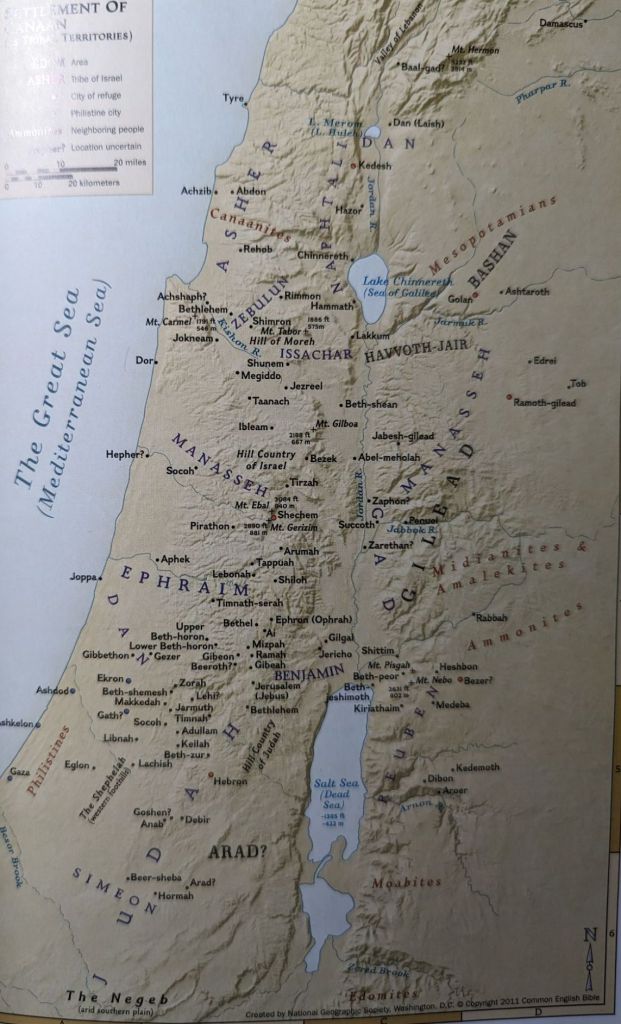
Today’s seven chapters close out the story about inheriting the Promised Land. It begins with a way to divide up the remaining land west of the Jordan. Lots are cast and land is allotted to the tribes of Benjamin, Simeon, Zebulun, Issachar, Asher, Nephtali, and Dan. Joshua also receives a legacy. Then, in chapters 20 and 21, the Levites are given cities and their surrounding pastureland. These 48 cities are spread out amongst the twelve tribes and they include the six refuge cities. God is preparing here for a day yet to come. God is good.

Now that the land legacies have been given and now that peace has come, Joshua summons the Reubenites, Gadites, and the half tribe of Manasseh. He thanks them for their faithful service and sends them home with a charge to be obedient and faithful to the Lord. At the Jordan these tribes build an altar as a witness to their belonging to the people of Israel west of the Jordan. It is a standing reminder.

Chapter 23 holds Joshua’s final words of warning. He first reminds the Israelites of all that God has done and then implores them to be faithful and obedient. Joshua warns them about mixing with the locals. They will be “a snare and a trap.” Joshua warns Israel that they will “vanish quickly” if they violate the covenant.

Chapter 24 closes Joshua’s story. He begins with a great review that takes Israel from Abram to this very moment. Joshua challenges Israel to decide “whom you will serve.” Joshua declares that he and his house will serve the Lord. So too will the people of Israel. May it be so for you and for me and for our households.

Prayer: Lord God, the story of another great leader and a meaningful period in Israel’s history comes to a close. Yet the choice at the end of Joshua remains our choice today. It’s a choice we make every day. So each day, O Lord our God, empower us to choose you. Amen.


Leave a comment

Thorns…

Readings: Joshua 12, Joshua 13, Joshua 14, Joshua 15, Joshua 16, Joshua 17

Joshua 16:10 – “But they didn’t remove the…”

Our reading today begins with a summary of the kings defeated by Moses and by Joshua. Moses’ efforts have a lot more detail. This follows the pattern found in Deuteronomy. Joshua’s efforts are simply a list of 31 names. In chapter 13 we learn that Joshua is old and “much of the land remains to be taken over.” There are many pockets of Canaanite tribes remaining here and there. The land east of the Jordan is then allocated to the tribes of Reuben and Gad and to half of the tribe of Manasseh.

Chapter 14 begins the process of assigning land west of the Jordan. Joshua, Eleazar, and tribal leaders assign a “legacy” to the remaining 9 1/2 tribes by lot. Caleb comes forward and requests the land that Moses promised him 45 years ago. Zelophehad’s daughters are later given a legacy, fulfilling another of Moses’ promises.

Judah, Ephraim, and the other half tribe of Manasseh are assigned legacies, determined by lot. It is interesting that Judah’s legacy is thoroughly detailed – it includes the names of 94 individual cities. Ephraim and Manasseh’s legacies are briefly described. No cities are even mentioned. At the end of chapter 17, Ephraim and Manasseh question the size of their inheritance. Permission is granted to expand by clearing forest, claiming more land for themselves.

Again and again in today’s readings we come across some version of “But they didn’t remove the…” Israel allows many Canaanite tribes to live amongst them in the Promised Land. These will become “thorns in your side” (Numbers 33:55.) When we too leave footholds in our hearts for the things of this world, they can and often do become thorns in our lives.

Prayer: Lord God, we see continued order and purpose as you allocate legacies or inheritances to Israel. You still lead and guide us in these ways of order and purpose. We also see little disobediences today – things that will lead to trouble for Israel. Help us to see these dangers in our lives too. Lead and guide and empower us in the conquest of these potential traps and dangers. Amen.


Leave a comment

God Will Show the Way

Reading: Deuteronomy 34:5-12

Verse 9: “Now Joshua son of Nun was filled with the spirit of wisdom because Moses had laid his hands on him.”

Photo credit: Robert Linder

Moses comes down from the mountain, having seen the Promised Land. He died there in Moab. Yet this is not the end of Moses’ impact on Israel. Just as he knew that he was a part of God’s unfolding plan during his lifetime, he also understood that his legacy would be part of the continuing plan. His words and actions have shaped and formed the people. He has mentored Joshua. These efforts will go forward with them into the Promised Land. And in his dying, he modeled faith and obedience. Even though 120 years old, Moses was strong and clear-minded. Moses understood that this too was God’s plan. Moses followed God even into death.

After Moses died, Joshua assumed leadership. He was chosen by God and he was trained and blessed by Moses. In verse 9 we read that he was filled with the spirit of wisdom because Moses had laid his hands on him.” Joshua was clearly the next leader. Israel followed his lead and they listened to his words. Even though “no prophet has risen in Israel like Moses,” the people will follow Joshua. It will not be the same, yet they will follow Joshua.

In our lives we experience change. We spend time in the wilderness, being shaped and formed into who God desires us to be. As we emerge and recognize that things aren’t exactly the same, may we first seek God’s guidance and direction, discerning the way that we should go. As it was with Israel, God will show the way. You might even play the role of Joshua! May it be for us as it was with Israel as they moved towards the Promised Land.

Prayer: Lord God, help us to faithfully and obediently step forward into your future. Remove our longing for the past and our worry about the present and the future. Give us the courage to look beyond self and to loosen our grip on our stuff. Open our eyes to the plans and purposes that you have for us. Lead us to faithfully join you in the plans that you have for us. Amen.


Leave a comment

The Clear Leading of God

Reading: Genesis 25:29-34

Verse 30: “Quick, let me have some of that red stew! I’m famished!”

As we continue the story of Esau and Jacob, Esau comes home from an apparently very long hunting trip. While he was away, Jacob has been busy too, working on this wonderful red lentil stew. At a place close to desperation Esau says, “Quick, let me have some of that red stew! I’m famished!” Maybe Jacob has been waiting for this chance, perhaps scheming for it ever since coming out of the womb. At this moment Jacob asks the famished Esau to trade his birthright for some stew. A desperate Esau agrees and satisfies his deep hunger.

We often read this passage and think that Jacob tricks his older brother or that he is deceitful in his scheming. But what if God was the one at work? What if the Spirit prompted Jacob to ask and Esau to answer as they did? What if this is another example of God’s penchant for raising the lowly over the powerful?

A birthright is a generations old tradition and practice that often insured the continuation of a family line by giving the oldest – the one who was usually the most experienced and most mature – the control of the family property, heritage, and legacy. It had operated this way for centuries and it has continued to operate through this day. Yet in this instance God has alternative plans. God’s ways are not always our ways. God’s plans are usually far greater than we could have ever imagined or taken them. So, in those moments, may we too lean into the clear leading of God, even when it is outside of what we think the norm.

Prayer: Lord God, open my heart to where and how you want to lead. Humble me so that I can easily get out of the way of whatever you are up to. Grant me the courage to step in to play a role as the Spirit leads. Amen.


Leave a comment

Resurrection Life

Reading: Luke 20:27-38

Verses 35-36: “Those who are considered worthy of taking part in the resurrection… are God’s children… are children of the resurrection.”

Photo credit: Greg Rakozy

In our gospel lesson this week the Sadducees come to Jesus and pose what they believe to be an impossible scenario. We read that they do not even believe in the resurrection. Yet they ask to solve a riddle about the resurrection. Their question is really about legacy and power – two things that they think are in their hands, not God’s. Jesus, as he often did, answers the impossible question as well as the real but unasked question.

Jewish law required a brother to marry a dead brother’s wife if they had no children. There were two factors behind this law. First, the family name would be carried on (legacy.) Second, children were produced to provide needed labor (which equals power.) In their wild scenario, 7 brothers marry the woman and none produce children. They all die. The Sadducees want to know whose wife she’d be in this resurrection thing. Again, this is a question of power for these religious leaders. Who would have full authority over this woman in your imaginary place, Jesus?

Jesus explains that the resurrection life isn’t like our earthly life. He begins by clarifying who will experience resurrection: those who are “worthy.” Jesus tells them that in the resurrection all are alive in God, all there are God’s children – not yours or mine or anyone else’s. Then Jesus turns to the unasked question. Yes, gentleman, there is a resurrection. He quotes from Moses, the one in whom the Sadducees place all authority, pointing out that Moses himself speaks of resurrection, naming God as the God of Abraham, Isaac, and Jacob. Moses did not say God was their God, but the God IS their God. Gentlemen, the soul, the spirit, our essence – who we are at our core – this remains alive in God.

In verses 39-40, the non-Sadducee religious leaders score one for Jesus. Debate over. Jesus 1, Sadducees 0.

Prayer: Lord God, to stand one day in your presence, a day without equal. It is so without equal that we can only begin to imagine how awesome it will be. We’re at maybe a 1 or 2 out of a million in our understanding. Yet we trust absolutely in the promise of life eternal. Day by day may we live worthy of the resurrection. Amen.


Leave a comment

Oh the Saints!

Reading: Luke 6: 20-31

Verses 20-21: “Blessed are you who are poor… hunger… weep”.

Today is All Saint’s Day. It is a day to pause and remember all those who have lived a life of faith and have shared the faith with others. The day is to remember all who have stood for Christ and have impacted others in faith – whether just a few or thousands. Many of the saints that are remembered today are just like us: simple Christians who tried every day to be faithful to God in their lives. Pause for a moment and think of those saints that have personally affected you and your faith. Thank God for their witness and example to you.

In our passage today Jesus is encouraging the disciples. They have left all behind to follow him. Verses 20-23 remind them that though they suffer now, it will not be forever. In the opening verses Jesus says, “Blessed are you who are poor… hunger… weep”. The faithful are blessed because the kingdom of God is theirs. They are blessed because one day they will be satisfied and they will laugh. He goes on to tell them that they will be blessed when persecuted and when they suffer for the faith, telling them “great is your reward in heaven”. For all the saints that are giants of the faith and for all the saints who were faithful in their little corners of the world, we celebrate because they are now leaping and rejoicing in heaven as they enjoy their reward for living a life of faith.

There is a personal consideration to this day as well. We each must consider if we are living out our faith in such a way as to encourage others in their faith. Are we too building a faith legacy? Is our mission here in this life to serve others and to bring the good news to the world? This can be hard to do. In verses 24-26 Jesus gives us some warnings. When we are so focused on our earthly desires – wealth, food, enjoying life – then we struggle to see and then meet the needs around us. When our focus is overly inward, we fail to meet the spiritual and physical needs of the world. We fail to be Jesus’ hands and feet and voice in the world. In the closing verses we are encouraged to love even our enemies, to give generously, and to do to all as we would have them do to us. We are being called to love others as Jesus first loved us. May it be so.

Prayer: Lord, thank you so much for those rich examples of faith that have walked in my life. Thank you too for the examples I find in your word and those that have been the great fathers and mothers of the faith. May I live each day to help others know you more. Help me to do your will each and every day. Amen.