pastorjohnb

Thoughts and musings on faith and our mighty God!


Leave a comment

As Long As You…

Readings: 2nd Chronicles 14, 2nd Chronicles 15, 2nd Chronicles 16

2nd Chronicles 15:2 – “The LORD is with you as long as you are with him. If you seek him, he will be found by you; but…”

Photo credit: Marcel Eberle

Asa’s reign fills chapters 14-16. Asa is a good king who seeks to walk in God’s ways and to lead Judah to do the same. Good, however, is not perfect. Following Abijah’s kingship and his sound defeat of Israel, Asa experiences 10 years of peace to begin his reign. He removes all of the foreign altars, shrines, pillars, and poles. He builds fortified cities to strengthen Judah.

After 10 years the Cushites come against Judah. They outnumber Judah almost 2:1. Asa turns to God, asking God to help the weak. He declares their reliance on God. The Lord strikes the Cushites and Judah wins a great victory. Judah collects a great amount of loot and plunder.

It is at this high point that the prophet Azariah comes. He begins by saying, “The LORD is with you as long as you are with him. If you seek him, he will be found by you; but…” We know what comes after that “but…” Azariah closes this word from God with an encouragement to be brave, to not lose heart. This word leads Asa to remove all idols. All Judah gathers, joyfully and wholeheartedly entering into a covenant with God. They declare that those who refuse to seek God will be out to death.

In Asa’s 35th year Israel attacks. Asa seeks an alliance with Aram instead of seeking God. Aram attacks Israel, ending that threat. But Hanani the seer comes with bad news. Because Asa did not seek God, war will now be the norm. In anger Asa throws Hanani in jail and takes his anger out on “some other people.” What a far cry this is from repentance.

Asa’s reign ends with continued disobedience. Good but not perfect – just like us. In illness Asa seeks help from doctors instead of from God. In our times of need, where do we turn other than the Lord?

Prayer: Lord God, as we seek to be faithful and obedient, help us to remove the shrines and idols that we set up in our lives. Give us the bravery and the faith to remove these other gods. Fill us with your Holy Spirit power so that we can confidently rely on you alone. Strengthen and encourage us in our times of need. Amen.


Leave a comment

Gracious and Compassionate

Readings: 2nd Kings 11, 2nd Kings 12, 2nd Kings 13

2nd Kings 13:23 – “But the LORD was gracious to Israel and had compassion on them, turning back to them because of his covenant with Abraham, Isaac, and Jacob.”

Chapters 11-13 are chapters filled with evil done in the sight of the Lord. Our readings begin with Athaliah killing off almost her entire family – so she can rule Judah. But one of Ahaziah’s sons escapes. Hidden away and raised in the temple, Jehoash becomes king at age 7. The priest Jehoiada orchestrates this. He then makes a covenant with the people to belong to the Lord. Jehoash is mostly a bright spot. He oversees the repair of the temple in spite of the priests’ reluctance. But he allows shrine worship to continue. And he buys off Aram’s King Hazael with the Holy objects and gold from the temple. In the end, a conspiracy by his own officials ends Jehoash’s reign after 40 years.

Shifting back to Israel in Samaria, Jehoahaz becomes king. He rules for 17 mostly evil years. A bright moment comes amidst heavy oppression from Aram. He cries out to God and God sends a savior who defeats Aram. There is peace, “But they didn’t deviate from the sins.” Joash is the next king. His 16 years are filled with what was evil in God’s sight. He dies and Jeroboam becomes king in Israel.

Our readings end with Elisha’s final appearance. He becomes gravely ill and King Joash pays him a visit. Through the use of a bow and some arrows, Elisha prophesies some rescue from Aram. He dies and is buried. And then his bones bring a man back to life. God is still present, in more ways than one. In verse 23 of chapter 13 we read, “But the LORD was gracious to Israel and had compassion on them, turning back to them because of his covenant with Abraham, Isaac, and Jacob.” Ah, the covenant. Ah, the love.

Prayer: Lord God, thank you for the closing reminder of your covenant love. No matter the evil done by Jehoash or Jehoahaz or Joash or by us, your love remains. You remain compassionate and gracious. You even work through some we least expect – like Jehoash and maybe even through us. You can use any situation and any person for your plans. Restore us when we fail. Use us as you will. Amen.


Leave a comment

A Temple and a Palace

Readings: 1st Kings 5, 1st Kings 6, 1st Kings 7, 1st Kings 8

1st Kings 8:58 – “May God draw our hearts to him to walk in all his ways and observe his commands, his laws, and his judgments.”

In today’s chapters the temple and Solomon’s palace are constructed. The King of Tyre, Hiram, reiterates the promise he made to David. Solomon and Hiram make an agreement. Solomon will receive wood and Hiram will receive wheat and oil. A huge work force is called up. The temple is 90′ by 30′ and is 45′ tall. It is beautiful and ornate and much is covered in gold. After 7 years, the temple is built. Hiram comes and makes items for the outer area: pillars, a huge tank, stands, washbasins… – all of bronze. For the inside items are made of gold: altar, table, lampstands…

Solomon is also building his palace. It will be 150′ by 75′ and is 45′ tall. It is much larger than the temple but is also much less ornate… It takes 13 years to finish the palace. As this is ongoing, the temple is dedicated. The ark of the covenant is brought into the Holy of Holies. God’s glory fills the temple. Solomon offers a long and beautiful prayer. He begins by acknowledging that there is no god like the one God. He acknowledges the covenant and God’s loyalty. He calls for the temple to be the center of worship and the focus of their faith. Whether famine or plague or sin or enemy invasion or exile, he calls on the people to look to the temple, to repent, to pray to God, and to turn their hearts fully to God. Solomon asks God to listen to their prayers and to do what is right. He closes and then offers an invitation: “May God draw our hearts to him to walk in all his ways and observe his commands, his laws, and his judgments.”

Extravagant sacrifices are made to dedicate the temple and courtyard. This is followed by a great celebration that lasts 14 days. The people are dismissed. They bless the king and head to their tents happy and pleased. It is a good day.

Prayer: Lord God, thank you for the picture painted today – a king and a people focused on doing something for your glory. Thank you for the example of a people with hearts turned fully towards you. Lead us to walk in these ways. Amen.


Leave a comment

Lines Drawn

Readings: 1st Samuel 18, 1st Samuel 19, 1st Samuel 20

1st Samuel 18:3 – “Jonathan and David made a covenant together because Jonathan loved David as much as himself.”

Photo credit: Nadine Shaabana

Jonathan and David become bound together, making a covenant because Jonathan loved David as much as himself.” He gives David his robe, sword, bow… – this symbolizes the passing on of the right to the throne. Jonathan is committed to David, and vice versa. Next, Saul’s anger rises as the woman sing of David’s greater victories. As the evil spirit returns to Saul, he tries to kill David – twice. David spends time away at war. The Lord gives him great success.

Saul then tried marriage as a means to control David. But David feels unworthy. A second attempt leads to a plot by Saul. God continues to be with David and he provides the wedding bounty. He married Michal, Saul’s youngest. After more success in battle, Saul orders David’s death. Jonathan defends David, placating Saul temporarily. But again the evil spirit rises up. David escapes a second spear and then Michal helps him to escape.

David flees to Ramah, where Samuel is. Saul sends three sets of messengers to retrieve David. All three sets fall into a prophetic frenzy and return empty handed. Saul himself goes and he suffers the same fate. Clearly the Spirit of the Lord is protecting David. These episodes lead David back to Jonathan. They devise a plan to see if Saul really wants to kill David. Yes, he certainly does. Jonathan and David renew their covenant and part ways for now. The lines have been drawn between Saul and David. Jonathan must now walk the difficult line between son and covenant friend.

Prayer: Lord God, in our moments of testing, may we be as faithful to you as David and Jonathan were. No matter what evil swirls around us, lead and guide us to walk in the way that is right and holy and true. Be a shield about us, O God, keeping us from harm. Amen.


Leave a comment

Finding God

Readings: 1st Samuel 4, 1st Samuel 5, 1st Samuel 6, 1st Samuel 7

1st Samuel 5:11 – “Send the chest of Israel’s God away! Let it go back to its own home so it doesn’t kill us and our people.”

Have you ever been around someone who has said something like, “I feel like we should say a prayer or something?” This thought reminds me of Israel at this point in their story. They have a vague notion of God but have no clue about how to really connect to the Lord. As the battle with the Philistines goes badly, they wonder why God would let this happen. But instead of praying or doing anything else that might connect them to God, they decide to bring the ark of the covenant to the next battle. This battle turns out worse. 30,000 die, the ark is captured, and Hophni and Phinehas die. This news causes Eli to fall over dead.

The ark brings nothing but trouble to the Philistines. They put it in their temple and their god Dagon falls over. They set it aright and the next morning it’s toppled again, this time missing its head and hands. The hand of God brings tumors on the people. Finally the Philistines say, “Send the chest of Israel’s God away! Let it go back to its own home so it doesn’t kill us and our people.” The Philistines even include an offering to honor God. At this point they know God better than the Israelites know God. The ark is received back. Time passes and Israel begins to long for God. Something is beginning to stir in their hearts.

Samuel calls the people back to God. He tells them to get rid of their idols and foreign gods. They gather with Samuel at Mizpah. Samuel draws and pours out water. They fast and confess their sins. And the Philistines gather an army. Israel is afraid. They look to Samuel. He prays to God and makes an offering. God brings Israel the victory. Samuel sets up an Ebenezer – a stone of remembering. There is peace. Samuel rules as a judge. All seems well…

Prayer: Lord God, today I’m reminded of how life seems to go when we go it on our own versus walking with you. When I’m tempted to sort of seek you, call me out. Remind me that it is my whole heart, soul, and mind that you seek. Pour those temptations out like water and draw me to the rock of faith that is a sure foundation. Amen.


Leave a comment

As for Me and My House…

Readings: Joshua 18, Joshua 19, Joshua 20, Joshua 21, Joshua 22, Joshua 23, Joshua 24

Joshua 24:15 – “But my family and I will serve the LORD.”

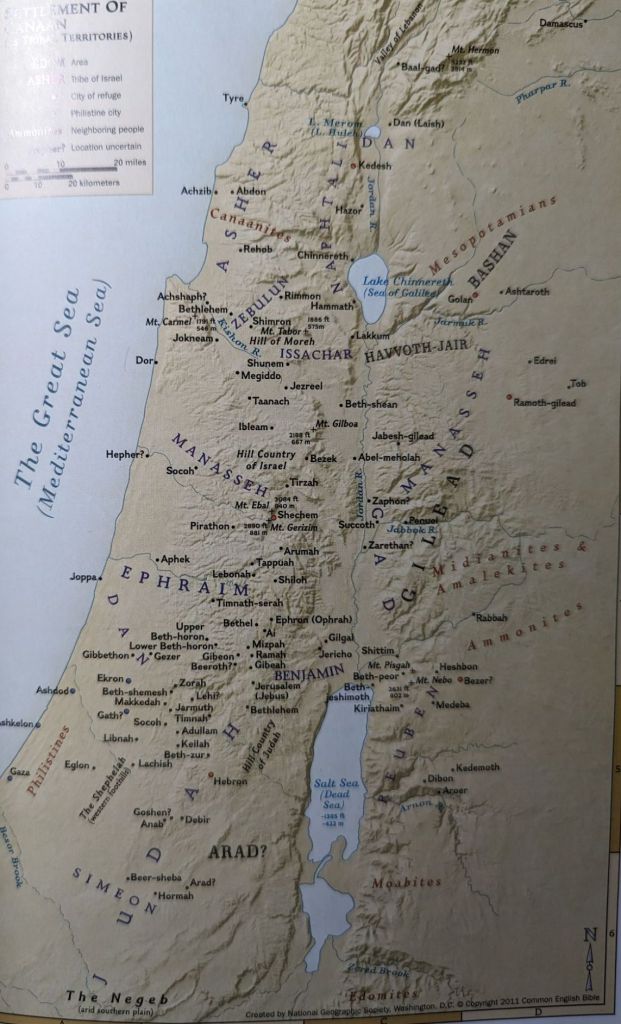
Today’s seven chapters close out the story about inheriting the Promised Land. It begins with a way to divide up the remaining land west of the Jordan. Lots are cast and land is allotted to the tribes of Benjamin, Simeon, Zebulun, Issachar, Asher, Nephtali, and Dan. Joshua also receives a legacy. Then, in chapters 20 and 21, the Levites are given cities and their surrounding pastureland. These 48 cities are spread out amongst the twelve tribes and they include the six refuge cities. God is preparing here for a day yet to come. God is good.

Now that the land legacies have been given and now that peace has come, Joshua summons the Reubenites, Gadites, and the half tribe of Manasseh. He thanks them for their faithful service and sends them home with a charge to be obedient and faithful to the Lord. At the Jordan these tribes build an altar as a witness to their belonging to the people of Israel west of the Jordan. It is a standing reminder.

Chapter 23 holds Joshua’s final words of warning. He first reminds the Israelites of all that God has done and then implores them to be faithful and obedient. Joshua warns them about mixing with the locals. They will be “a snare and a trap.” Joshua warns Israel that they will “vanish quickly” if they violate the covenant.

Chapter 24 closes Joshua’s story. He begins with a great review that takes Israel from Abram to this very moment. Joshua challenges Israel to decide “whom you will serve.” Joshua declares that he and his house will serve the Lord. So too will the people of Israel. May it be so for you and for me and for our households.

Prayer: Lord God, the story of another great leader and a meaningful period in Israel’s history comes to a close. Yet the choice at the end of Joshua remains our choice today. It’s a choice we make every day. So each day, O Lord our God, empower us to choose you. Amen.


Leave a comment

Choose God, Find Life

Readings: Deuteronomy 26, Deuteronomy 27, Deuteronomy 28, Deuteronomy 29, Deuteronomy 30

Deuteronomy 30:19-20 – “Now choose life… by loving the LORD your God, by obeying his voice, and by clinging to him.”

Chapter 26 begins by establishing a solemn oath to be taken when entering the Promised Land. The oath recalls the past and celebrates all that God has done. It reminds them of the important role that they will play upon entering Canaan – to obey God’s word. If Israel lives this way they will be God’s “treasured people.”

Moses instructs the people to set up giant stones and to write the Law upon them once they cross the Jordan. There is then a blessing-cursing ceremony in which Moses reviews a sampling of the Law. Failure to keep these brings curses. This is then followed by “future blessings.” If Israel carefully keeps all of God’s commandments, blessing will come in many ways. The other nations of the world will be in awe of Israel.

Next comes a long section on the curses that will come if Israel does not obey God. Death and destruction, plague and oppression and death, exile – it will be horrific. Much of this will come to pass. Chapter 29 halts this bad narrative and invites the people into a covenant relationship with God. The good and the bad have been laid out. Chapter 30 returns to reality. The sin cycle will be fully lived out. The curses will befall Israel. But… when you turn back to God, you will be restored. Israel will be gathered back up.

Our reading closes with words of encouragement. To obey – it’s not too difficult. These words, this God – “in your mouth and in your heart.” Life and death, blessing and curse, they have been set before Israel – and before us.“Now choose life… by loving the LORD your God, by obeying his voice, and by clinging to him.” May it be so.

Prayer: Lord God, you lay out the reality before us – life with you versus life without you. It is not a promise, though, of everything being good if we’re obedient. The promise is your presence. There we do find good in all things, even in the defeats and exiles. Thank you for being our constant God. Amen.


Leave a comment

Not So Tightly

Readings: Leviticus 24, Leviticus 25, Leviticus 26, Leviticus 27

Leviticus 25:23 – “The land must not be permanently sold because the land is mine. You are just immigrants and foreign guests of mine.”

Photo credit: Javardh

We draw to the close of our time in Leviticus today. The last four chapters begin with commands concerning the eternally burning lamp stand, its oil, and the bread for the table of God. Punishment for blaspheming and assault are clarified. Standards are set so that the punishment fits the crime. Standards are also set for the land’s sabbatical year and for the Year of Jubilee. The land is given a year to rest, to lie fallow. God promises to provide generously, as was done with the manna, to carry Israel through.

The Year of Jubilee is a 50-year reset. Land and debts are restored or forgiven. Values are set according to this special year – both in buying and selling, even for those in servitude or hardship. This year of restoration is grounded in the spirit of verse 23: “The land must not be permanently sold because the land is mine. You are just immigrants and foreign guests of mine.” The land, the crops and herds… our time, our resources, our wealth – it is all God’s. Don’t cling so tightly to it.

In chapter 26 covenant blessings are followed by covenant curses. The blessings are fewer numerically – ample food, peace, victory in battle, prosperity, population growth, God’s presence. The curses are stacked in if-then, escalating scenarios. Verses 14-39 remind me of the plagues in Egypt. Yet as bad as it gets – and it does get bad as all of these curses unfold – we still have verses 40-42. If Israel confesses, if they humble their hearts and repent, then God will remember the covenant made with Abraham, Isaac, and Jacob – “because I am the Lord their God “

Leviticus closes with dedications and gifts to the Lord. Dedication values are set for people (??!); homes, land, and livestock belong to the Lord. Jubilee rules apply. We close with the command that 1/10 of the produce of the land and 1/10 of the herd or flock belongs to God. Again, don’t cling to it so tightly.

Prayer: Lord God, your grace and mercy, your love and care flow freely. Yet we are to live in covenant. We have responsibilities. Or are they responses to your blessings? Help us to understand this relationship correctly. Amen.


1 Comment

A Heart for Relationship

Readings: Leviticus 15, Leviticus 16, Leviticus 17, Leviticus 18

Leviticus 18:4 – “My regulations and my rules are the ones you must keep by following them: I am the LORD your God.”

Chapter 15 deals with genital emissions. Didn’t ever think I’d ever start a journal entry or blog with those words! These laws deal with becoming unclean via contact with emissions from the body. The concern and the remedy are the same as we read about in recent chapters. Wash the affected items and bathe the body. Contact with male emissions rendered one unclean until evening. Contact with a woman’s emissions made one unclean seven days – because of contact with blood. Two birds were sacrificed in both cases. One was a purification offering; the second was as a wholly burned offering.

Chapter 16 establishes the Day of Reconciliation (or Atonement.) Aaron bathes in the holy of holies and then wears special, set apart clothing. A bull, a ram, and two goats are gathered. The bull is sacrificed first to purify Aaron and his household. Lots are cast over the goats. One becomes “the Lord’s” and one becomes “Azazel’s.” Incense is then burned in the holy of holies. The smoke represents the prayers of the people. The first goat is sacrificed. Blood is sprinkled, making reconciliation for the peoples’ sin. Aaron then does the same for the tent and the altar, reconciling them to God’s holiness. Azazel’s goat, the scapegoat, is brought to the entrance and Aaron presses his hands onto its head, confessing all the sins of the people. It is led away and released into the wilderness. Aaron bathes and changes back into his normal priestly clothing. This day of self-denial and Sabbath will be observed annually on the 10th day of the 7th month.

Chapter 17 and 18 begin the “Holiness Code” that runs through chapter 26. All animals slaughtered are to be killed at the entrance to the tent of meeting because it involves the shedding of blood. Blood is life, it is sacred. Blood is not to be consumed. Chapter 18 deals with sexual actions. It begins with a warning: don’t be like the Egyptians or Canaanites. God demands better, holier behavior: “My regulations and my rules are the ones you must keep by following them: I am the LORD your God.” Within the great detail of this chapter we find a simple truth: God is prohibiting sexual sin. This is sex that only gratifies self. Sex for personal gain or sex outside of covenant relationship makes one unclean or unholy. Such perversion will “cause the land to vomit you out.” PS – don’t offer up your children to that Canaanite god Molech!

Prayer: Lord God, sandwiched between the health codes we began today with and the personal conduct codes we ended with we find your heart for relationship. We see your desire to provide a way for your children to be reconciled to you. Eventually you’ll send Jesus as the final atoning sacrifice. For your heart bent on relationship with us, your children, we rejoice and offer our thanks and praise. Amen!


Leave a comment

God Is…

Readings: Exodus 31, Exodus 32, Exodus 33, Exodus 34

Exodus 34:6-7 – “The LORD! A God who is compassionate and merciful, very patient, full of great loyalty and faithfulness… forgiving.”

Photo credit: Diego Gennaro

Chapter 31 begins with the appointment of two skilled artisans to oversee the building of the tabernacle. This is followed up by a reiteration of the Sabbath guidelines. God’s point: even the building of God’s home is not to be used as an excuse to break the Sabbath. All of our excuses pale by comparison.

The story of the gold bull calf fills chapter 32. The people go astray and Aaron goes along. Moses has been gone a long time. The people forget who and what God has been and done. An idol is made and is worshipped. God is ready to “devour” them in fury, but Moses intercedes, reminding God of their history. God’s anger relents. Moses and Joshua return to camp. Moses becomes furious, smashing the covenant tablets. He destroys the bull calf and forces the Israelites to drink its ash mixed in water. Moses then rallies the Levites. About 3,000 are killed by the sword. A plague then follows.

As chapter 33 begins, God refuses to go with these stubborn people. Moses sets up a tent outside of the camp, symbolic of real separation that their sin has created. God meets with Moses in the tent. The people are faithful, paying close attention. Moses again intercedes for the people, laying his relationship with God on the line. God relents. Moses is then allowed to see God’s glory. Passing by Moses, God declares that God is compassionate and merciful, very patient, full of great loyalty and faithfulness… forgiving.”

God then renews the covenant with the people. God warns the people about making a covenant with those that God will drive out. God instructs them to purge the land of the idols and altars that are there. They are warned about marrying the locals. God then reiterates much of the material from the first covenant. This time Moses comes down with a face aglow – reflecting God’s glory.

In today’s return to a story format we can again see ourselves – at times as the sinful, idol-worshipping Israelites and at times as Moses as he pleads with God. We can see ourselves as the Israelites eagerly watching for God and as the people who need warnings about the pagan culture around us. Through it all, though, both then and now, God remains compassionate and merciful, patient and forgiving. Thanks be to God.

Prayer: Lord God, how true and faithful you are. What a long, patient walk you have been on with your children. I am awed by your love. Amen.