pastorjohnb

Thoughts and musings on faith and our mighty God!


Leave a comment

Faithful Actions

Reading: James 2:14-24

James 2:24 – “So you see that a person is shown to be righteous through faithful actions and not through faith alone.”

As we come to a close reading scripture and applying is to John Wesley’s “Three Simple Rules,” we turn to James 2. This short passage works well to illustrate how doing no harm, doing good, and staying in love with God should work together in the life of a believer.

Our passage begins with a question: What good is it to say you’re a Christian if you don’t act like one? To claim to have faith does nothing. James points to wishing well someone in need without meeting those needs. You are, then, in fact, doing harm to the image of Christ.

As he continues, James argues that one cannot separate faith from your actions. Yes, he says, to believe is good. But our faith cannot stop there. It must flavor or impact all areas of our lives. James cites Abraham as an example of one whose faith was “made complete” by his actions. Nearly sacrificing his only son Isaac, Abraham’s obedience to God through faithful actions brought him to the place of righteousness. To faithfully follow God’s word, nudges, whispers… leads us to do good for the image of Christ.

Woven into Abraham’s example is one who stays in love with God. Abraham listened to the voice of God. He chose to worship God alone – elevating his love of God over his love for his own son. In summary, James writes, “So you see that a person is shown to be righteous through faithful actions and not through faith alone.” May this be what the world sees through our faith as well.

Prayer: Lord God, interweave into our lives these three practical pieces of faith. Guard us against doing harm and lead us to do good. Fuel both of these practices through the power and presence of the Holy Spirit in our hearts. May our love for you arch over all we say, do, and think, drawing others into the great love that you have for us all. Amen.


Leave a comment

Modeling Christ

Reading: Acts 10:34-38

Acts 10:34-35 – “God doesn’t show partiality… whoever worships him and does what is right is acceptable to him.”

Today’s scripture from Acts 10 serves as a bridge between the first two of John Wesley’s three simple rules. Peter first acknowledges that “God doesn’t show partiality.” He has come to understand that God accepts the Gentile Christians as they are. Peter now sees that their attempts to make these believers Jews first (then Christians) was wrong and was doing harm to these brothers and sisters in Christ. We too can do harm when we seek to elevate what we think is right over what God is doing at the time. We too can put up barriers to people coming to Christ. We do this when we say or imply that they must look or act or dress or… like us to attend church or to be baptized or…

Peter then recognizes that the Gentile Christians are worshipping God and are living out the example of Jesus. Getting past himself, he has come to understand that they are totally acceptable to God. Indeed, “He is Lord of all!” Reflecting back on his three years with Jesus, Peter can see how Jesus himself engaged one and all. Jesus did not show partiality. Instead he demonstrated welcome, acceptance, and love to all people.

Our passage closes with this observation about Jesus: “He traveled around doing good and healing everyone.” Jesus sought to do good to all. He didn’t first check to see if they really believed in him or belonged to a church. Sometimes faith or belief even came after the good act or after the healing. May we always be generous with our acts of kindness and love. Modeling Christ to others, we draw them towards Jesus and his love.

Prayer: Lord God, open our hearts wide too. Lead and guide us to see all people as Jests saw them. Each person was worthy of his time, his attention, his efforts, his love. Help us to engage our world this way too. Amen.


Leave a comment

A Steadfast, Patient Resolve

Reading: James 3-5

James 4:7-8 – “Submit to God. Resist the devil, and he will run away from you. Come near to God, and he will come near to you.”

Photo credit: Aaron Burden

Chapters 3-5 deal with living as a friend or enemy of God. To be a friend of the world is to be an enemy of God. James first addresses speech: taming the tongue. Though small, like the rudder of a ship or a spark, the tongue is powerful: “a world of evil at work in us.” With the tongue we both bless God and curse one another. “It just shouldn’t be this way!”

A better way is suggested: “wisdom from above.” Contrasted with the jealousy and selfish ambition of the world, the better way is “pure… peaceful, gentle, obedient, filled with mercy and good actions, fair, and genuine.” The ways of the world lead to murder, fighting, theft… Instead, James says, pray to the Lord, go to God: “Submit to God. Resist the devil, and he will run away from you. Come near to God, and he will come near to you.” When we cry out to God, humbly seeking the Lord, God will “lift you up.”

James encourages us to live in the present, not looking too far ahead, not relying on our wealth or other things of this earth. Soberly, we are reminded, “You are a mist.” We are but a tiny blip on God’s eternal timeline. All we do and say and think should be done with God’s will, plan, and purposes in mind. Accordingly, we are to pray for one another, confess our sins to each other, and hold one another accountable. And as we live this life, looking forward to the day of the Lord, we should do so with patient resolve. Like the prophets and like Job, may we be steadfast in our walk of faith.

Prayer: Lord God, the battle is real, the war wages on. We are helpless and weak; you are strong and mighty. Come alongside us in Spirit, fight for us and with us. Give us a patient resolve and a sure faith. Guide us moment by moment. Amen.


Leave a comment

Live Amongst Us

Reading: Ezekiel 38-43

Ezekiel 38:23 – “I will display my greatness, show my holiness, and make myself known in the sight of many nations.”

Chapters 38-39 deal with Gog, a representation of the evil empires. Coming from the north, Gog could represent Nebuchadnezzar. Gog gathers many nations to his side. This mighty army comes to Israel, intent on conquering and looting God’s children. God’s anger is aroused and God unleashes nature on them, followed by turning their swords upon one another. God calls on the birds and animals of prey to feast on the horde’s bodies. So vast was the army, it took Israel seven years to bury the bodies. In the end God promises to pour out “my Spirit” upon Israel. With this Spirit within them, God will never again hide God’s face.

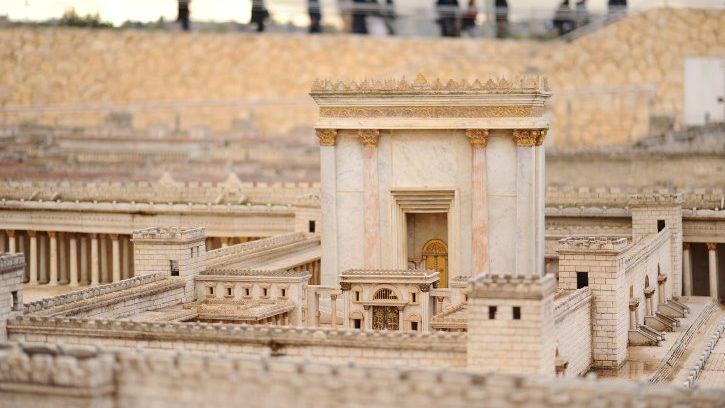
Chapters 40-42 contain the first part of Ezekiel’s temple vision. He is told to pay close attention so he can tell all to Israel. The temple described has some commonalities with Solomon’s temple, but much is different. While a temple will be rebuilt, this temple is never realized in the Bible. Ezekiel’s temple compound is 750 feet by 750 feet. It has three gates, courtyards, chambers, holy places and equipment. The Zadokite clan is set apart as the only Levites to “draw near” to God – to offer sacrifices on the altar. The temple is adorned with winged creatures and palm trees. There are holy chambers, places to store holy things.

The temple is at the center of God’s restoration of Israel, both physically and spiritually. It is a part of the sanctifying process, making Israel into the holy people of God. For Ezekiel and his audience, the temple represented God’s presence with the people. These words and vision bring hope and encouragement to the people living in exile. God longed to live amongst the people of God. God still longs to live amongst us today. May it be so.

Prayer: Lord God, your power and might extend over all things: over Gog and his allies, over today’s idols and temptations, over our selfish hearts. Ezekiel’s temple vision reflects your power and might. But it is still just a building. Just as your presence will fill this visionary temple, fill our hearts with your indwelling spirit, transforming our lives and our hearts. Amen.


Leave a comment

A Holy Covenant

Reading: Song of Songs 1-4

‭Song of Songs 4:12 – “An enclosed garden is my sister, my bride; an enclosed pool, a sealed spring.”

Today and tomorrow we read Song of Songs. On one level it is a song that celebrates the love of two people. On another level, it is an expression of the ideal love between God and humanity/Israel/the church – depending on your time reference. As we are in the Christian world, we will focus on the relationship between God (the man) and the church (the woman), both corporate and individual.

Chapter 1 expresses longing. The woman longs for the man’s kisses. The man brings her in and wants to exult and rejoice over her. God longs for our love. God longs to exult and rejoice over our faithfulness. The woman longs to be with him. He says to “follow the tracks of the herds.” We long for community and relationship with God. God says to follow the instructions, read my Word. They rejoice in one another’s beauty. We were created in the image of God. This is at the core of all of our relationships.

In chapter 2 the woman sees her live as an apple tree among the wild trees. We are invited to live holy lives, to be set apart from the world. She needs sustaining, weary from expressing her love. We too need God in many ways. God provides for us in numerous ways. He draws near and looks in on his love. He waits. God too longs to see us, to fear our voice. She declares that they belong to one another. Ideally we say this to God. God says, “I am the Lord your God… You are mine.”

Chapter 3 is a searching and a finding, a process that we repeat often with God. Once there, we find it beautiful too. Chapter 4 celebrates the beauty of the woman. The church is beautiful too when love and grace flow down and out into the world, reflecting God’s love and grace given to us. The man calls his love an “enclosed garden.” This implies a closed relationship, a holy covenant love. May it be so for you and for me in our relationship with God.

Prayer: Lord God, how lovely and beautiful you are! You are steadfast and true, coming to us again and again with a love that never fails, with a grace that never runs out. Lead and guide us to love you and one another in these same ways. Amen.


1 Comment

God’s Faithfulness

Readings: 2nd Chronicles 10, 2nd Chronicles 11, 2nd Chronicles 12, 2nd Chronicles 13

2nd Chronicles 12:12 – “Total destruction was avoided. There were, after all, some good things still in Judah.”

Leaving behind the ideal kings David and Solomon – at least according to the chronicler – we turn today to the reigns of Rehoboam and Abijah. Jeroboam of Israel is also a minor part of the story. Rehoboam’s reign begins poorly. He allows the pride of youth to lead him to a bad decision and God’s people are split into two nations. Jeroboam rules over ten tribes in the northern kingdom. Rehoboam rules over two in the southern kingdom of Judah. In comparison, Rehoboam is a good king. Through Shemaiah the prophet, war is avoided. Rehoboam strengthens his defenses. The Levites flee the idolatry of the northern kingdom and support Rehoboam.

But Rehoboam was not faithful to God. So God sends Egypt to bring divine punishment. But God sends Shemaiah and Rehoboam and Israel’s elders submit to God. God relents – somewhat. Egypt attacks and is victorious, hauling away the treasures of the temple and the palace. We find a silver lining in verse 12:12 – “Total destruction was avoided. There were, after all, some good things still in Judah.” Warfare with Jeroboam marks the rest of Rehoboam’s monarchy.

Abijah becomes the next king of Judah. Jeroboam and 800,000 soldiers march out against Abijah and 400,000 soldiers. Abijah first calls out Israel’s unfaithfulness and reminds them of Judah’s faithfulness. He claims that God is on Judah’s side. This proves to be true as Judah wins a stunning victory, killing 500,000 soldiers from Israel. This blow weakens Jeroboam, who soon dies, struck down by the Lord.

In today’s readings we see a truth that flows throughout the scriptures: God is merciful to those who are faithful or who turn back to God with changed hearts. When we falter or doubt or sin – which we will more surely do – may we remember God’s faithfulness, turning once again to the one who is always merciful and loving.

Prayer: Lord God, thank you for the reminder of your great love and mercy. Draw us back to you again and again when we turn from you over and over. God, you are so good and so faithful. Thank you. Amen.


Leave a comment

A Temple and a Palace

Readings: 1st Kings 5, 1st Kings 6, 1st Kings 7, 1st Kings 8

1st Kings 8:58 – “May God draw our hearts to him to walk in all his ways and observe his commands, his laws, and his judgments.”

In today’s chapters the temple and Solomon’s palace are constructed. The King of Tyre, Hiram, reiterates the promise he made to David. Solomon and Hiram make an agreement. Solomon will receive wood and Hiram will receive wheat and oil. A huge work force is called up. The temple is 90′ by 30′ and is 45′ tall. It is beautiful and ornate and much is covered in gold. After 7 years, the temple is built. Hiram comes and makes items for the outer area: pillars, a huge tank, stands, washbasins… – all of bronze. For the inside items are made of gold: altar, table, lampstands…

Solomon is also building his palace. It will be 150′ by 75′ and is 45′ tall. It is much larger than the temple but is also much less ornate… It takes 13 years to finish the palace. As this is ongoing, the temple is dedicated. The ark of the covenant is brought into the Holy of Holies. God’s glory fills the temple. Solomon offers a long and beautiful prayer. He begins by acknowledging that there is no god like the one God. He acknowledges the covenant and God’s loyalty. He calls for the temple to be the center of worship and the focus of their faith. Whether famine or plague or sin or enemy invasion or exile, he calls on the people to look to the temple, to repent, to pray to God, and to turn their hearts fully to God. Solomon asks God to listen to their prayers and to do what is right. He closes and then offers an invitation: “May God draw our hearts to him to walk in all his ways and observe his commands, his laws, and his judgments.”

Extravagant sacrifices are made to dedicate the temple and courtyard. This is followed by a great celebration that lasts 14 days. The people are dismissed. They bless the king and head to their tents happy and pleased. It is a good day.

Prayer: Lord God, thank you for the picture painted today – a king and a people focused on doing something for your glory. Thank you for the example of a people with hearts turned fully towards you. Lead us to walk in these ways. Amen.


Leave a comment

Lines Drawn

Readings: 1st Samuel 18, 1st Samuel 19, 1st Samuel 20

1st Samuel 18:3 – “Jonathan and David made a covenant together because Jonathan loved David as much as himself.”

Photo credit: Nadine Shaabana

Jonathan and David become bound together, making a covenant because Jonathan loved David as much as himself.” He gives David his robe, sword, bow… – this symbolizes the passing on of the right to the throne. Jonathan is committed to David, and vice versa. Next, Saul’s anger rises as the woman sing of David’s greater victories. As the evil spirit returns to Saul, he tries to kill David – twice. David spends time away at war. The Lord gives him great success.

Saul then tried marriage as a means to control David. But David feels unworthy. A second attempt leads to a plot by Saul. God continues to be with David and he provides the wedding bounty. He married Michal, Saul’s youngest. After more success in battle, Saul orders David’s death. Jonathan defends David, placating Saul temporarily. But again the evil spirit rises up. David escapes a second spear and then Michal helps him to escape.

David flees to Ramah, where Samuel is. Saul sends three sets of messengers to retrieve David. All three sets fall into a prophetic frenzy and return empty handed. Saul himself goes and he suffers the same fate. Clearly the Spirit of the Lord is protecting David. These episodes lead David back to Jonathan. They devise a plan to see if Saul really wants to kill David. Yes, he certainly does. Jonathan and David renew their covenant and part ways for now. The lines have been drawn between Saul and David. Jonathan must now walk the difficult line between son and covenant friend.

Prayer: Lord God, in our moments of testing, may we be as faithful to you as David and Jonathan were. No matter what evil swirls around us, lead and guide us to walk in the way that is right and holy and true. Be a shield about us, O God, keeping us from harm. Amen.


Leave a comment

Generously and Graciously

Reading: 2nd Corinthians 9:6-15

Verse 13: “Men will praise God for the obedience that accompanies your confession of the gospel of Christ.”

On this Thanksgiving Day we read Paul’s words about sharing the good news of Jesus Christ “generously.” I wonder, is that how others would describe the way you and I live out the great commission to make disciples of all peoples?

Paul used a farming analogy to encourage how we answer that question about how we share the good news. He begins by telling us that if we sow sparingly, we will reap sparingly. A seed here and a seed there may produce a few plants. But we’re looking for a crop. A seedling here and there soon withers and dies. A crop grows to produce a harvest. Half-hearted or lukewarm or reluctant sharing of the good news will not result in a bumper crop. Non-believers must feel the intensity of our Jesus relationship. They must come to know that Jesus is the source of the love and grace and hope and peace and… that they feel and see when they encounter you and me.

We’re also reminded that we do not work alone. God supplies all that we need to sow seeds of faith generously in the world. Equipped by God, our task is to “abound in every good work.” When we live out our faith in this way, then “Men will praise God for the obedience that accompanies your confession of the gospel of Christ.” This can be our truth every day.

May we generously and graciously share the gospel of Jesus Christ with all that we meet. Doing so we will draw others to Christ. May it be so.

Prayer: Lord God, as we respond to your call to be sharers of the gospel, may your hand nurture the seeds we plant. As we bear witness to your love and grace with our lives, may your power produce an abundant crop for the transformation of the world. Amen.


Leave a comment

Come and Listen

Reading: Joshua 3:7-9

Verse 9: “Come here and listen to the words of the Lord your God.”

Photo credit: Terry Vlisidis

As we begin the first of two days in Joshua 3, we start with God speaking to Joshua. God assures him of God’s power and presence in this transition of leadership. These words must have been very assuring and encouraging to Joshua: “I will begin to exalt you… so they may know that I am with you.” As important as it is for Joshua to hear these words, it is at least as important for the people to experience these words being lived out. They need to know and trust that Joshua is indeed God’s next chosen leader.

In Joshua 3:9 he gathers the people with these words: “Come here and listen to the words of the Lord your God.” The first part is an invitation into God’s presence – come here, draw near, enter into holy space. The second part is an invitation into an attitude of readiness and expectation. The call to listen is more than a call to notice that someone is talking. It is a call to pay attention, to be ready to receive these words, to be expectant and ready for what the words call us to. In this proper attitude and posture Israel is ready to receive God’s word as spoken through Joshua.

These two practices are essential elements of our relationship with God. They are essential because without these two practices, God remains a distant buzz somewhere in the periphery of our lives. Step one is to draw near. Whether that is making quiet time each day, bowing one’s head in intentional prayer, or entering the sanctuary for worship, we must make the effort to step into God’s presence, inviting the holy to draw near to us. Next we must quiet ourselves and be attentive to the voice of God. This voice may be revealed in the scriptures, in the nudge or whisper of the Holy Spirit, or in a myriad of other ways that God uses to lead and guide us.

This day and every day may we choose to draw near to God, seeking holy presence and guidance for our daily life.

Prayer: Lord God, kindle in me a fire to know you more, better, deeper. Pour out your love into my heart, breaking it wide open to receive your word. Fill my hands and feet with that overflowing love, making you known to the world. Amen.