pastorjohnb

Thoughts and musings on faith and our mighty God!


Leave a comment

What Promise, What Hope

Readings: Psalms 46-49

‭Psalm 47:2 – “Because the LORD Most High is awesome, he is the great king of the whole world.”

Photo credit: Ricardo Gomez Angel

Our first three Psalms are about trusting God and celebrating God’s power and might. Psalm 49 comes as a warning about trusting in something other than God. While this Psalm is about the danger of trusting in wealth, we could substitute self, status, power, beauty, fame, possessions… There are more than a few false gods that we can worship instead of the one true God.

Psalm 46 celebrates God as our refuge and strength – always. Storms will come. Some are powerful. Life will rain on our parade. Yet God is always there. God won’t crumble. God is our place of safety. This theme is picked up in Psalm 49, except this one is about physical safety. God is in the very walls of Jerusalem. The city is a place of safety and security. Within the walls one also finds God’s righteousness and justice. These too dwell in the city of God.

Psalm 47 celebrates God as “the great king of the whole world.” God subdues the nations and chooses Israel’s inheritance. God will subdue the forces of this world too. God will reign over all those voices that clamor and vie for our attention and allegiance. It is a choice we all must make: to listen or not.

Psalm 49 addresses this choice. The author begins, “Listen closely… rich and poor alike.” He or she offers this wisdom: “Wealth? It can’t save a single person!” By the way, the psalmist says, the wise die too. But those who “do right in their heart” – the psalmist(s) declare, “God will save my life from the power of the grave.” What hope, what promise. May we set our hearts on doing right.

Prayer: Lord God, there are many choices about what or whom to follow, on what to be consumed by. O Lord our God, be our consuming fire. Like a moth to a flame, draw us into your presence. Refine us in your fire. Draw us into the power of your love. It has the power to save. Guide us deep into that love. Amen.


Leave a comment

Always There with Us

Readings: Psalms 33-36

‭Psalm 36:6 – “Your righteousness is like the strongest mountains; your justice is like the deepest sea.”

Photo credit: Lidia Nikole

Our readings today begin and end with two Psalms of praise. Psalm 34 begins with praises for God’s goodness and faithfulness, for God speaking creation into being. The psalmist celebrates God’s rule over all the earth. Kings and warriors aren’t saved by their strength and power (and neither are we!) No, the psalmist says, put your hope and trust in the Lord alone. Psalm 36 does begin by recognizing the evil and wicked choices of the sinful. But the psalmist quickly shifts to praising God for God’s faithful love and for “Your righteousness is like the strongest mountains; your justice is like the deepest sea.” God is worthy of our praise! Yes, we take refuge under God’s wings. Yes, God’s light is our light!

Psalms 34 and 35 speak of the good and evil that is present in our world and in our lives. Psalm 34 begins with blessing and praising God for answered prayers and for deliverance. Then the psalmist offers a warning and also some words of encouragement: keep your tongue from evil, do good, seek peace. The author declares that “the Lord is close to the brokenhearted; he saves those whose spirits are crushed.” Note the present tense of these verbs! These warnings, the hope, the encouragement – they apply to our lives too!

Psalm 35 begins with pleas for God to act: “Stand up and help me!” Rescue is needed from those who want to humiliate, shame, and harm. We too have lifted these calls. The psalmist laments that even though he or she fasted and grieved when “they” were sick, now they rejoice in his or her stumbles. The psalmist cries out, “How long…?”

The Psalm closes with renewed requests for justice, for the enemies to be the ones who are disgraced. Then, then the psalmist will praise the Lord. Then… When we are hard-pressed, when we feel the full assault of evil, then, yes, it can be hard to praise the Lord. Yet, as the song goes, “May we praise you in the storm.” May it be so because God is always there with us.

Prayer: Lord God, we so want justice to be served, to see wrongs made right. When we are tempted to execute our justice, pause us and remind us first of your grace that covers us. And then, then remind us that you alone are the judge, that you alone know true justice. Help us to trust, O God, in your strong righteousness and in your deep justice. Help us to stand on that mountain, to wade into that deep sea, for you alone are God. Amen.


Leave a comment

As for Me and My House…

Readings: Joshua 18, Joshua 19, Joshua 20, Joshua 21, Joshua 22, Joshua 23, Joshua 24

Joshua 24:15 – “But my family and I will serve the LORD.”

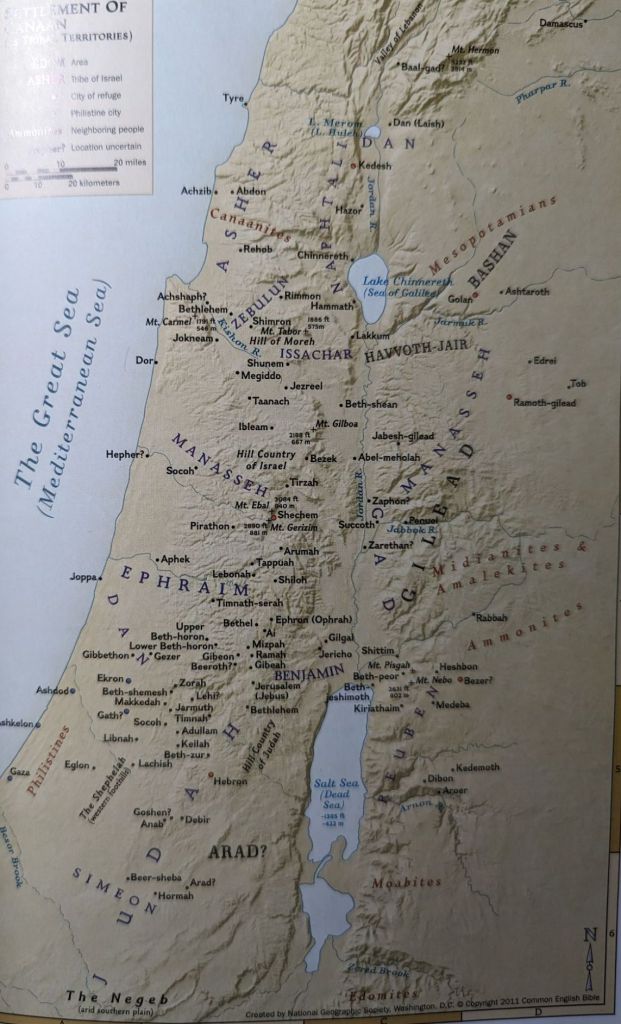
Today’s seven chapters close out the story about inheriting the Promised Land. It begins with a way to divide up the remaining land west of the Jordan. Lots are cast and land is allotted to the tribes of Benjamin, Simeon, Zebulun, Issachar, Asher, Nephtali, and Dan. Joshua also receives a legacy. Then, in chapters 20 and 21, the Levites are given cities and their surrounding pastureland. These 48 cities are spread out amongst the twelve tribes and they include the six refuge cities. God is preparing here for a day yet to come. God is good.

Now that the land legacies have been given and now that peace has come, Joshua summons the Reubenites, Gadites, and the half tribe of Manasseh. He thanks them for their faithful service and sends them home with a charge to be obedient and faithful to the Lord. At the Jordan these tribes build an altar as a witness to their belonging to the people of Israel west of the Jordan. It is a standing reminder.

Chapter 23 holds Joshua’s final words of warning. He first reminds the Israelites of all that God has done and then implores them to be faithful and obedient. Joshua warns them about mixing with the locals. They will be “a snare and a trap.” Joshua warns Israel that they will “vanish quickly” if they violate the covenant.

Chapter 24 closes Joshua’s story. He begins with a great review that takes Israel from Abram to this very moment. Joshua challenges Israel to decide “whom you will serve.” Joshua declares that he and his house will serve the Lord. So too will the people of Israel. May it be so for you and for me and for our households.

Prayer: Lord God, the story of another great leader and a meaningful period in Israel’s history comes to a close. Yet the choice at the end of Joshua remains our choice today. It’s a choice we make every day. So each day, O Lord our God, empower us to choose you. Amen.


Leave a comment

Heed the Warning

Reading: Luke 18:9-12

Verse 11: “The Pharisee stood up and prayed about himself.”

Today we will look at the first part of Luke’s telling of Jesus’ parable about the Pharisee and the tax collector. Let us begin with the audience. Luke shares that Jesus tells this story to those who were “confident in their own righteousness and looked down on everybody else.” Jesus is not talking with some Pharisees or other religious leaders here. He is talking to a group of his followers. This tendency towards feeling superior and towards judging others remains strong today. These words very much apply to our lives, to our churches, to our world.

As Jesus begins we learn that two men go to the temple to pray. Going to pray – an personal and private time with God. Prayer is a good thing – like going to church or serving on a mission project. Two men go to pray. One is a Pharisee and one is a tax collector. Jesus is intentional with these characters. These two men represent the opposite ends of the spectrum. One was highly respected. One was deeply despised. In Jesus’ day these men were seen as the most and least connected to God and to faith.

In the parable Jesus offers the Pharisee’s prayer first. He begins by standing up, praying aloud to be heard. It is not a conversation between him and God. He first thanks God that he “is not like other men” and then goes on to name them. They are the bottom rung, the lowest of low. He gestures over and adds the tax collector to the list. The Pharisee clearly thinks that he is on the top rung. As proof he shares that he fasts twice a week and that he tithes. Like prayer, these two spiritual disciplines are good things. They are practices that express our gratitude to God. But, like almost all things, these too can be twisted and turned, used for personal glory instead of to bring God the glory.

For the Pharisee, it is all about him and how holy and righteous he is. In his life and in his prayer, there is no humility, no compassion or kindness, no faith that moves a heart closer to God. We can fall into thinking we’re high and mighty. So may we heed Jesus’ warning today. When we are tempted to compare ourselves to others, when we are tempted to think about how religious we are, may this Pharisee remind us of the dangers of elevating self over others and over our relationship with God.

Prayer: Lord God, is it so easy to slip into feeling superior, judgy, critical. When self and ego rise up, draw me back down. Knock me down if necessary! Focus me back to the call to love as you first loved us. Amen.


2 Comments

Even in This

Reading: 1st Samuel 8: 10-20

Verse 18: “You will cry out for relief from the king you have chosen, and the Lord will not answer you in that day”.

Photo credit: Nick Fewings

After God acquiesces to the people’s request for a king, God gives some words of warning to the people. Yes, a king can bring stability and leadership and authority to the nation. Yes, a king can negotiate with other kings and can lead the troops out into battle when needed. A king can fight for the people! But a king can also demand or, at times, take when the demands are not met. A king can call for military service and can seize land, crops, livestock, and servants. A king can tax the people to support his reign. A judge or prophet would never do any of these things. The leader that the people reject, God, would never do any of these things. Yet the people want a king.

All of this, both the good and the bad, comes true as king after king leads Israel. Reading through 1st and 2nd Kings, we see that God is right. There are more bad kings than good kings. The fate and the lives of the people rise or fall under the leadership of each king. Yet even though the people reject God in favor of a king, God remains engaged. Even though God grants them this autonomy, God does not abandon his children. God continues to send prophets to guide and redirect and shepherd these kings. God even chooses the first few kings.

God leads you and me in the same way. God does not force us to love and obey him or to believe in Jesus Christ as our Lord and Savior. God engages us, the Spirit leads and guides us. But we are free to choose our own kings, our own gods. God allows us free will, just as he did with the Israelites. God warned them, saying, “You will cry out for relief from the king you have chosen, and the Lord will not answer you in that day”. When leadership is oppressive, selfish, authoritarian… God will allow them to learn their lesson. In time God will respond to their cries. We too experience this process. We have to endure a consequence for our poor choices. God will always forgive us when we’re repentant. But our poor choices and bad behaviors often impact others, creating ramifications. We too must go through a refining and learning process. Even in this, God is at work. Thanks be to God for loving us enough to always be there on the other side.

Prayer: Heavenly Father, your love always leads and informs. Your love is greater than our limitations and failures. We are ever a work in progress. You are so patient, so faithful, ever true. What a wonderful God you are! Amen.


Leave a comment

Like a Mighty River

Reading: Ezekiel 34: 20-24

Verse 22: “I will save my flock, and they will no longer be plundered. I will judge between one sheep and another”.

In today’s reading Ezekiel turns his focus to those who are leading, to those who are in charge. The Babylonians were powerful. They exerted their might and took many Israelites into captivity. In exile, the Israelites lived in a society that favored the privileged and wealthy, that allowed greed to exploit the weak, that turned a blind eye to injustice. Those who were wealthy, greedy, unjust are the “fat sheep” that Ezekiel refers to. As one considers our nation today, Ezekiel could very well be writing in 2020.

The ways of greed and inequity and oppression are not the ways that God intends for us to live. God therefore pledges to judge between the fat and lean sheep. God sees how the wealthy and powerful “shove with flank and shoulder”, forcing their agendas, manipulating the weaker, the less powerful. God will intervene, God will put an end to the sins being committed against his children. In verse 22 we read, “I will save my flock, and they will no longer be plundered. I will judge between one sheep and another”.

Plunder is an interesting choice of words. It maybe feels like an old term, an outdated term. Yet it is very relevant today. A man in our community invested many years earning an advanced degree in college. He is a skilled professional in the medical field. The major corporation that he works for unilaterally cut all people in his profession to 30 hours a week. He, like his colleagues, now has no benefits. This corporation has plundered these people.

God promises to save his flock, to judge between the sheep. There is a promise to end greed, oppression, and injustice. To those living in exile, to those living in unjust systems today, these words speak hope. To the fat sheep, these words should be a warning, a call towards self-reflection. But only the sheep with ears to hear will be changed.

Just as God sent Ezekiel to the exiles in Babylon, we read that God will send David to the Israelites who are surrounded by enemies, who live daily under threat of assault. In time God will come in the flesh, bringing hope and salvation to the people oppressed by the Romans and their own religious leaders. Jesus charged his followers to do as he did: feed the hungry, tend to the sick and lonely and imprisoned, clothe the naked, unbind the captives, bring sight to the blind. It is no wonder many Jews thought Jesus the second coming of Ezekiel.

As we seek to do these things, to follow the example of Christ, we do so with the realization that they run counter to our culture, against the ways of greed and power, in defiance of the oppression and injustice that is too prevalent in our nation. May the Lord our God empower us as we seek to be light and love, peace and compassion, mercy and justice to the world.

Prayer: Lord God, give me feet to walk the narrow road, the hard path. Give me courage to stand for those who are weak, lean, powerful, voiceless. May your justice roll down like a mighty river. Amen.


Leave a comment

The Foundation

Reading: Exodus 32: 1-6

Verse 1: “Come, make us gods… this fellow Moses… we don’t know what has happened to him”.

As our passage opens today, we learn that Moses is once again up on the mountain speaking with God. This is not the first or last time that Moses speaks to God. Conversations have already happened many times and this is his third or fourth trip up the mountain. Moses’ conversations with God are sprinkled throughout their forty years in the wilderness. But this trip takes longer than usual. The people grow restless and they gather around Aaron, who is second in charge. They say to him, “Come, make us gods… this fellow Moses… we don’t know what has happened to him”. Scholars believe the Israelites have been in the wilderness about three months at this point. The many gods of Egypt are still fresh in their minds. Aaron fashions a golden calf and the people worship as the Egyptians had. The Israelites rise early and offer sacrifices and then proceed to eating and drinking and they party it up.

My initial reading of the passage stirred up feelings of judgment inside of me. How could they so quickly lose their focus on God? Then I remembered that snow day back in college. The weather was so bad that school was cancelled. We walked to the liquor store first thing that morning so we could “celebrate” not having to go to class. Classes the next day weren’t the best. Another reaction I felt was disgust with how easily they abandoned Moses, the one who has led them so faithfully. That triggered another thought, also from college. Sometimes the professor was late for class. In about one minute we were discussing how long we needed to wait. We’d give five minutes if we didn’t like the class and a whole ten minutes if we really like the professor or the class. Moses was “always” correcting them and giving “tons” of rules to follow. Maybe those who chafed at these things were the first voices to stir the pot, rallying the people to abandon this fellow Moses.

These are but two examples of times when I have quickly fallen into poor decisions or have abandoned leaders who had my best interests at heart. I believe we all have these experiences. Like sheep we are easily led astray. Like the Israelites, we can quickly turn to our own “golden calves” – to things or people that we think will make us happy or that we think will do what we want them to do. We too can quickly abandon the Lord our God when it seems to be taking too long for that answer to prayer or when the outcome isn’t to our liking. We quickly turn to our selfish desires and to the things of the world. As we are honest and acknowledge these truths today, may this story serve as both a reminder and as a warning. May it serve to always help us to keep God as our foundation, as our guide and as our way of life. May it be so.

Prayer: Living God, when I begin to look to other things, when my heart starts to wander, send the Holy Spirit’s voice to call me back to your ways. When my will begins to rise up, gently nudge me away from placing self on the throne of my heart. Help me day by day to find peace and joy and contentment in following you. Amen.


Leave a comment

Standing Firm

Reading: 1 Corinthians 10: 1-13

Verse 12: “So, if you think you are standing firm, be careful that you do not fall”.

Paul begins today’s passage by reviewing the years after the Israelites were freed from slavery in Egypt. The people were all “under the cloud” – the pillars that were God’s constant presence with the people. They all experienced the miracles of God – the manna and quail, the water from the rock. Even with God’s presence day and night and even with the miracles that all saw, they slipped into sin often. They fell to idol worship, sexual immorality, and they tested God over and over. Paul concludes verses 1 through 10 with the reminder that this history is an example and a warning to them.

As I think back over my years, I think Paul would easily find several examples of times when my story has been similar. There are plenty of times I have chased after the things of this world or have acted in ways much less than pleasing to God. There are ample choices for examples of grumbling at, complaining to, and testing God. In my life are also times when I have felt the tangible presence of God and scores of times when God has guided me or answered prayers or has provided for me or has guided me through a trial. In many ways I am much like the Israelites. If we are honest, these truths – these goods and bads – are a part of all of our journeys of faith.

Paul, in verse 12, gives us this warning: “So, if you think you are standing firm, be careful that you do not fall”. Satan is ever on the prowl, always looking for the next opportunity to try and lead us astray. If we are not aware of this fact, we are more likely to fall. Then, in verse 13, we find hope.

Paul first reminds us that being tempted is a common thing. We all face temptation. Some of what it is may vary from person to person, but we all face it. And then Paul offers this great line: “And God is faithful; he will not let you be tempted beyond what you can bear”. God protects us. Like with the Israelites in the desert, God watches out for us. We, through Jesus Christ, have what it takes to stand firm. Our passage concludes with the reassurance that God will always provide the way out of or the way past temptation. Thanks be to God!

Prayer: Lord, when the temptations come, fill me with your Holy Spirit. Remind me of your promises in the Word and of my experiences with you as my savior and rescuer. Help me to stand firm. Amen.


Leave a comment

Listen

Reading: Genesis 2: 15-17

Adam and Eve began in the garden.  Each day they walk and talk with God, enjoying all that God has provided.  They have been given almost unlimited access to the garden and all of its bounty.  The one restriction God places is upon the tree of the knowledge of good and evil.  God lets Adam and Eve know that they will die if they eat of this one tree.

Can you remember as a kid when your Mom or Dad said, “Don’t do” this or that?  At least some of the time these were things you never would have thought of on your own.  But more often than not, your wise and loving parents knew from experience that sooner or later that tree or rooftop or toy your sister had would be more than you could resist.  We were the same way.  All parents are.  If there was something that could harm or be bad for our children, we warn them about it.  God was doing the same thing in the garden.  God knew that once the knowledge of good and evil entered the minds of mankind, that the world would never be the same.  He was right.

As grown adults, we continue to get many warnings.  Sometimes they come from our spouse or our friend or our coworker.  Sometimes the warnings even come from our own minds.  Sometimes the words are in the form of a whisper from the Holy Spirit.  Like we would have been when we were children, we would be wise to heed the warning, to listen to the voice of those with our best interests at heart.  This day, O Lord, help me to be obedient and faithful as I try to follow the example of Jesus.  It is only possible through your power and presence, so please be with me today.


Leave a comment

Listening and Seeing

The prophet Micah is like all of God’s other prophets.  He speaks the word that God gives him to speak to the people.  While much of the time the prophets are warning the people of the consequences of their sins and calling them to repent, sometimes the prophets also spoke of the hope in and the promise of God’s faithfulness.  Such is the case with our passage today from Micah.

Since the life of Jesus, Christians read this section of Micah like many other prophecies found in the Old Testament.  As Christians we read the Old Testament not only as the history of the people of Israel and our faith, but also as a book that points to the New Testament and ultimately to Jesus.  When Micah writes of a leader who will come out of Bethlehem and speaks of him as one who will shepherd the flock, our mind immediately links up with the story of Jesus’ birth and life.  Micah also connects Jesus to long before His birth – “whose origins are of old, from ancient times.”  These words echo the message we find in the opening lines of John’s gospel.

The prophets, Micah included, also always provide hope and remind us to believe in the promises of God.  God is always at work in our lives and in our world.  In hard times that can be difficult to remember.  But Micah reminds us of the promises and that in hard times we most need to rely on God’s presence and call upon His strength.  Micah also reminds us that we must seek God’s word and see God in our daily experiences.  This day may we have a heart that listens and eyes that see God.

Scripture reference: Micah 5: 2-5a