pastorjohnb

Thoughts and musings on faith and our mighty God!


Leave a comment

God’s Love, Justice, Mercy, and Care

Readings: Genesis 18, Genesis 19, Genesis 20

Genesis 18:24 – “Abraham approached and said, ‘Will you really sweep away the innocent with the guilty?'”

Genesis 18 begins with 3 men visiting Abraham. He graciously welcomes them, giving them water and shade, then food. One tells Abraham that he will return next year and that by then Sarah will have a son. Sarah laughs at this notion. She “was no longer menstruating.” In the end, God responds, “Is anything too difficult with the Lord?”

One visitor remains (the Lord) and the other 2 head to Sodom. The Lord shares the depravity of Sodom with Abraham. He learns of God’s justice. Abraham then negotiates with God to spare the city. God agrees to save the city for 50 innocent people. Then for 45… 40… 30… 20… and finally for 10. Abraham learns of the depth of God’s mercy. The 2 men who went to Sodom meet Lot and are welcomed into his home. Very soon, though, the depth of Sodom’s sin is revealed. Lot and his wife and daughters escape the city just before it is destroyed. Lot’s wife, however, looks back and is turned to a pillar of salt. Chapter 19 ends with Lot’s daughters sleeping with a drunk Lot to preserve the family line.

In chapter 20 Abraham returns to his old ways as he again lies about Sarah’s identity to save his own skin. That same fear returns. But this time God intervenes sooner, keeping Abimelech innocent. The king confronts Abraham, who admits his fear. To make things right, Abimelech blessed Abraham with flocks and servants and money and an offer of land. All is set right. Abraham then blessed Abimelech and his household. Good health returns to them all.

In today’s chapters we are reminded once again of the depth of God’s love for humanity, of God’s great justice and mercy, and of God’s abundant care for each of God’s children. We are recipients of all this and more. In response, we say, thanks be to God!

Prayer: Lord God, through these challenging stories we see your love, your grace, your mercy, your care. What was true long ago remains true for us today. We rejoice in and celebrate today who you are, O God. Amen.


1 Comment

Covenant Faithfulness

Readings: Genesis 15, Genesis 16, Genesis 17

Genesis 17:7-8 – “I will be your God and your descendants’ God after you. I will give you… the whole land of Canaan.”

Today we begin with God’s promise to Abram of a biological heir. To illustrate the abundance of God’s promise, Abram is invited to look to the stars – “this is how many children you will have.” A sacrifice seals the covenant promise. As fire, God passes through the sacrifice, sealing God’s commitment to the covenant. Within this section God also reiterates and ties in the promise of this land for Abram’s descendants.

In chapter 16 we see Abram and Sarai taking matters into their own hands. It has been about 15 years since God first promised them descendants. Abram sleeps with Hagar, Sarai’s slave girl. Her pregnancy creates a rift in the family. Treated harshly by Sarai, Hagar runs away. God meets her there and promises Ishmael a large family, land… Hagar names God “El Roi” – the God who sees me. She returns to Sarai and Abram with God’s assurances of blessings.

Chapter 17 brings a reaffirmation of the covenant promises. “El Shaddai” – the God of power and might – invites Abram to walk with God. Abram becomes Abraham and Sarai becomes Sarah. This name change signals a new era and status for them. God initiates circumcision on the 8th day of life as a symbol of the covenant, saying, “Your flesh will embody my covenant as an enduring covenant.” That very day Abraham will circumcise his entire household, including himself at 99 years old. God assures Abraham and Sarah that the covenant will be fulfilled through their son Isaac. God tells them that Ishmael will be blessed too, but the covenant will run through Isaac’s descendants.

Reflecting on Abraham’s actions in these chapters, I wonder which Abraham I am most often like. Am I more often like the one who takes things into his own hands? Or am I more often like the one that acts on God’s word right then and now?

Prayer: Lord God, most of the time Abram/Abraham was a great example of faith. Guide me to be so obedient and faithful. At times, though, he stumbled and failed. At times, I do too. As you did with Abraham, continue to walk with me. Amen.


Leave a comment

Abram – A Model Faith

Readings: Genesis 12, Genesis 13, Genesis 14

‭Genesis‬ ‭12:4-5 – “Abram left just as the LORD told him… Abram took his wife Sarai, his nephew Lot, all of their possessions.”

As we begin chapter 12 the stories become more personal. We explore the relationships between God and Abram and between various human characters. The relationship between Abram and God reveals the ideal human relationship with the divine. All of the relationships between the human characters run the gamut from faithful and true to selfish and power-hungry. In many ways these human relationships mirror our relationships today.

Chapter 12 begins with God directing Abram to leave Haran to go to “the land that I will show you.” Abram doesn’t know the destination or the time frame. Yet in verses 4-5 we read, “Abram left just as the LORD told him… Abram took his wife Sarai, his nephew Lot, all of their possessions.” Living out a radical faith and obedience, Abram heads out. Abram leaves everything to follow God’s word. He is the model of faith in the Old Testament and beyond.

But Abram isn’t perfect. That’s another thing that character after character reveals in the Bible. Famine forced Abram and family to Egypt. He lies about who Sarai is to save his own life. She becomes part of Pharaoh’s house. This brings plagues on Pharaoh and his house. Abram is figured out and expelled from Egypt. While living there, however, God has abundantly blessed both Abram and Lot. This becomes a problem when they get back to Canaan. Splitting up is necessary and Abram graciously gives Lot the first choice. He greedily chooses the best land. It is near Sodom, a place of sin and evil.

Lot then becomes a victim of a local war. He and all he has is taken away as plunder. A survivor tells Abram who goes and rescues Lot. On the way home they meet Melchizedek, who blessed them in the name of El Elyon – the God of heaven and earth. Abram returns the blessing by giving the priest a tenth of the plunder.

The question I’m left with today is this: Do my relationships with God and others seek to emulate the relationships modeled by the good and faithful Abram?

Prayer: Lord God, were I to be as obedient and faithful as Abram, how my life and faith would change! When I lean towards being selfish or sinful, bend me back to your will and ways. When you bless me, O God, turn me to others so that I may bless them in turn. Amen.


Leave a comment

Center Stage

Readings: Genesis 9:18-39, Genesis 10, Genesis 11

Genesis 11:4 – “Come, let’s build for ourselves a city and a tower with its top in the sky, and let’s make a name for ourselves.”

Continuing in chapter 9 today we see that sin hasn’t left the world with the flood. Noah grows grapes and makes wine. He gets drunk then naked. Ham sees his father naked and instead of covering him up, he tells Shem and Japheth about it. They do the right thing and later receive Noah’s blessings. Ham, by contrast, is cursed because he did not honor his father.

Chapter 10 details the most of the descendants of Shem, Ham, and Japheth. They are listed a variety of ways – names, families, languages, lands, nations. This creates a kind of early ethnic map of the ancient world. Shem’s genealogy is found again in chapter 11. But it diverges in verse 18 as it follows Peleg’s branch of the family tree. This branch ends with Abram and family in the land of Haran. Sarai and her barrenness is also mentioned. This is a sharp contrast to the long list of children and descendants found in chapters 10-11.

In the middle of these genealogical lists we find the story of the Tower of Babel. In this story we see that the human tendency towards pride and arrogance survived the flood. At Shinar the people begin to scheme, saying to one another, Come, let’s build for ourselves a city and a tower with its top in the sky, and let’s make a name for ourselves.” They want to build a tower that reaches to heaven. It could be to connect with God or it could be to be like God. It’s likely the second as they also desire to be famous, to be recognized for their skill. As a means to counter this pride and sin, God confuses or jumbles their languages and then dispersing this prideful bunch all over the earth.

When we try to take center stage for ourselves, how does this affect our relationship with God and with one another? How does God normally respond?

Prayer: Lord God, in my thoughts, my words, my actions, may I honor you and bring all the glory to you. When I’m tempted to bring the focus to me, remind my heart of you, my audience of one. Amen.


Leave a comment

In Love and in Grace

Readings: Genesis 6, Genesis 7, Genesis 8, Genesis 9:1-17

Genesis 6:9b: “Noah was a moral and exemplary man; he walked with God.”

Today’s readings center on the great flood. God sees that humanity has become “thoroughly evil.” Every thought was “completely evil.” The world was so bad that God even regrets making human beings. This situation leaves God “heartbroken.” Things are almost as bad as they can get. Almost. There is Noah. In Genesis 6:9b we read, “Noah was a moral and exemplary man; he walked with God.” At least there is Noah. At least there is one person that is worth saving.

Today our world is not perfect. It is far from it. Noah was an Old Testament example of piety. I wonder, as God looks down on the earth today, who are the Noahs? Specifically, are you and I modern day examples of an exemplary relationship with God?

In obedience to God, Noah builds an ark and gathers up his family and the animals – a pair of some, seven pairs of others. This gathering up insures not just Noah’s salvation, but the salvation of all of creation. God then shuts the hatch and the rains come down and the “springs of the deep sea” open up. In 7:22 we read, “Everything on dry land with life’s breath in its nostrils died.” The loss of all life is catastrophic, horrific, complete.

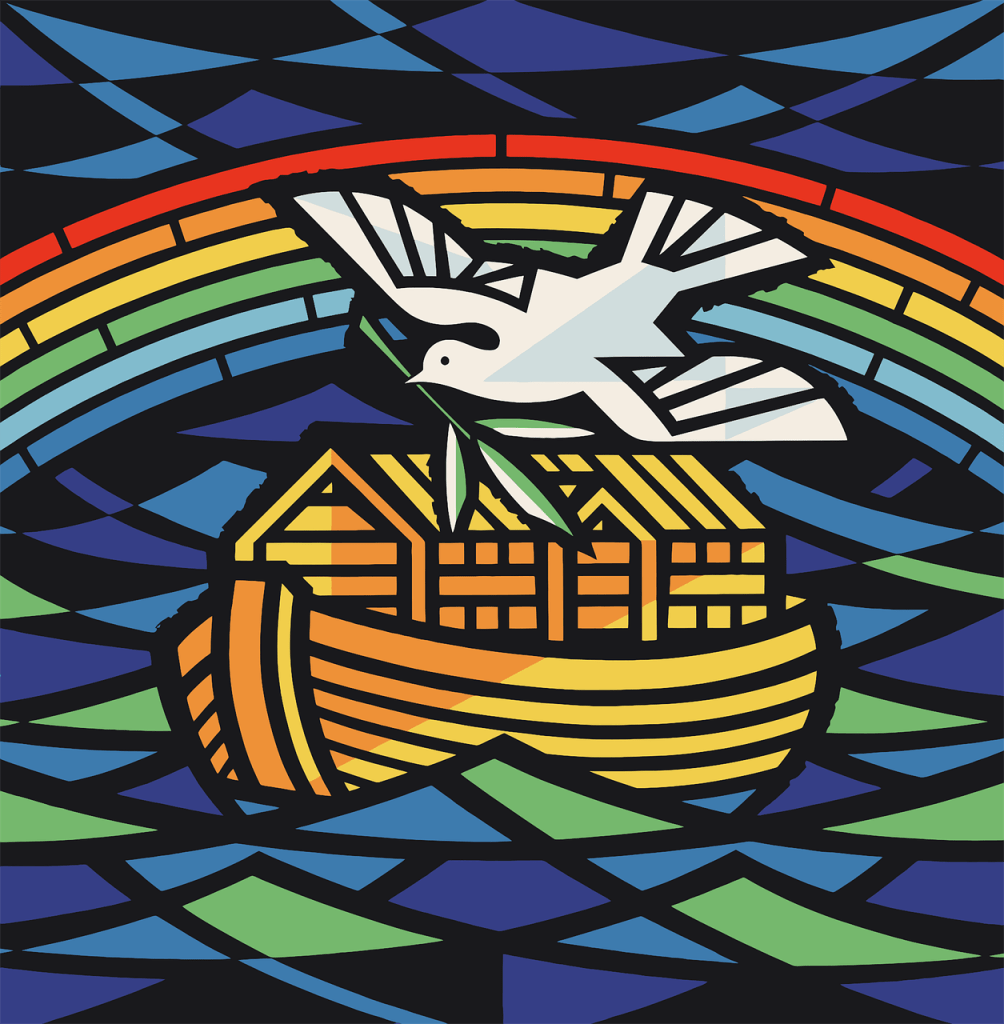
Eventually the waters recede. Noah sends out a dove to test the earth’s readiness for life. The third time the dove does not return. God tells Noah to exit the ark. Noah’s first acts on dry land are to build an altar and then to offer a sacrifice to God. This pleases God and moves God to make a covenant. There will never be another flood “to destroy the earth.” God placed “his bow” in the sky – it will be a frequent reminder to God of God’s commitment to stay in relationship with humanity. This is a gift that we rejoice in yet today.

Prayer: Lord God, what a horrible place the world became. Humanity broke your heart. Things deteriorated to the point that your justice required action. Thanks be to you, O God, that we had Noah – an example of faithful living. In your love you provided a way for the world to continue. In your grace you committed to us and to creation forever. Thank you, God. Amen.


Leave a comment

God with Us

Reading: Genesis 4, Genesis 5

Genesis 4:10: “The Lord said, ‘What have you done? Listen! Your brother’s blood cries out to me from the ground.'”

Chapter 4 contains the story of Cain and Abel – Adam and Eve’s first two sons. Living outside of the garden because of their parents’ sin, Abel works as a shepherd and Cain as a farmer. These two brothers bring an offering to God. Cain brings some of his crops and Abel brings the firstborn, including their fat portions. God sees Abel’s offering as “favorable,” angering Cain. At times we all come to this place that Cain came to – realizing that our offering to God was less than what it could or should have been. Maybe it was a half-hearted effort with that neighbor. Maybe we came to worship with a really poor attitude. When the realization comes that we fell short, we too can get angry. It’s always harder to look within.

Even though God warns Cain – “sin will be waiting at your door ready to strike” – Cain still allows his anger to smolder, leading him to murder Abel. God knows yet asks, “What have you done? Listen! Your brother’s blood cries out to me from the ground.” God is not searching for the answer but for remorse and repentance. None is found. Cain even doubles down, denying any knowledge of what has happened to Abel. As a result, Cain is moved further from community. He is to be a wandering nomad. Punishment at least brings a hint of remorse. Even here, God’s grace remains present. Isolated, alone, vulnerable, God marks Cain with a sign, protecting him from harm. Like Cain, as bad as we can become, God remains with us.

Chapter 5 brings a list of descendants. Many are just names. They lived a long time before the flood – 930, 912, 962… All but Enoch died. He was “taken up,” presumably because he walked faithfully with God. As sin continues to grow, this rapidly becomes less common. The list of singular descendants branches out at Noah. Each of his three sons will have a role in the ongoing story of God.

Prayer: Lord God, thank you for always being with us, even in our sin. Thank you for not giving up on us and for always trying to work us towards your good plans. Please forgive us when we go astray, pursuing other things. Thank you for your love and grace. Amen.


Leave a comment

God: Good, Creative, Loving

Readings: Genesis 1, Genesis 2, Genesis 3

Genesis 3:5 – “You will see clearly and you will be like God, knowing good and evil.”

Photo credit: Marek Piwnicki

As we begin our adventure of reading the Bible in a year, we start at the beginning, in the creation story. Genesis 1 is a very familiar passage – day 1 there is light, day 2 the waters are separated, day 3 land is formed and plants are created… Four times we read, “God saw how good it was.” Then, on day 6, God creates humanity “in our image.” Creation is completed and God now says, “it was supremely good.” Humanity completes creation and raises it from good to supremely good. In chapter 1 we find two themes that run throughout the Bible: God is good and God creates or gives life.

Turning to Genesis 2 we read a different creation story. In this account we read that on day 3 God creates a man. Then, on day 6 of the original story, God creates a woman from the man’s rib. Among the rest of creation, a “helper that is perfect” could not be found so once again, God creates. In chapter 2 we experience our first dissonance. Our brain tells us that both stories cannot be “true.” Our brain is right. Here we learn an important thing about the Bible: it is not a book of “how” but is a book of “who” and of “what.” It is not a science or history book. The Bible is a book about our relationship with a good and loving God.

We close today’s reading with chapter 3. This is another very familiar story. The temptation and sin and fall of Adam and Eve represent another recurring theme in the Bible: human arrogance. Adam and Eve believe the snake’s words: “You will see clearly and you will be like God, knowing good and evil.” To be like God – it’s too tempting to pass up. They eat and God’s heart is broken. They hide when God comes to walk and talk with them in the garden. God asks, “What have you done?” This certainly won’t be the last time God asks this question. And it won’t be the last time that God works to restore our relationship with God. All we can say is: thanks be to God.

Prayer: Lord God, in love and with purpose, you created our world and you created us. You allowed us the freedom to choose you or other things. Then and now when we choose other things, your love does not fail, you still desire relationship, and you seek to draw us back to you. Thank you for your great love for all of creation, especially for us, O God. Amen.


Leave a comment

God in Jesus -> The Same

Reading: Hebrews 1:1-12

Verse 12: “You remain the same, and your years will never end.”

Photo credit: Tyler Milligan

Today’s text is fitting for this last Sunday and last day in 2023. As we conclude the year, this text reminds us of who and what Jesus Christ is, was, and will be. It reminds us of Jesus’ presence throughout the scriptures and of his place in our lives.

Hebrews begins by recognizing that God spoke through the prophets and has now spoken through Jesus. God incarnate in Christ is “the radiance of God’s glory and the exact representation of God’s being.” Jesus was God’s will, way, and heart lived out as a model for us to follow. After dying for our sins, Jesus returned to heaven to sit for a time at the right hand of God. At the end of the passage we are reminded that one day Jesus Christ will return. He will “roll them up” like a robe and “they will be changed” as the new heaven and earth are created. All that we know will be made new. But not Christ: “You remain the same, and your years will never end.”

As we come to the last day of 2023 and look forward to 2024, this truth remains: God in Jesus is the same today, tomorrow, and forever. This is foundational to our faith. With that in mind, let us reflect on how we can change for the better faith wise in 2024. What faith practices are you willing to commit to in 2024? What changes need made to give faith more of a priority? How can 2024 be an even better year for your relationship with Jesus?

Prayer: Lord God, help us to genuinely reflect on our 2023. Lead us to honestly consider our 2024. Form in us a commitment and an obedience to live more faithfully in the coming year. Amen.


Leave a comment

In All of Life

Reading: Psalm 98

Verse 1: “Sing to the Lord a new song, for he has done marvelous things.”

Photo credit: Rainier Ridao

Psalm 98 is a song of praise and worship. The psalmist lifts up salvation and God’s righteousness and faithfulness as reasons to sing praises to the Lord. In our lives, we certainly can offer lots of praise and thanksgiving to God when we are experiencing these and other blessings in our lives. In the good days it is easy and natural to praise God and to lift our worship heavenward.

It is not always easy, though, to praise the Lord. When we experience unwanted change or loss, when we receive that sobering diagnosis, when we feel isolated or lonely – it can be hard to find joy and to have praise on our lips. Today I am reminded that worship or praise doesn’t always have to be loud or joyous or exuberant. It can be prayerful or quiet or meditative. It can be centered on our understanding that as a child of God, God loves us and has plans to prosper us and wants to bring good into our lives.

Yes, I am sure that God enjoys listening in on a good old hymn or a communal prayer. But our faith is also personal and intimate. A quiet moment, a heartfelt prayer, a stillness simply resting in God’s presence – these too are deeply pleasing to God. In and through all things, we know that God is in control. Praise and worship is sometimes simply reflecting this truth back to God. May our praise and worship reflect this in all of life.

Prayer: Lord God, in the days of sunshine and beauty, in the days of darkness and despair, in the days of intermittent clouds and the everyday of life – may I ever praise and worship your holy name. You are my constant in all of life. For that I can always rejoice. Amen.


Leave a comment

Into the Community

Reading: Luke 2:22-40

Verse 22: “Joseph and Mary took him to Jerusalem to present him to the Lord.”

The context for today’s passage is Mary and Joseph doing what all devout parents did – they brought Jesus to the temple to be redeemed. This ritual reminds me of our practice of baptism. As is the case with these parents, I can see Mary and Joseph beaming as they bring Jesus before the Lord. They offer the set amount to redeem their son – a sacrifice of two birds, the price required for a poor couple to bring their son back home.

On Sundays when parents present their child for baptism or for dedication, there is a special feeling, a sense of joy really, that covers the sacrament. It is contagious too – the smiles on the faces of the congregation are a little brighter as the child is made a part of the family of God and a part of our faith community. There is a joy in claiming the child and in committing to help that child walk in the way of the Lord.

There is a joy that we find today in Simeon and Anna. Both are devout, Holy Spirit filled Jews that are awaiting “the consolation of Israel” – the Messiah, the Savior. Both speak of the God-driven life that Jesus will lead. Both rejoice in the gift that Jesus is to them and to the world. Both are now at peace in their hearts. It is a beautiful scene.

As I think of baptism and this passage, I can’t quite imagine doing another baptism without incorporating verse 40: “And the child grew and became strong; he was filled with wisdom, and the grace of God was on him.” May it be so for each that we welcome into our community of faith.

Prayer: Lord God, there is such joy in dedicating a child to you. It brings happiness to our hearts to welcome them into the body of Christ. Lord, help us all to keep our commitments to these children. Amen.