pastorjohnb

Thoughts and musings on faith and our mighty God!


Leave a comment

Our Covenant God

Readings: Exodus 22, Exodus 23, Exodus 24

Exodus 24:7 – “They responded, ‘Everything that the LORD has said we will do, and we will obey.’”

Photo credit: Paul Pastourmatzis

The first part of today’s reading contains more of the instructions found in the covenant scroll. The first instructions cover the proper use and treatment of other’s stuff. We are still called to live by the ideals found here. If I break a tool I’m borrowing, for example, then I buy a new one and return that to the lender. Then the instructions shift to personal responsibilities, to how we are to treat and care for and interact with each other. Several verses touch on how to treat the immigrant, widow, and orphan – the vulnerable and powerless. We are to treat them well. God extends doing the right thing even to our enemies. Taken as a whole, these instructions reveal “God’s subtle yet steady work of grace.”

The Israelites are then reminded to observe three yearly festivals. The first is from the Passover – God’s great rescue of Israel. The other two center on the harvest and on giving God thanks for God’s provision. Then the text leads us into the provision of the Promised Land. A conflict in the text struck me today – “wipe out… completely destroy” and “I’ll drive them out… little by little.” There is a faith concern: mixing in with the locals will threaten Israel’s fidelity to God. And there is a practical concern: the Israelite population will not be large enough yet to properly care for the whole Promised Land.

These instructions are written into the covenant scroll and read to the people. It is sealed with burned offerings and with blood. The people declare, “Everything that the LORD has said we will do, and we will obey.” Moses and the elders are then brought into God’s presence. They worship and celebrate their covenant God. They see God and they do not die. Then Moses goes up the mountain to receive the stone tablets and many more instructions. Moses will be with God for a long time – 40 days and nights. He leaves Aaron and Hur in charge.

Prayer: Lord God, thank you for the grace and love that flows throughout your instructions. You remind us to care for the vulnerable and to treat even our enemies with love and grace. May we read these words and also declare our intent to walk in your ways as we seek to witness to your love and grace in the world. Amen.


Leave a comment

Relationship

Readings: Exodus 19, Exodus 20, Exodus 21

Exodus 20:1 – “I am the Lord your God.”

Photo credit: Robert Linder

As the Israelites travel on in the wilderness they arrive at Mount Sinai. Moses goes up the mountain and God speaks to him. Through Moses, God invites the people into relationship – obey me and stay true to the covenant. To accept means that Israel will become “my most precious possession… a kingdom of priests, a holy nation.” The people accept the invitation, paving the way for the giving of the Law. In order to be ready to receive God’s law, the people prepare themselves, becoming ritually clean.

God descends on the mountain, filling the people with fear. They are warned to stay off of the mountain while God is present. Then Aaron joins Moses as they go up the mountain. In chapter 20 God begins to give Moses the Law. It begins with the Ten Commandments. These well-known verses begin with this foundational statement: “I am the Lord your God.” The “I am” echoes who and what God is. This was God’s name that Moses brought with him when he first went to Egypt.

The first four commandments are about us living in right relationship with God – no other gods or idols, no using God’s name carelessly, honor the Sabbath to covenant with God. The last six deal with our relationship with one another. They cover how to treat each other. An interesting side note – the last one, the one dealing with coveting, is the only one against inward thoughts. One can look at the last as a summary too. Coveting leads to the actions covered in commandments five through nine.

Today’s readings close with instructions that apply these relationship rules to some specific situations: slavery and animals. While many of these do not apply to us anymore, there is value in understanding their spirit. John Wesley’s simple rules “do no harm” and “do good” convey this same spirit. They are about treating and loving each other as God loves and treats us. May this be the spirit that we live by.

Prayer: Lord God, thank you for taking the time to define, to explain, to invite us into faithful living with you, our covenant God. Fill us with your Spirit and empower us to live as your witness to love, grace, and mercy. Amen.


Leave a comment

God’s Guiding Presence

Readings: Genesis 31, Genesis 32, Genesis 33, Genesis 34, Genesis 35, Genesis 36

Genesis 32:28 – “Your name won’t be Jacob any longer, but Israel, because you struggled with God and with men and won.”

Today’s readings begin with Jacob leaving Haran. God directs this move and watches over it. As Laban catches up to the escaping Jacob, God intervenes on his behalf. This leads to a “symmetrical covenant.” Laban and Jacob part ways peacefully and with God’s blessing. As his journey continues, Jacob prepares to and is prepared to meet Esau, the brother he stole from and deceived.

Jacob first sends messengers to Esau, who comes out to meet Jacob with 400 men. This terrifies Jacob. He splits all that he has into two camps. Then he prays a “reminder” prayer to God. He reminds both God and himself of the covenant promises made to Abraham and to Isaac and to himself. He then sends a very large gift of livestock to Esau, seeking to pacify him. That night Jacob wrestles with God. He is renamed “Israel” and he receives God’s blessing.

In the morning Jacob arranged his family strategically – servants then Leah then Rachel, each with their children. But then he goes in front to meet Esau. He bows low 7 times as Esau is approaching. Esau runs to greet him. It is an emotional and joyful reunion. Jacob sees the face of God in his brother’s grace.

In chapter 34 a terrible thing happens to Dinah – she is raped and humiliated by a local prince. Her brothers exact revenge, killing every male and looting everything in the town. They use deception to set it all up. They are Jacob’s sons. But now Jacob fears revenge too, so the family moves on. God protects them as they go. In the process God reiterates the name change as well as the covenant. Sadly, Rachel dies giving birth to Benjamin. Isaac dies too and is buried with his ancestors by Jacob and Esau together. Our reading closes with Esau’s genealogy.

Reflecting on today’s six chapters I am struck by God’s presence guiding Jacob’s life. Many things happen that remind me that God is with us no matter what – when we are faithful, when we are less than faithful. God is steadfast and true.

Prayer: Lord God, thank you for your hand ever guiding Jacob. Thank you for your hand that desires to guide us. As you work in our lives, shape and form us as you did Jacob – more and more into one who knew and loved you. Amen.


Leave a comment

What a Tale!

Readings: Genesis 28:10-22, Genesis 29, Genesis 30

Genesis 29:30 – “Jacob slept with Rachel, and he loved Rachel more than Leah. He worked for Laban seven more years.”

Photo credit: Patrick Schneider

As we wrap up chapter 28 Jacob has a dream. He sees a stairway connecting earth and heaven. The Lord appears to Jacob and reiterates the covenant promises made to Abraham and to Isaac: many descendants and the promised land. The Lord also adds promises of presence, protection, and guidance. Jacob recognizes the sacredness of this place and of this encounter. He sets up a sacred pillar and names the place “Bethel” – the house of God. And, yet, Jacob’s faith is still immature. In verse 20 he begins, “If God…” The relationship is still very conditional.

In chapter 29 Jacob arrives in Haran and soon meets Rachel and then Laban, her dad. Laban welcomes Jacob. After a month, Laban asks Jacob’s price for his labor. Jacob offers 7 years of labor in exchange for marrying Rachel. After 7 years, the night comes. There is a great banquet and much celebration. Jacob awakens in the morning to find Leah in his tent. He must work 7 more years for Rachel. Older before the younger, you know – customs!

What follows next would put the best ever soap opera to great shame. Leah is unloved so God opens her womb. She thought sons would make Jacob love her. After son 4, she instead praises God for the gift of another son. To get in the game Rachel gives her servant girl to Jacob. This produces 2 sons. To try to again win his favor (or to compete with her sister), Leah gives her servant girl to Jacob. 2 more sons. Then God “responds” to Leah again – 2 more sons and a daughter! Finally God “remembers” Rachel and she bears Jacob a son, taking away her shame.

In Genesis 30:25 Jacob declares his desire to go back home. But he has no wealth. He worked 14 years to pay the customary bride price. He had left home with nothing. Laban sees Jacob’s presence has blessed him, so he agrees to an arrangement to build Jacob’s flocks – the only measure of wealth at this time. Both men try to trick and outwit the other. Laban steals livestock and Jacob manipulates the mating. Jacob ends up “very, very rich.” What a tale we are weaving! The story continues tomorrow.

Prayer: Lord God, blessing, competition, jealousy, the gift of children, trickery and theft. Phew! Promises, a God who sees, provides, loves. Ah… Today we turn pages and read an almost unfathomable tale. And then we pause and realize that this is still our world, still our lives today. Lord, when we are tempted by status or power or possessions, remind us of where we find our true identity and worth – in our relationship with you. Amen.


Leave a comment

Connection, Belonging, Faith

Readings: Genesis 21, Genesis 22, Genesis 23

Genesis 22:7 – “Isaac said, ‘Here is the fire and the wood, but where is the lamb for the entirely burned offering?’”

Chapter 21 brings a shift in the family dynamics. Sarah gives birth to Isaac. Her laughter of doubt and shame turns to the laughter of joy and celebration. As Isaac grows so too does the tension over the inheritance. This leads to Hagar and Ishmael being sent away. God assures Abraham of their future too, so he is able to send his firstborn son away. Death soon feels near and Hagar and Ishmael cry out to God. Once again God sees her and hears their cries. God promises to make him into a “great nation.” The chapter closes with Abraham making a treaty with Abimelech. This secures water rights for an immigrant living in a foreign land. This reality comes up again in chapter 23.

In chapter 22 God tests Abraham. He is instructed to sacrifice Isaac – his one and only son, again in a place that God will reveal. Showing radical obedience once more, Abraham rises early, chops the wood, and heads out – the fire, the knife, and also Isaac in tow. Leaving the two servants behind, Abraham says to them, “The boy and I will walk up there, worship, and then come back to you.” Carrying the wood himself and seeing the fire, Isaac asks, “But where is the lamb for the entirely burned offering?” Abraham’s response – “God will see to it” – demonstrates his faith. Going so far as to raise the knife over Isaac then demonstrates his trust. God intervenes, providing a ram. Then God reiterates the covenant promise of many, many descendants.

Sarah dies at the beginning of chapter 23. After grieving for her, Abraham goes to the Hittites – the locals – to buy land to bury Sarah. He is at their mercy. Abraham is a temporary immigrant. After some culturally necessary back and forth, he buys land at a very high price. It provides a burial space and it begins a social relationship with the Hittites. To a small degree, they have now become “family.” There is connection and there is belonging, something we all need.

Prayer: Lord God, as the story progresses we see that you do not change. You are faithful, you provide, you are grace. Abraham experiences all of these things again and again as he walks faithfully and obediently with you. Encourage and guide us as we seek to walk this same walk. As we do, Lord, bless us too with your care, your provision, your grace. Amen.


1 Comment

Covenant Faithfulness

Readings: Genesis 15, Genesis 16, Genesis 17

Genesis 17:7-8 – “I will be your God and your descendants’ God after you. I will give you… the whole land of Canaan.”

Today we begin with God’s promise to Abram of a biological heir. To illustrate the abundance of God’s promise, Abram is invited to look to the stars – “this is how many children you will have.” A sacrifice seals the covenant promise. As fire, God passes through the sacrifice, sealing God’s commitment to the covenant. Within this section God also reiterates and ties in the promise of this land for Abram’s descendants.

In chapter 16 we see Abram and Sarai taking matters into their own hands. It has been about 15 years since God first promised them descendants. Abram sleeps with Hagar, Sarai’s slave girl. Her pregnancy creates a rift in the family. Treated harshly by Sarai, Hagar runs away. God meets her there and promises Ishmael a large family, land… Hagar names God “El Roi” – the God who sees me. She returns to Sarai and Abram with God’s assurances of blessings.

Chapter 17 brings a reaffirmation of the covenant promises. “El Shaddai” – the God of power and might – invites Abram to walk with God. Abram becomes Abraham and Sarai becomes Sarah. This name change signals a new era and status for them. God initiates circumcision on the 8th day of life as a symbol of the covenant, saying, “Your flesh will embody my covenant as an enduring covenant.” That very day Abraham will circumcise his entire household, including himself at 99 years old. God assures Abraham and Sarah that the covenant will be fulfilled through their son Isaac. God tells them that Ishmael will be blessed too, but the covenant will run through Isaac’s descendants.

Reflecting on Abraham’s actions in these chapters, I wonder which Abraham I am most often like. Am I more often like the one who takes things into his own hands? Or am I more often like the one that acts on God’s word right then and now?

Prayer: Lord God, most of the time Abram/Abraham was a great example of faith. Guide me to be so obedient and faithful. At times, though, he stumbled and failed. At times, I do too. As you did with Abraham, continue to walk with me. Amen.


Leave a comment

In Love and in Grace

Readings: Genesis 6, Genesis 7, Genesis 8, Genesis 9:1-17

Genesis 6:9b: “Noah was a moral and exemplary man; he walked with God.”

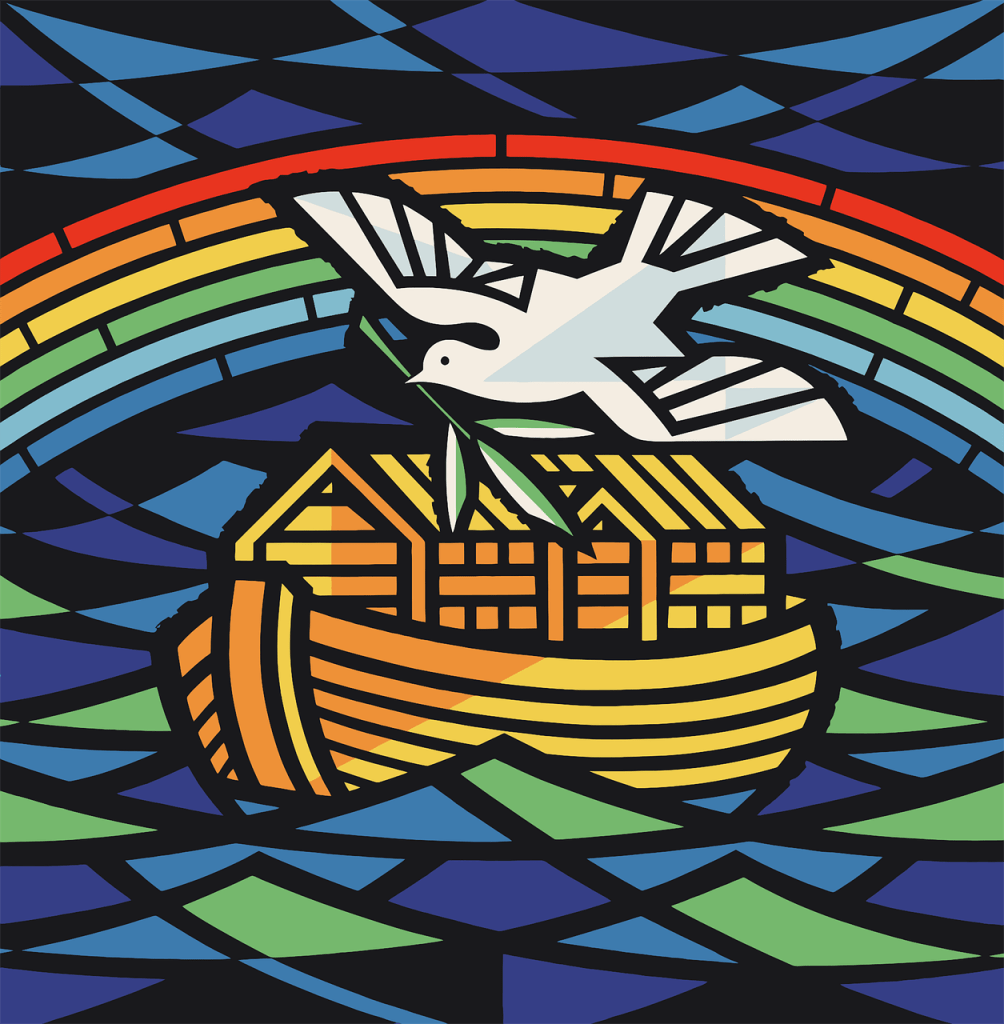
Today’s readings center on the great flood. God sees that humanity has become “thoroughly evil.” Every thought was “completely evil.” The world was so bad that God even regrets making human beings. This situation leaves God “heartbroken.” Things are almost as bad as they can get. Almost. There is Noah. In Genesis 6:9b we read, “Noah was a moral and exemplary man; he walked with God.” At least there is Noah. At least there is one person that is worth saving.

Today our world is not perfect. It is far from it. Noah was an Old Testament example of piety. I wonder, as God looks down on the earth today, who are the Noahs? Specifically, are you and I modern day examples of an exemplary relationship with God?

In obedience to God, Noah builds an ark and gathers up his family and the animals – a pair of some, seven pairs of others. This gathering up insures not just Noah’s salvation, but the salvation of all of creation. God then shuts the hatch and the rains come down and the “springs of the deep sea” open up. In 7:22 we read, “Everything on dry land with life’s breath in its nostrils died.” The loss of all life is catastrophic, horrific, complete.

Eventually the waters recede. Noah sends out a dove to test the earth’s readiness for life. The third time the dove does not return. God tells Noah to exit the ark. Noah’s first acts on dry land are to build an altar and then to offer a sacrifice to God. This pleases God and moves God to make a covenant. There will never be another flood “to destroy the earth.” God placed “his bow” in the sky – it will be a frequent reminder to God of God’s commitment to stay in relationship with humanity. This is a gift that we rejoice in yet today.

Prayer: Lord God, what a horrible place the world became. Humanity broke your heart. Things deteriorated to the point that your justice required action. Thanks be to you, O God, that we had Noah – an example of faithful living. In your love you provided a way for the world to continue. In your grace you committed to us and to creation forever. Thank you, God. Amen.


Leave a comment

A People the Lord Has Blessed

Reading: Isaiah 61:8-11

Verse 11: “The LORD God will grow righteousness and praise before all the nations.”

In the second half of this week’s Isaiah 61 passage God declares a love for justice and a corresponding hate of robbery and iniquity. In all things God loves good and hated evil. This is because God is good and in God there is no evil whatsoever. Created in God’s image, God’s intent is for us to mirror the character of God. In verse 8 God promises an everlasting covenant. Through this covenant the people of the Lord will be blessed.

Beginning in verse 10, Isaiah responds. The promises of God bring delight and joy to his soul. The prophet noted that God has “clothed me with garments of salvation… in a robe of righteousness.” Covered in these figurative garments, Isaiah is empowered to practice and to reflect the character of God. The living out of a deeply rooted faith will be a witness to the people of God and to the world. This connects back to verse 9b, where we read, “‭All who see them will recognize that they are a people blessed by the LORD.”

Our passage also connects with an analogy that I’ve touched on the last two Sundays. In these words of hope and of a promise of new life, Isaiah draws on the image of a garden. The soil and the seed are essential. Good tending is necessary. And then God gets involved as the seed sprouts, grows, and eventually bears a crop. The same concepts are true in our faith. Time in the Bible tolls the soil of our hearts. Worship and study and prayer plant seeds that we must tend to and nourish. Then God’s Holy Spirit gets involved, leading and guiding our growth, causing our faith to grow deeper, allowing it to be witnessed by all, leading others to seek out the One in whom we delight and find joy, the One who leads us in righteousness and into salvation. May this be so for you and for me today and every day.

Prayer: Lord God, your covenant remains true today – you are our God and we are your people. Clothe us in righteousness, fill us with the joy and delight of salvation through Jesus Christ. Then set us out into the world, Lord, drawing others into a saving faith. Amen.


Leave a comment

This Same God

Reading: Isaiah 51:1-6

Verse 6: “My salvation will last forever, my righteousness will never fail.”

Isaiah 51 reminds reminds me of the “then and now” of our faith. Written to those “who pursue righteousness and who seek the Lord,” it calls them and us to remember the long arc of the relationship between God and God’s people. Looking into today and beyond into eternity, we are also reminded of God’s standing promise: “My salvation will last forever, my righteousness will never fail.”

Isaiah writes these words to the Israelites living with him in exile. Their time in exile has grown long. They are living as strangers in a place far away from all they’ve ever known. It has been a wearying and difficult stay. So Isaiah calls them to remember where they came from and whose they are. He calls them to remember Abraham and Sarah, the ones who received the covenant and who were blessed as God fulfilled the promise. When we find ourselves in a trial or in a season of suffering, it is good to remember the great stories of faith and to be reminded of “the rock” that we too stand upon.

The prophet also speaks of hope and restoration. Isaiah tells the exiles that God looks “with compassion on all her ruins” – both those back home and those that are their lives now. He prophesies that God will transform these dry and barren places and lives into a garden paradise, into a place where there will be “thanksgiving and the sound of singing.” Isaiah tells them that justice and salvation are on the way! This was all probably hard to hear in the darkness and despair of exile. But, wait. Remember, God took one and “blessed him and made him many.” This same God promises to restore Israel. This same God can and will bring us through our trials and sufferings. Thanks be to God.

Prayer: Lord, it is good to remember and to know once again that your promises of salvation and compassion are for all people who call on you and who seek your righteousness. The promises are for us. Thank you, Lord. Amen.


Leave a comment

To Preserve a Remnant

Reading: Genesis 45:5-15

Verse 7: “God sent me ahead of you to preserve for you a remnant on earth.”

Photo credit: Tyler Milligan

As Joseph’s reunion with his brothers continues, he offers them words of assurance and encouragement. Joseph fully believes that it is God’s plan unfolding. He is 100% sure that God’s plan has both human and divine purposes.

There are a few human purposes. The first is to preserve lives. Joseph is placed in mighty Egypt, in a country with large enough resources to grow and store enough extra food to sustain themselves and others during 7 years of famine. That is a monumental task. God gifted and directed Joseph to orchestrate this massive food program. Without Joseph there it is unlikely that any of this would’ve happened. And God sent Joseph ahead to be in a spiritual place to offer grace and forgiveness to his brothers. The trials and sufferings accompanied by the joys and victories have readied his heart to reconcile with his brothers.

As amazing as this all is, there was a greater purpose being worked out: “God sent me ahead of you to preserve for you a remnant on earth.” Everything that has happened is wonderful. But the main purpose was to preserve a remnant of God’s people to keep alive God’s covenant promises. The family of Israel moves to Egypt and not only survives but thrives. They become a great nation. This is ample proof of God’s love for Israel.

Today I look at the church and the word remnant comes to mind. God and faith seem to have less and less space in our collective hearts. The church’s influence feels in decline. Yet God is faithful. In the end we know that Jesus returns and makes all things new. Evil does not win. This brings to mind a question: How is God using you and me to preserve a remnant that will ultimately triumph over all?

Prayer: Lord God, you are faithful and true. Not a word has gone out or will go out from your lips that isn’t forever. Give us hope. Encourage us as we seek to be your faithful disciples here on earth. Amen.