pastorjohnb

Thoughts and musings on faith and our mighty God!


Leave a comment

God at Work

Readings: Judges 13, Judges 14, Judges 15, Judges 16

Judges 15:14 – “The LORD’s spirit rushed over him, the ropes on his arms became like burned-up linen.”

Today we read about Samson. He is the last major judge. Evil has befallen Israel and God has given them over to the Philistines – for 40 years. The messenger of the Lord comes to a Danite woman and tells her that she will have a son. Because he will be a nazarite, she must keep the vows while pregnant. Samson is born and as he grows up, the Lord blesses him.

Samson falls in love with a Philistine woman – much to his parents displeasure. He demands that they get her for his wife. They do not realize that God is at work. Samson kills a lion bare-handed and on a later trip discovers honey in the carcass. This becomes the basis for his wedding riddle. Samson’s wife nags the answer out of him and she tells her people. He reacts violently, killing 30 men to get the 30 sets of clothing to pay off his wedding riddle. He exits quickly and the woman is married to another. Later this news leads an angry Samson to use foxes and torches to burn the Philistines’ grain. Samson is turned over to the Philistines but God is with him once more. Freed, he uses a jaw bone to kill 1,000 Philistines. God then brings water from a rock to revive and reenergize a tired Samson.

Samson then meets, falls in love with, and marries Delilah. The Philistines offer her 1,100 pieces of silver for the secret to his strength. After three failed attempts and a lot of nagging, he tells her. He awakens and thinks he’ll just escape this too. But he is captured. They gouge his eyes out and put him to slave labor. During a celebration to their god Dagon, Samson is brought in to perform. He asks God for one last time of strength. Samson collapses the temple, killing the Philistine rulers, freeing God’s people.

Samson breaks all of his vows. He allows lust, anger, and revenge to lead him to some horrific decisions and actions. And yet God remains at work. Samson will not be rescued or redeemed, but through him God’s people will be.

Prayer: Lord God, you are ever at work. In the hardest of situations you still can bring about your desired outcome. Help us to heed today’s warnings about the outcome of lust, anger, and revenge. Amen.



Leave a comment

Holy Living

Readings: Leviticus 19, Leviticus 20, Leviticus 21, Leviticus 22, Leviticus 23

Leviticus 20:26 – “You must be holy to me, because I the LORD am holy, and I have separated you from all other peoples to be my own.”

Photo credit: Shane Rounce

Today’s readings are all about living as a holy people. Each of these laws or instructions rest upon the same foundation: God is holy so God’s people need to be holy. This foundation is the ethical, moral, and spiritual standard for living in community with God and with God’s people.

Although chapter 19 can feel like a hodge podge of topics – don’t lie, don’t turn to idols, leave some crops for the needy, no cross breeding, no cuttings or tattoos – taken as a whole, they can be summed up in verse 18: “You must love your neighbor as yourself.” This is half of the shemah, the daily Jewish prayer. We’ll add the other half as we read in Deuteronomy.

The practice of worshipping Molech begins chapter 20. The practice of this Canaanite religion is strictly prohibited. This is followed by sexual prohibitions. In this chapter the practice of idolatry is equated with prostitution and adultery. The root need for these prohibitions is summed up in verse 23: “You must not follow the practices of the nations that I am throwing out.” Instead, for the Israelites, “You must be holy to me, because I the LORD am holy, and I have separated you from all other peoples to be my own.” God is holy so God’s people need to be holy.

Chapters 21 and 22 deal with special laws for the priests. The call to holy living is elevated when applied to the priests. They are set apart from the people set apart. The priests are to be living examples of God’s holiness. This is why priests with imperfections are limited in their service.

Our reading for today closes in chapter 23 with instructions for the holy or sacred times. Note that this section begins with a reminder to keep the Sabbath. This weekly observance is essential to holy living. The yearly events remember and celebrate significant events with God. The Passover and connected Festival of Unleavened Bread celebrate the exodus. The Festival of Weeks begins with thanks for the first fruits and concludes by thanking God for the harvest. The Festival of Booths remembers their time in the wilderness, where God provided again and again. The Day of Reconciliation is also included. This celebrates God’s mercy and grace and forgiveness.

Each day and each festival reminds the people of God’s love and care. They remind the people of God’s holiness and of their call to reflect this holiness. To remember and to celebrate reinforces their faith and their commitment to God. May we too remember and celebrate the ways that our holy God has touched our lives, calling us to be holy as God is holy.

Prayer: Lord God, flowing through these chapters we see again and again the call to holy living and to live as a people set apart from the ways of the world. Strengthen our understanding of these calls and empower us to live holy and faithful lives as people in but not of the world. Amen.


Leave a comment

Building God’s Dwelling

Readings: Exodus 35, Exodus 36, Exodus 37, Exodus 38, Exodus 39, Exodus 40

Exodus 40:33-34 – “When Moses had finished all the work, the cloud covered the meeting tent and the LORD’s glorious presence filled the dwelling.”

Photo credit: Kyle Johnson

Today’s six chapters cover the construction of the tabernacle. To accomplish this monumental task God and Moses call for a free will offering. So great is the generosity of the people that Moses finally has to say, “Stop!” In total the people brought 2,200 pounds of gold, 7,500 pounds of silver, and 5,300 pounds of copper/bronze – not to mention the cloth, yarn, gemstones, wood, spices… The census was taken. 603,500 men give their half shekel to the sanctuary of God.

Leaders are appointed and the work begins. Men and women contribute. It is a community effort. This project is like a lot of church projects. Generous hearts and willing hands are needed. As it was then so it is now: the people are the heart and soul of the community of faith. The work is done exactly as the Lord has commanded in Exodus 25-31. Every detail is done exactly as the Lord desired. What an example of obedience and attention to detail. In this way it reflects the creation story.

The work is done and the tabernacle is erected. Everything finds its place and the priests are blessed. Moses blesses the people for their work just as God blessed creation when that task was completed. In verses 33-34 of chapter 40 we read, “When Moses had finished all the work, the cloud covered the meeting tent and the LORD’s glorious presence filled the dwelling.” Exactly one year after Israel was delivered from Egypt, the tabernacle is finished and God’s presence comes to dwell among the people. This is the fullest expression of God’s presence in the Old Testament. It expresses God’s desire to be with all people. This desire continues today. Thanks be to God.

Prayer: Lord God, you were present in and through this magnificent process. You opened hearts and hands to give and serve. Through this your glory was revealed. Continue to be present in and through us, O God. Continue to open our hearts and hands in service to you, O Lord Almighty. In and through us may your glory be revealed! Amen.


Leave a comment

All Is Beloved

Reading: Psalm 148

Verse 14: “God has raised up for his people a horn, the praise of all his faithful servants.”

Merry Christmas! Peace and joy, love and hope to you!

On this special day we turn to Psalm 148. This Psalm is all about praise. While not a traditional Christmas text, it does fit very well the spirit of the day. The psalmist’s encouragement to praise is sprinkled throughout this text – 12 times in my home Bible! The opening stanza encourages the first parts of creation to praise God – the angels, the sun, moon, and stars, the heavens and the skies. The encouragement to praise next includes the physical creation – trees, mountains – and the living creation – animals, birds… Continuing along the creation narrative the psalmist lastly includes us – all of us. Kings and rulers, old men and maidens, children – all are encouraged to praise the Lord of all creation.

You and I are certainly included in today’s Psalm. So we must ask ourselves: What does it look like to praise God with our lives? It begins with our acts of piety. These include daily prayer and Bible study, regular worship, and fasting. These practices surely elicit our praise! These acts or practices then lead us to acts of mercy. These include all forms of loving and caring for our neighbor.

Returning to the Psalm, it closes with these connecting words: “God has raised up for his people a horn, the praise of all his faithful servants.” This horn or king is Jesus Christ, our Lord and Savior. The Messiah came to teach us how to love. Jesus’ example of love was one without limits. In a world that sees race, gender, ethnicity, religion, nationality, and many other things as reasons to hate instead of love, let me say that again: Jesus’ example of love was one without limits. All people were invited into Jesus’ love. None were excluded. As part of the action of creation, which is detailed in today’s Psalm, Jesus knew that all of creation was divine. All of creation continues to carry the spark of the divine within. Therefore, my friend, all of creation – all – is beloved by God. May it be so for you and me as well. This is our true act of praise.

Prayer: Lord God, make me more full thine today. Fill me with your love so fully that all I do and say and think is praise to you. Use me to help others to see and love the spark of the divine within themselves. Amen.


Leave a comment

The Thin Space

Reading: Luke 2:1-20

Verse 19: “Mary treasured up all these things and pondered them in her heart.”

Photo credit: Kelly Sikkema

We begin this day where many of us will end the day – in Luke 2, verses 1-20. In his gospel to the Gentiles, Luke offers the best known telling of Jesus’ birth story. Luke’s gospel was aimed at those outside of the Jewish circles of faith. Perhaps that is why his telling resonates so well with so many. To recount how the “good news of great joy” came first to the shepherds – to those very near to the bottom of the socio-economic ladder – is to remind us all that the good news of Jesus Christ is indeed for all people.

The Upper Room Disciplines devotional for today reminded me of a very similar experience with what author Richard Morgan calls a “thin space.” This is the liminal space where heaven and earth touch and we enter the presence of the holy. We also were caroling in a care facility when a woman who had sat still and silently the whole time came to life and began singing Silent Night in German as we sang in English. The tune and words touched a deep place in her mind and soul. It was a sacred and holy moment to be a part of as we entered that thin space.

Towards the end of today’s passage we read, “Mary treasured up all these things and pondered them in her heart.” After a long journey and first-time labor, after receiving this holy story from the shepherds, Mary soaked it all in. She entered that thin space and seeped in God’s presence. This is my hope and prayer for all who will be drawn to worship and to celebrate the birth of the Savior. As each enters into worship, may each find a sacred space to enter into. There, may they each be touched by God so that the dear Christ child may enter into their hearts this night.

Prayer: Lord God, open the hearts of all who will come today to sing carols and to hear the story. May the words and songs draw them into the thin space where heaven touches their hearts. Amen.


Leave a comment

The Thin Space

Reading: Luke 2:1-20

Verse 19: “Mary treasured up all these things and pondered them in her heart.”

Photo credit: Kelly Sikkema

We begin this day where many of us will end the day – in Luke 2, verses 1-20. In his gospel to the Gentiles, Luke offers the best known telling of Jesus’ birth story. Luke’s gospel was aimed at those outside of the Jewish circles of faith. Perhaps that is why his telling resonates so well with so many. To recount how the “good news of great joy” came first to the shepherds – to those very near to the bottom of the socio-economic ladder – is to remind us all that the good news of Jesus Christ is indeed for all people.

The Upper Room Disciplines devotional for today reminded me of a very similar experience with what author Richard Morgan calls a “thin space.” This is the liminal space where heaven and earth touch and we enter the presence of the holy. We also were caroling in a care facility when a woman who had sat still and silently the whole time came to life and began singing Silent Night in German as we sang in English. The tune and words touched a deep place in her mind and soul. It was a sacred and holy moment to be a part of as we entered that thin space.

Towards the end of today’s passage we read, “Mary treasured up all these things and pondered them in her heart.” After a long journey and first-time labor, after receiving this holy story from the shepherds, Mary soaked it all in. She entered that thin space and seeped in God’s presence. This is my hope and prayer for all who will be drawn to worship and to celebrate the birth of the Savior. As each enters into worship, may each find a sacred space to enter into. There, may they each be touched by God so that the dear Christ child may enter into their hearts this night.

Prayer: Lord God, open the hearts of all who will come today to sing carols and to hear the story. May the words and songs draw them into the thin space where heaven touches their hearts. Amen.


Leave a comment

The Thin Space

Reading: Luke 2:1-20

Verse 19: “Mary treasured up all these things and pondered them in her heart.”

Photo credit: Kelly Sikkema

We begin this day where many of us will end the day – in Luke 2, verses 1-20. In his gospel to the Gentiles, Luke offers the best known telling of Jesus’ birth story. Luke’s gospel was aimed at those outside of the Jewish circles of faith. Perhaps that is why his telling resonates so well with so many. To recount how the “good news of great joy” came first to the shepherds – to those very near to the bottom of the socio-economic ladder – is to remind us all that the good news of Jesus Christ is indeed for all people.

The Upper Room Disciplines devotional for today reminded me of a very similar experience with what author Richard Morgan calls a “thin space.” This is the liminal space where heaven and earth touch and we enter the presence of the holy. We also were caroling in a care facility when a woman who had sat still and silently the whole time came to life and began singing Silent Night in German as we sang in English. The tune and words touched a deep place in her mind and soul. It was a sacred and holy moment to be a part of as we entered that thin space.

Towards the end of today’s passage we read, “Mary treasured up all these things and pondered them in her heart.” After a long journey and first-time labor, after receiving this holy story from the shepherds, Mary soaked it all in. She entered that thin space and seeped in God’s presence. This is my hope and prayer for all who will be drawn to worship and to celebrate the birth of the Savior. As each enters into worship, may each find a sacred space to enter into. There, may they each be touched by God so that the dear Christ child may enter into their hearts this night.

Prayer: Lord God, open the hearts of all who will come today to sing carols and to hear the story. May the words and songs draw them into the thin space where heaven touches their hearts. Amen.


1 Comment

The Gift We Live For

Reading: Titus 2:11-14

Verse 11: “For the grace of God has appeared, bringing salvation for all people.”

We begin this week in Paul’s letter to Titus. It is a short letter of instruction and encouragement. Titus was a co-worker of Paul’s who was left on Crete to work with the newly forming church. Today’s passage comes from the section titled “What Must Be Taught to Various Groups.” Our small portion of this section comes as something to teach to all people and groups.

In verse 11 Paul writes, “For the grace of God has appeared, bringing salvation for all people.” The starting place of this passage is in the past. Jesus Christ has come, bringing grace that leads to salvation to all people. This is what we will celebrate in six days – the coming of Immanuel, God with us! In the next verse Paul shifts to the present, to what the gift means now. Paul encourages Titus to teach the believers to live Christ-like lives. Say “no” to the things of this world, living upright, godly, self-controlled lives now. The next verse looks to the future – “while we wait for the blessed hope” – waiting for the return of Jesus Christ.

These words fit so well in the Advent season and in the week in which we turn to Mary and then to Christmas Eve. Mary was a humble servant who obediently received God’s call. She bore the gift that Paul lives for and encourages Titus and all the believers in Crete to live for. May this too be the gift that we live for – Jesus Christ, who was and is and always will be.

Prayer: Lord God, thank you for coming to us, revealing the depth of your love and grace for all people. We rejoice in the salvation that you bring to all who call on the name of Jesus Christ as Lord and Savior. Guide us to turn that rejoicing into living each day so that others can receive the gift of your son. Amen.


Leave a comment

Glorious and Beautiful – One Day and Now

Reading: Revelation 7:9-17 (Link only partial. Sorry.)

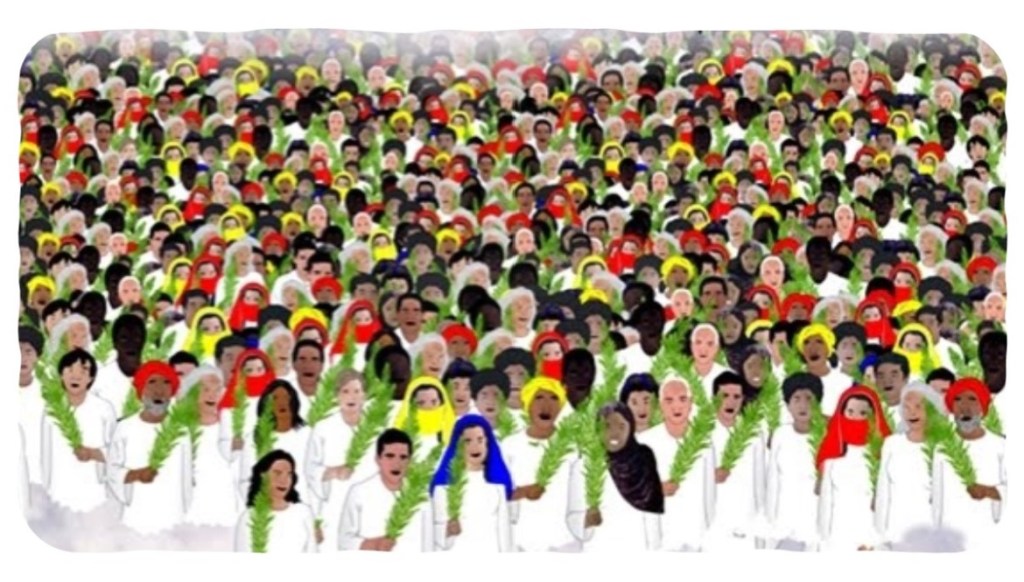
Verse 9: “There before me was a great multitude that no one could count, from every nation, tribe, people and language.”

As we turn to John’s book of Revelation we turn to a vision that gives hope for eternity, offers a picture of the kingdom of God, and calls us to a glorious kingdom here on earth. Our passage today and much of the book of Revelation is a “then, now, and will be” vision.

John sees a “great multitude” gathered in heaven – far too many to count. In this vast crowd there are people “from every nation, tribe, people, and language.” Oh how the religious leaders of yesterday’s text must’ve cringed when they first heard of this vision of heaven! But what a beautiful picture of heaven it is! One day we will be gathered with a representation of all of humanity. To John’s audience this was a reminder that they do not suffer alone. Many all around the world suffer alongside them. To us it is a reminder to work to make our churches and faith communities look more like the actual community all around us.

The scene in our passage is filled with worship. The multitude, the angels, the elders, and the four living creatures all worship God and the Lamb. They joyously offer praise and thanksgiving and adoration. This scene is “church” at its finest and most glorious. Next an elder identifies those in “white robes” as those who have gone through the “great tribulation” – the suffering and persecution and trials of this life. The passage closes by contrasting this life with the life to come. In glory there will be no hunger or thirst, no oppression or suffering. God will “wipe away every tear” and the Lamb will lead us “to the springs of living water.” What hope these words gave to John’s audience. What hope these words give to all who long to one day be redeemed by Jesus Christ. Oh what a glorious and beautiful day that will be. Thanks be to God.

Prayer: Lord God, thank you for the hope that today’s passage gives. Thank you for the seed of what will be. But, God, help us to see that this vision is also a vision for today and an understanding for our time now. As we hold onto our hope for eternity, guide us to expand the kingdom here and now. Use us to satisfy hunger and thirst now. Use us to end oppression and suffering now. Use us to make our churches and communities more like the kingdom to come. Amen.


Leave a comment

Go with Us, O God

Reading: Exodus 33:12-16

Verse 15: “If your presence does not go with us, do not send us up from here.”

Photo credit: Ruthson Zimmerman

In our Old Testament text this week we once again find Moses interceding on behalf of the people. The golden calf incident has just occurred and God is upset with this “stiff-necked people.” God’s words about potential punishment and destruction have gotten the people’s attention and Moses’ attention. Moses’ intercession focuses in on God continuing to be with him and with the people.

Moses begins by reminding God that God once said, “I know you by name and you have found favor with me.” Moses wants to re-establish their relationship as the starting point for the continuing conversation. It is like saying, “Since we’re good friends…” before getting to the heart of the conversation. Moses begins by asking God to continue to teach him God’s ways so that he can know God and find favor moving forward. Moses wants the relationship to grow and develop. And then Moses reminds God that “this nation” (yes, this stiff-necked people) is (are) God’s people. This nation that God has asked Moses to lead? Yes, God, they are your people. The implied question remains this: Will you go with us, God?

God affirms their relationship, saying, “My presence will go with you.” Moses is relieved. Making sure that this is the promise, Moses says, “If your presence does not go with us, do not send us up from here.” Don’t send us on if you’re not going with us God. Moses knows that without God, the Israelites are just like all the other people. The same is true for us, for you and for me.

Prayer: Lord God, just as you went with Moses and the Israelites, be present to us and go with us. Through your presence, distinguish us from all the other people of this world. Going with us, help us to be different in the best ways possible. Use us to be love amidst the hate, to be peace amongst the violence, to be healing for the broken and suffering. Go with us, O God, as we seek to live as your light and love in this world. Amen.