pastorjohnb

Thoughts and musings on faith and our mighty God!


Leave a comment

Words of Teaching and Instruction

Reading: Psalm 78:1-4

Verses 2-3: “I will utter dark sayings from of old, things that we have heard and known, that our ancestors have told us.”

Telling a story, have you ever omitted parts or embellished parts to either gloss over something “bad” or to make a particular point? In telling stories it can be tempting to amend them to suit our purposes. We might even tell an altered version to this person or group of people if it best suits our agenda. There are, of course, inherent dangers in modifying our stories. These dangers magnify when we begin altering our communal history. Psalm 78 was written to be used in worship as a teaching tool. Today’s passage sets the stage for the rest of the Psalm. In the body of the Psalm, Asaph tells the whole story of God’s redemptive work. He includes the reasons for why God had to redeem again and again: the people were often unfaithful and disobedient to God’s leading and guiding.

It can be difficult or hard to “tell the whole truth and nothing but the truth.” As individuals, as churches, as denominations, as communities, as states and nations, we can shy away from the practice of honest truth-telling. Asaph writes, “I will utter dark sayings from of old, things that we have heard and known, that our ancestors have told us.” In the rest of the Psalm he does indeed tell all – the good, the bad, the beautiful, the ugly. Each of these aspects of our stories and of our histories has something to offer both to us and to future generations. We learn from our mistakes; we build upon our successes.

As we offer words of teaching and instruction to our children (and to one another), may we “tell the next generation” of the “deeds of the Lord” in honest and full detail, empowering them for the best future possible. In this way, they too will come to know “the powers and wonders” of God for themselves.

Prayer: Lord God, my past is scattered with bad decisions, failures, hurtful words and actions – both in my life and in the churches that I’ve been a part of. Some were my own doing, some were not. All of these have shaped and formed me into who I am in you. There are hard lessons and some painful moments. All were instructive; all led to growth and maturity. Guide me to use these experiences to mentor and to guide others, to shape a better future. Amen.


Leave a comment

What Is Required?

Reading: 1st Thessalonians 4:13-18

Verse 17b: “And so we will be with the Lord forever.”

Today’s words from Paul connect really well with the themes and ideas around All-Saints’ Day. In Revelation 7 the vision of heaven and all its glory brought hope to the believers suffering in John’s time. These words offer hope to all believers. The Thessalonians aren’t quite there yet. The vision detailed in Revelation probably hasn’t reached them. They are concerned with the souls of those who have died (“fallen asleep”) before Jesus returned. The common belief was that Jesus was coming back any day, soon. They fear that these souls might miss out or forever be trapped in limbo.

Paul begins to address their fears and concerns by assuring them that because Jesus died and rose again that one day all who believe in him will one day rise with him. Paul further assures them using Jesus’ own teachings. He reminds them that Jesus taught that when he returns “the dead in Christ will rise first.” Those who have fallen asleep will indeed join Jesus in glory. Paul then turns to those who are alive, reminding them that Jesus taught that those who are still alive “will be caught up together with them.” All who call on Jesus as Lord and Savior “will be with the Lord forever.” What words of hope and encouragement Paul shared with the Thessalonians and with us!

The underlying question that bubbles up here for me is this: What is required of me so that I am one day a part of this heavenly gathering? I first turn to Micah 6:8. These words are my daily prayer of commitment to God. Each day I strive to act justly, to love mercy and kindness, and to walk humbly with the Lord. These words and actions focus and frame my day. What words and practices guide you to living in a way that brings honor and glory to God?

Prayer: Lord, justice, mercy, kindness, and humility – they are a good start but I know that this is not all that is required of me. By the power of your Holy Spirit fill me with your love and compassion, with your grace and forgiveness. Show me the way to daily serve you and neighbor. Amen.


Leave a comment

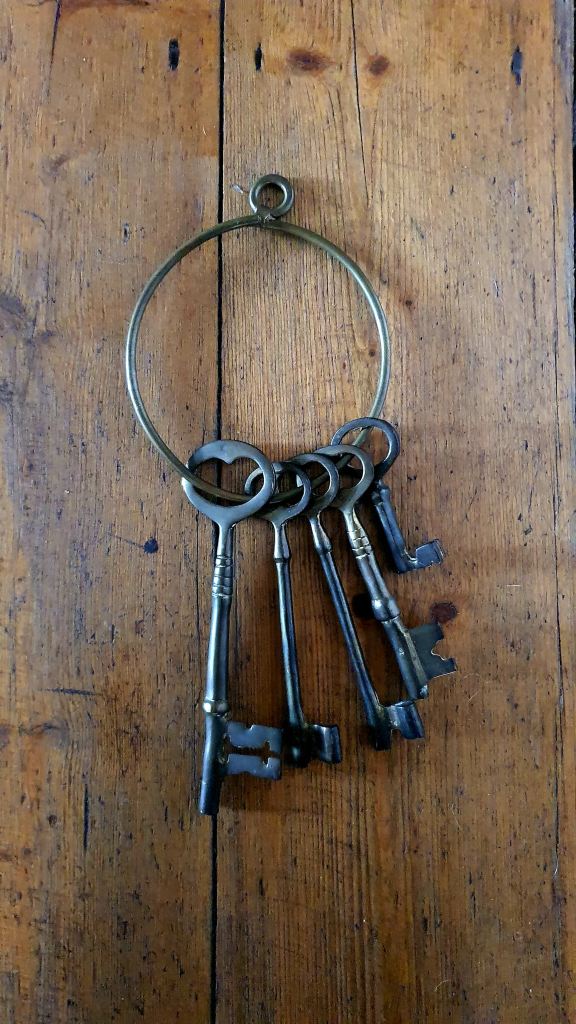
Keys

Reading: Matthew 16:13-20

Verse 19: “I’ll give you the keys of the kingdom of heaven.”

Photo credit: Nerene Grobler

Jesus pauses to get a pulse on how things are going. He asks the disciples who people say he is. The response provides a pretty impressive list of prophets. Jesus has a good amount of respect from the general population. Then he turns to the 12, to his inner circle, to the ones who have been with him practically 24/7 for almost 3 years. He says, “What about you? Who do you say I am?” This is a personal question.

Simon answers first, declaring Jesus the Christ, the Messiah, the Son of God. Jesus recognizes that the Spirit has given him this answer and because of this he says that Peter is blessed. Continuing Jesus renames Simon to Peter, which translates “rock.” He then identifies Peter as the one upon whom Jesus will build his church. Peter will be the leader of the early church.

And then Jesus says, “I’ll give you the keys of the kingdom of heaven.” Keys represent access to knowledge. Peter – and all others who come to call on Jesus as Messiah and Lord – will receive all the knowledge necessary to bind or set free from bondage those struggling with or trapped in sin. Just as the Spirit revealed Jesus’ true identity to Peter, so too will the Holy Spirit reveal the words and actions needed to bring others to Christ, the one who sets us free from our sins. With a holy confidence may we witness to this good news!

Prayer: Lord God, thank you for all who have poured into me, building up my faith and my knowledge of you. Thank you for those that continue to do so, including the Holy Spirit. Continue to fill me. Continue to use me to share the good news with a world in need of Jesus Christ. Amen.


Leave a comment

Life or Death?

Reading: Romans 8:1-11

Verse 6: “The mind governed by the flesh is death, but the mind governed by the Spirit is life and peace.”

Photo credit: James A. Molnar

Turning to our Epistle reading today and tomorrow, Paul writes about “Life in the Spirit.” He begins with an important truth: there is no condemnation for those who believe in Jesus Christ. Yes, we still sin. But – thanks be to God – our sin does not have the final word. Christ’s love and grace and mercy has the final word. And it has already been spoken. Because of his death and resurrection, one day Jesus will “give life to your mortal bodies” as all who believe in Jesus will join him eternally.

In our passage Paul juxtaposes the will of the flesh and the will of the Spirit. In Paul’s actual words and in his way of thinking, “flesh” is our fallen human condition. It is our proclivity to sin. It is our tendency to idolatry – both to the things of this world and to self. It is not the physical body. These words and others like them have been misused to judge and enslave and marginalize those who were not white males. Sadly this continues to be some people’s reality today. Prayers for us to all see all people as equally beloved by God.

To help us move away from this harmful, destructive, distorted viewpoint, let us turn to verse 6. Here we read, “The mind governed by the flesh is death, but the mind governed by the Spirit is life and peace.” This verse places the battle between sin and life squarely in our minds. It removes the physical and emotional and places the battle solely in the spiritual realm. The mind controls our words, thoughts, actions, and inactions. We make choices. Sin or God? Love or hate? Welcome or exclusion? Life or death?

Prayer: Lord God, raise up and give strength to the will of the Spirit in my life. In your love, help me to die to self and to the sin it so easily leads to. Day by day, occupy more and more of my mind, more of my heart. Amen.


Leave a comment

Provision

Reading: Genesis 22:6-14

Verse 14: “So Abraham called that place ‘The Lord will provide.'”

In our Genesis 22 reading God provides the ram as the sacrifice. Isaac is lifted off the altar and he is replaced by this ram. It dies in his place, much as Jesus died in our place to pay the price for our sins. The ram does so that the child can live. In an act of gratitude and worship, Abraham names the place “Jehovah Jireh” – the Lord will provide.

God continues to provide for our needs. Sometimes it is by giving us the words to speak, sometimes it is by guiding us to the correct action to take. And sometimes words fail and God is directing us to simply provide presence. God provides in many other ways. A door can be opened, another closed. A meal or help in some other form can show up unexpected and meet a need.

We too can be used by God as the means of provision. Many years ago, for example, a family in our church was struggling financially. A group got together and left $1,000 in a blank envelope in their mailbox. Our financial blessings are often a way that we can be part of God providing a blessing for others. It can also be something as simple as a card or phone call – hearing “it came exactly when I needed it most” assures us of God’s hand guiding and providing.

The keys to both receiving from God and being used by God to provide for others begins with an open ear, followed closely by a willing heart. May we all be receptive to God’s working in and through us as God loves and provides for our needs.

Prayer: Lord God, use me today to accomplish your will. Use my words or my hands and feet, use my presence, O God, as you seek to love and care for our world and for all of your children. And when your will turns to me, may I humbly receive all that you have for me. Amen.


Leave a comment

Provision

Reading: Genesis 22:6-14

Verse 14: “So Abraham called that place ‘The Lord will provide.'”

In our Genesis 22 reading God provides the ram as the sacrifice. Isaac is lifted off the altar and he is replaced by this ram. It dies in his place, much as Jesus died in our place to pay the price for our sins. The ram does so that the child can live. In an act of gratitude and worship, Abraham names the place “Jehovah Jireh” – the Lord will provide.

God continues to provide for our needs. Sometimes it is by giving us the words to speak, sometimes it is by guiding us to the correct action to take. And sometimes words fail and God is directing us to simply provide presence. God provides in many other ways. A door can be opened, another closed. A meal or help in some other form can show up unexpected and meet a need.

We too can be used by God as the means of provision. Many years ago, for example, a family in our church was struggling financially. A group got together and left $1,000 in a blank envelope in their mailbox. Our financial blessings are often a way that we can be part of God providing a blessing for others. It can also be something as simple as a card or phone call – hearing “it came exactly when I needed it most” assures us of God’s hand guiding and providing.

The keys to both receiving from God and being used by God to provide for others begins with an open ear, followed closely by a willing heart. May we all be receptive to God’s working in and through us as God loves and provides for our needs.

Prayer: Lord God, use me today to accomplish your will. Use my words or my hands and feet, use my presence, O God, as you seek to love and care for our world and for all of your children. And when your will turns to me, may I humbly receive all that you have for me. Amen.


Leave a comment

Ever by Our Side

Reading: Psalm 23

Verse 1: “The Lord is my shepherd, I lack nothing.”

Photo credit: Felipe Correia

We return to Psalm 23 today. This is something we do again and again. These words are powerful. We recite these words at many funerals – a reminder that God is always with us. We recite these words in our minds when we are not sure of the next step to take in life – a reminder to ourselves that the Good Shepherd will guide and protect. We pray these words in our hearts – reminding ourselves that the Lord will be our still waters in moments of anxiousness or doubt. We offer these words as a plea – an assurance that the guardian of our soul will meet our every need. And we offer these words as a prayer of thanksgiving, remembering again and again how God is with us in all of life. With these words we rejoice in the Lord.

Today I invite you to an exercise. It won’t take too long. Take a little time to pray your way through the Psalm. Reopen your Bible or click on the link above. Pray through one phrase at a time. Not one verse – that is too much. Begin with “The Lord is my shepherd.” Offer words to God around this phrase. It may be words of praise. It may be a request. It may be gratitude or realization. Allow the Spirit to lead you. Then go on to “I lack nothing.” Take your time. Be with the Lord a while…

What a powerful reminder this exercise was for me. God is with me in so many ways. God brings so much to my daily walk and to my life. The Lord is ever by our side. Thanks be to God.

Prayer: Lord God, thank you for this time today with this amazing Psalm. Draw me back to these words again and again – not only in moments of need but also in times of joy and thanksgiving. You are present in all of life, in every moment. Thank you, Lord. Amen.


Leave a comment

Inviting Others Along

Reading: 2nd Corinthians 5:20-21 and 6:1-10

Verse 20: “We are therefore Christ’s ambassadors, as though God were making his appeal through us.”

On this first Sunday in Lent, as we take this mostly personal journey of faith, today’s reading brings this question to my mind: Who are we inviting along in this journey? In today’s passage, Paul describes his journey and this can serve as a model for us as we seek to share Christ with others. In the first verse Paul states: “We are therefore Christ’s ambassadors, as though God were making his appeal through us.” Friends, we are all Christ’s ambassadors.

In verses 2 Paul writes of the imperative nature of this role: “Now is the time of God’s favor, now is the day of salvation.” For every lost soul that crossed paths with Paul and for every wayward person that crosses our path, this statement remains true. Today is the day to meet the Savior. In the rest of the passage Paul speaks mostly of his hardships, not as a way to brag or as a means to show how faithful he was, but as a way to show how God has always been with him. Paul is modeling how his faith was not a “stumbling block” to others but was instead what allowed him to live “having nothing, yet possessing everything.”

In each of these hardships Paul sought to and invites us to be servants who “commends ourselves in every way.” In other words, his faith and trust in Jesus is what he relied on and is what carried him through. In our lives, our actions usually speak louder than our words. So the question for us is this: In our times of hardship, how is the power of Jesus Christ revealed in and through us? That is how we invite others into relationship with Jesus Christ and onto this journey of faith.

Prayer: Lord God, in the good and in the bad, but especially in the hardships, may I reveal you in me to the world. Guide me to turn to you first and always, relying not on my own ability or efforts. Lead me to trust fully in you. Amen.


Leave a comment

Complete and Total Love

Reading: John 14:23-26

Verse 23: “If anyone loves me, he [or she] will obey my teaching.”

Photo credit: Clay Banks

In today’s verses from John 14, Jesus connects loving and obeying. In verse 23 we read, “If anyone loves me, he [or she] will obey my teaching.” For emphasis, Jesus adds, “He [or she] who does not live me will not obey my teaching” in verse 24. To love means to obey. To not obey means no love. Jesus is not just talking about what it looks like on the surface, but is speaking to the heart of the matter.

Today we might use the phrases “practice what you preach” or “walk the talk” to illustrate what Jesus is getting at here. To preach about forgiveness on Sunday morning and then to withhold forgiveness on Tuesday afternoon is not obeying Jesus. It is disobedience because Jesus taught us to forgive just as we are forgiven. If I tell my children to respect others and then I myself exclude someone for whatever reason, I am not obeying Jesus’ command to love one another – even my enemies. To encourage generosity and compassion in others and then to be stingy and selfish – yes, not obeying what Jesus taught and modeled. Yes, saying the right thing. No, not walking the talk.

This list could literally go on and on, page after page after page. It is so because the command to love had no limits, no stipulations, no conditions, no excuses, no rationalizations… It was a straight-up command to love those who are hard to love and to love those easy to love, to love those who love us and to love those who hate us, to love those like us and to love those different from us.

Today we are reminded that it must be more than words. It must be practiced and lived out all the time. If it is not, we fail to obey Jesus’ teachings. If we fail, it is not love. Today may our love be total and complete.

Prayer: Lord God, when I’m struggling to love and obey, send Jesus’ Holy Spirit to remind me, to convict me, to do whatever is necessary for me to obey and love. In my obedience to your teachings may I demonstrate my love for you and for all people. Amen.


Leave a comment

The Holy Seed

Reading: Isaiah 6:9-13

Verse 13: “The holy seed will be a stump in the land.”

In today’s section of our Isaiah passage the Lord gives the prophet a message to bring to the people. In verses 9 and 10, is the Lord calling the people to not understand, to not perceive, to have calloused hearts? This would be a gloomy and hard message to hear from God’s prophet. It is as if this road of sin that leads to destruction is inevitable. It is if the people continue on as they are, living with hard hearts and a mind closed to the word of God.

Recognizing the uphill battle, Isaiah asks, “For how long, O Lord?” How long do I have to preach this message? How long will the people choose to be far from the Lord? This message cannot be popular. It will not be well received. Rarely does a person living in sin or one making poor choices like to be called out, especially after making this choice for a long time.

God’s response to Isaiah’s question matches the tone set in the opening verses. “Until the cities are ruined… the land utterly forsaken.” The consequences of the people’s choices will not be pretty. These are hard words to hear too. But at some level we all know that our poor choices will cost us, that we will face some consequences. Yet that doesn’t mean we always listen.

One of the difficult parts of the pandemic for me personally has been those who have drifted from the church. Letters, notes, texts, phone calls have been made. Words of invitation, of welcome, of encouragement have been given. Yet separation remains. If I’m honest I too have wondered, how long? I’ve felt like surrendering. But the prayers continue to be lifted to God. The end of this passage brings hope, both to me and to Isaiah in his day. “The holy seed will be a stump in the land.” The roots are there. One day God will cause growth to occur. The seed will not be snuffed out. The remnant will not be extinguished. God is good. By God’s grace faith will grow again. Thanks be to God.

Prayer: Lord God, your vision is longer and greater than ours. When our hearts begin to harden and when our ears and eyes want to shut, flood us with your love and hope and grace, reviving the soul, bringing life anew. Amen.