pastorjohnb

Thoughts and musings on faith and our mighty God!


Leave a comment

Not Far

Reading: Mark 12:28-34

Mark 12:34 – “He said to him, ‘You aren’t far from God’s kingdom.”

The Pharisees and Sadducees have just taken turns trying to trap Jesus using questions based on the Law. Jesus has answered these questions that seemingly has no correct answer with answers that left these religious leaders stumped. Entering today’s passage we find a legal expert, impressed with Jesus’ previous answers, also asking Jesus a question. Based on the interaction that Jesus with the man, this seems like a legitimate question.

The religious expert wants Jesus’ opinion on the most important command. There are a lot of potential answers to this question but only one truly correct answer. I wonder, if someone asked this question of us and then examined our lives to find evidence for our answer, would the results match Jesus’ words? Observing our daily living for a few days, would our love of God and our love of neighbor be the guiding forces in our lives?

Jesus answers with the two great commands from Deuteronomy 6 and Leviticus 19. For all devout practicing Jews, this was the only answer: to live God with all that you are and to love neighbor as yourself. This should be our lives’ answer too. The legal expert appreciates and adds to Jesus’ answer. In response Jesus says, “You aren’t far from God’s kingdom.” May the evidence of our lives reveal the same.

Prayer: Lord God, your call is to love – to love you completely and then to allow this love to flow into the relationships we have with others. Love is to guide our decisions and actions, our words and our thoughts. Empower us this day and every day to be love lived out in the world. Amen.



Leave a comment

Our Daily Choice

Reading: Daniel 6:4-16

Daniel 6:10c – “Daniel knelt down, prayed, and praised his God three times a day, just like he always did.”

Photo credit: Noah Silliman

Today’s small peak into Daniel’s story reminds us of how hard it can be at times to choose to stay in love with God. Daniel has consistently chosen to do good in his role as an administrator. His work is without fault. Even though he is living in exile, along with most of Israel, Daniel has made an intentional choice to “stay in love with God.”

As our reading begins we see that the other administrators and officials – all 122 of them – are trying to find a way to do harm to Daniel. They are jealous and want to take him down. Finding no fault with his work, they sink to trying to use his faith against him. Tricking the king into writing a law about praying only to the king, these men find a way to possibly be rid of Daniel.

In verse 10 we read that Daniel is fully aware of this new law. As we press on we read, “Daniel knelt down, prayed, and praised his God three times a day, just like he always did.” Daniel chose to continue doing what he always did. The crowd bursts in and catches Daniel praying to God. Despite the king’s best efforts, Daniel is thrown into the lion’s den. (The story does not end here!)

In that moment, when choosing God really mattered, Daniel chose to do what he did every day to nourish his faith, to deepen his relationship with God. In our moment, when practicing our faith might place us in harm’s way, will we make Daniel’s choice? If our daily choice is the same – taking time every day to invest in our faith and in our relationship with God – then we are likely to find the courage and faith to trust God and to step forward in faith. May it be so.

Prayer: Lord God, how beautiful is Daniel’s slow and sure walk of faith. Again and again you proved worthy of his trust and devotion. First, Lord, guide us to such a place of deep faith as we daily invest in our own relationship with you. And then, in the moment, give us the courage to continue to walk the walk. Amen.


Leave a comment

The Great Commands

Reading: Matthew 22:34-40 and 7:9-12

Matthew 7:12 – “Treat people in the same way that you want people to treat you.”

Photo credit: Shane

In Matthew 22 the Pharisees get together and decide to test or trap Jesus. Their religious rivals, the Sadducees, have just been left speechless after their attempt to trap Jesus in his words. The Pharisees send one forward to test Jesus with a question: What’s the greatest commandment? The Law has 613 (or 623) commands. Which is the most important one Jesus?

Quoting from the Law, Jesus identifies the Deuteronomy law to love God with all that you are. He quickly adds one from Leviticus: “love your neighbor as you love yourself.” For a devout Jew these are the two core commands. These two verses form the heart of a prayer offered each and every day, both morning and night. While the concept of loving God and neighbor is easy to understand, the actual execution of these commands can be very hard. To date, I believe that Jesus is the only one with a 100% success rate.

Jesus offers some practical application tips in chapter 7, verses 9-12. Here he uses parenting as the analogy. If your child asks for bread or fish because they are hungry, who would give them a rock or a snake instead? Well, no good parent would. Jesus then reminds us that the one who loves us as children will do the same and even more. He then generalizes this teaching on loving well to others, adding, “Treat people in the same way that you want people to treat you.” Give that person in need not just bread but some water too. Give that stranger not just a fish but a place to stay too. Just as the Lord our God is good and loving and generous, Jesus says, you do the same.

Prayer: Lord God, the call is clear: love well, love deeply, love genuinely. You have modeled this and your son Jesus modeled it. We have no excuses. We can’t play dumb. Yet we sure can struggle to love you with all that we are and to love others as we love ourselves. Lord, encourage and empower us today to love as you call us to love. When we waver, strengthen us by the power of your Holy Spirit. Thank you, God. Amen.


Leave a comment

Was, Is, Will Be

Reading: Luke 20-21

Luke 21:36 – “Stay alert at all times, praying that you are strong enough to escape everything that is about to happen and to stand before the Human One.”

We begin today with the religious leaders questioning Jesus’ authority. He responds with a question for them, asking about John the Baptist’s authority. Trapped, they refuse to answer. Jesus then tells them a parable that reveals his authority. The tenants are greedy. They abuse those sent to collect fruit owed to the owner. Finally they kill the son whom the owner dearly loves. In response the owner destroys the tenants. Jesus then quotes from the Psalms, referencing the stone rejected. It becomes the cornerstone. The religious leaders recognize that the parable is about them. They want to arrest Jesus but fear the people.

In an attempt to orchestrate a charge, the religious leaders take turns trying to trap Jesus with questions about paying taxes and marriage in the resurrection. Pay taxes? Yes, but more importantly give to God what belongs to God. Marriage? Yes, here and now, but not in the age to come. We will all be God’s children in the resurrection. There, God is as here: the God of the living. In response to their falsehood, Jesus condemns the religious leaders for their longing for recognition and honor and for the unfair burdens placed upon the people. He tells them that they’ll be “judged most harshly.” The widow’s gift is then lifted up as both a great example of trust in God and of how the religious leaders’ greed leads people into vulnerability as they struggle to meet the religious leaders’ expectations.

Verses 5-28 of chapter 21 deal with three events. Two sections reference the actual destruction of the temple and city. One part references the time of persecution that will soon occur. And one part references Jesus’ return. Two of three will unfold just as Jesus says. We await his return. Our reading closes by addressing how we are to wait. We are to be aware of the signs and we are to “Stay alert at all times, praying that you are strong enough to escape everything that is about to happen and to stand before the Human One.” May it be so for you and for me.

Prayer: Lord God, today we’re reminded that there’s always been a plan. Since the beginning you were spoken of and destined to come in human form. You came and revealed love lived out. You called us to follow your example. You spoke of a future that we eagerly await. You call us to be love lived out as we wait. Empower, encourage, and strengthen us to daily follow your example. Amen.


Leave a comment

Human Wants

Readings: Nehemiah 5, Nehemiah 6, Nehemiah 7

Nehemiah 6:16 – “The nations around us were afraid and their confidence was greatly shaken. They knew that this work was completed with the help of our God.”

Internal unrest almost derails the building process. Taxes had gone up due to Persia’s growing war with Greece. A famine has set in. As is almost always the case, these factors hit the poor the hardest. And is often the case, the wealthy and powerful take advantage of the most vulnerable. How little things have changed in 2,000+ years. The poor (roughly 95% of the population) find themselves indebted to the small landowning class. The poor are losing what little they have. Some children have become slaves and more are on their way. The righteous Nehemiah intervenes on behalf of the poor. Land and homes and interest and slaves are returned or freed. The work continues.

External opposition attempts to strike next. Sanballat and Geshem try to lure Nehemiah away to a quiet secluded place… Their human want is for power. They want to eliminate this political rival. After Nehemiah refuses four invitations, they send a letter accusing him of treasonous acts. He replies, “You are simply inventing this.” Tobiah and Sanballat try hiring an Israelite to sullen Nehemiah’s reputation. But God helps him to see and avoid this trap as well.

The wall is finished – in 52 days! This is so amazing that “The nations around us were afraid and their confidence was greatly shaken. They knew that this work was completed with the help of our God.” The gate doors are built and hung. The priests and Levites are appointed to their roles. Hanani and Hananiah are appointed to rule over Jerusalem. This should be easy – it’s almost uninhabited at this point. No homes have been rebuilt. Nehemiah then registers all the families that returned from exile. This list is almost an exact match to the one in Ezra 2 – except there are more singers. The people return to their towns and villages. The spiritual work on the people’s hearts begins in tomorrow’s reading.

Prayer: Lord God, you walk faithfully with Nehemiah and with your people. Yet some forget. This leads to the human tendency to want to accumulate. This want resides in us too. When that tendency surfaces – whether for things or for power – when that desires calls, remind us that we are to be stewards not hoarders, caretakers not overlords. Remind us of our call to love all of your children. Amen.


Leave a comment

As for Me and My House…

Readings: Joshua 18, Joshua 19, Joshua 20, Joshua 21, Joshua 22, Joshua 23, Joshua 24

Joshua 24:15 – “But my family and I will serve the LORD.”

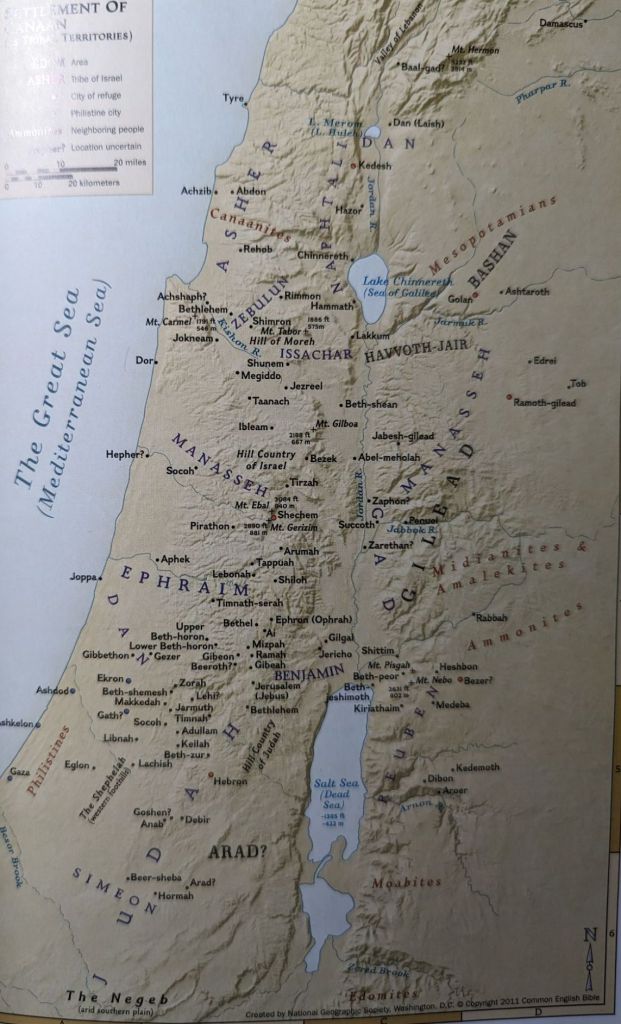
Today’s seven chapters close out the story about inheriting the Promised Land. It begins with a way to divide up the remaining land west of the Jordan. Lots are cast and land is allotted to the tribes of Benjamin, Simeon, Zebulun, Issachar, Asher, Nephtali, and Dan. Joshua also receives a legacy. Then, in chapters 20 and 21, the Levites are given cities and their surrounding pastureland. These 48 cities are spread out amongst the twelve tribes and they include the six refuge cities. God is preparing here for a day yet to come. God is good.

Now that the land legacies have been given and now that peace has come, Joshua summons the Reubenites, Gadites, and the half tribe of Manasseh. He thanks them for their faithful service and sends them home with a charge to be obedient and faithful to the Lord. At the Jordan these tribes build an altar as a witness to their belonging to the people of Israel west of the Jordan. It is a standing reminder.

Chapter 23 holds Joshua’s final words of warning. He first reminds the Israelites of all that God has done and then implores them to be faithful and obedient. Joshua warns them about mixing with the locals. They will be “a snare and a trap.” Joshua warns Israel that they will “vanish quickly” if they violate the covenant.

Chapter 24 closes Joshua’s story. He begins with a great review that takes Israel from Abram to this very moment. Joshua challenges Israel to decide “whom you will serve.” Joshua declares that he and his house will serve the Lord. So too will the people of Israel. May it be so for you and for me and for our households.

Prayer: Lord God, the story of another great leader and a meaningful period in Israel’s history comes to a close. Yet the choice at the end of Joshua remains our choice today. It’s a choice we make every day. So each day, O Lord our God, empower us to choose you. Amen.


Leave a comment

To God What Is God’s

Reading: Matthew 22:15-22

Verse 21: “Give back to Caesar what is Caesar’s, and to God what is God’s.”

In this week’s gospel lesson we see the Pharisees and Herodians trying to set a trap for Jesus. Part of me can’t but wonder how these schemes are devised. Is it late at night as they are trying to go to sleep in the temple dormitory? Is it after hearing about another amazing miracle that Jesus has done?

The plan is to try and trap him with a question about paying taxes to Caesar. This is a very heated subject amongst the Jews. The heavy taxes imposed by the Romans are very unpopular with most of the locals. Yet with Rome’s power and military presence, one has little choice. Speaking out against the taxes or refusing to pay them drew a harsh response from the Romans.

So these religious leaders send their underlings to ask Jesus this question: “Is it right to pay taxes to Caesar or not?” If Jesus says “yes,” then the religious zealots come after him. If he says “no,” then the Romans come after him. But instead of a yes/no answer, Jesus first asks for and then inspects a coin. He finds out that Caesar’s image is on the coin. He knows whose image is on the Pharisees, on the Herodians, on his audience, on the Romans – God’s image. The same is true for you and for me.

Jesus’ summary teaching is this: “Give back to Caesar what is Caesar’s, and to God what is God’s.” Caesar has a right to what is his. And so too does God. The question for us to ponder is this: If we are God’s, how do we give to God what is God’s?

Prayer: Lord God, I know that the things of this world belong to this world. They are temporary. While they do have their place here and now, help me to hold them lightly. I know too that I belong to you – me and all that I have and all that I am. Guide me to freely give to you all of me. Help me to be generous in all ways. Amen.


Leave a comment

The Fast You Choose?

Reading: Isaiah 58:1-5

Verse 2: “They seem eager to know my ways… seem eager for God to come near them.”

The title to Isaiah 58 is “True Fasting” in my NIV Bible. This chapter begins with God telling Isaiah, “Shout it aloud, do not hold back... Declare to my people their rebellion… their sins.” It is not a good day for Israel. We too have these days once in a while. In the next verse God observes, “They seem eager to know my ways… seem eager for God to come near them.” To me, “seem” is the important word here. Israel is kinda pursuing God, but not really.

Evaluating their fasting God declares, “Yet on the day of your fasting you do as you please.” It is not a time set apart to honor God and to draw close to God. It’s almost become the opposite. The Israelites “exploit all your workers” and they are “striking each other with wicked fists.” We too can fall into this trap. We can claim we’re ‘Christian’ or we can do something ‘religious’ and neither bring God glory nor draw closer to God ourselves. We can seem to be faithful when we are anything but.

In verses 4 God tells the people, “You cannot fast as you do today and expect to be heard on high.” The walking of the walk must be consistent and steady. Going on, God asks a rhetorical question: “Is that what you call a fast, a day acceptable to the Lord?” There is no good answer to this question. So we must ask: reflecting on our religious practices, when or why might God ask us the same question?

Prayer: Lord God, when I am tempted to play the game, to just show up in body, but not in mind, heart, and spirit, convict me quickly. Use the Holy Spirit to call my selfishness and sin out, to wake me up to my falsehood. Help me, O Lord, to be authentic to you in all of my ways. Amen.


Leave a comment

Faith Alone

Reading: Romans 4: 13-25

Verse 25: “He was delivered over to death for our sins and was raised to life for our justification”.

Photo credit: Mael Gramain

What does God expect or require of you? What did Jesus expect of his disciples and of those that would follow him? If we were to make a list to answer these questions, would the list be a collection of things to do or would it detail how to live our lives? Paul is answering these questions for the church in Rome in today’s passage.

The church in Rome was falling into the trap that Paul has been caught in for most of his life. Faith was a form of legalism – of checking boxes and staying within the lines defined by the Law. Faith was not a way of life. To help them understand this Paul goes back to Abraham, the father of Israel, the patriarch of all patriarchs in the Jewish faith. In our passage today Paul points out that God credited Abraham as righteous because of his faith in God. Abraham’s faith was demonstrated in his trust and obedience to God’s direction. The Law was not even in existence yet. Entering into this right relationship with God through faith alone made Abraham and his descendants heirs of God’s promises. For Paul, all who believe in Jesus fall into that line of descendants. Belief is what gets one in that line, not following any set of rules or lists that we can make up.

Paul defines belief in Jesus as the only action necessary to be “credited” as righteous – being right with God. He wants to be clear that righteousness does not come from following the Law or any other set of rules, but from faith in Jesus Christ. In verse 25 Paul reminds those in the church in Rome and all who follow Jesus why belief in him is essential: “He was delivered over to death for our sins and was raised to life for our justification”. In dying for our sins, Jesus removed the weight of the Law – that sacrifice for this sin, this sacrifice for that sin… – and he paid the price through his blood. A final sin sacrifice was offered by one for all. Through Jesus’ sacrifice we are made righteous before God. In being raised from the dead, Jesus defeated death, opening the way for us to receive eternal life. Both are gifts, given to us without price, without any requirement except believing that Jesus did this for each of us. These is no law or rules that we can follow to receive or earn these gifts. They come through faith alone. Thanks be to God.

Prayer: God, I am so grateful for these gifts of love – born to the cross and into the grave for me. You stood in my place and took the punishment for me. And you did not stop there. You walked out of the grave, breaking those chains too. Thank you for the gifts of love that make it possible to experience joyful and abundant life now and to enter eternal life one day through Jesus Christ, my Lord. Amen.


Leave a comment

Who and What?

Reading: Matthew 22: 15-22

Verse 20: “Whose portrait is this? And whose inscription”?

As the end of Jesus’ ministry draws to a close, the tension between Jesus and the religious leaders has escalated. Early in the final week of his life the Pharisees send some folks to test Jesus, to try and trap him. Even when they are flattering Jesus to soften him up, their words have truth in them. The words of these envoys belie their dilemma. Jesus is a man of integrity – so why are they trying to trap him? Jesus is one who teaches the truth – so why begin with words that are not believed by the ones that sent them? Jesus is not swayed by men – so why try to trap him with a political and religious question? Because Jesus is all of these things, to find or catch him sinning is not possible. So the religious leaders distress to trickery.

After calling out the hypocrisy, Jesus asks for a coin to use in his answer to their question: “Is it right to pay taxes to Caesar or not”? A “yes” would anger many Jews. They resent the Romans and their oppressive taxes. A “no” would be seen as treason by the Romans. Jesus chooses a better answer than a ‘yes’ or ‘no’. After receiving a denarius, he asks the questions, “Whose portrait is this? And whose inscription”? Before going on to hear Jesus’ answer to the original question (that is for Sunday), let us apply these questions to ourselves.

If our lives were held up for all to see and examine, what would be the answer to the question of whose image we bear? This question gets at the root or core of who we really are. When others look at us, do they see the image of Jesus Christ? Do they see one who has integrity, who speaks truth, who is not swayed by the things of the world? Or do they see one who is willing to be a little immoral at times, one who will occasionally bend the truth, one who sometimes does chase after the things of the world, or one who does all three?

Who and what we are matters. It matters to God and it matters to the witness that we have to the world. Who we are, and, more importantly, whose we are really are great things to consider. May our reflection today upon these questions lead us closer to living in the image of Jesus Christ, our Lord and Savior.

Prayer: Lord of all people and of all the earth, in each of my words, in each of my actions, in each of my thoughts, may I bring you the glory. May all that is selfish and prideful and sinful be laid aside in the pursuit of your son, Jesus Christ. Amen.