pastorjohnb

Thoughts and musings on faith and our mighty God!


Leave a comment

What We Needed

Reading: Exodus 16:13-15

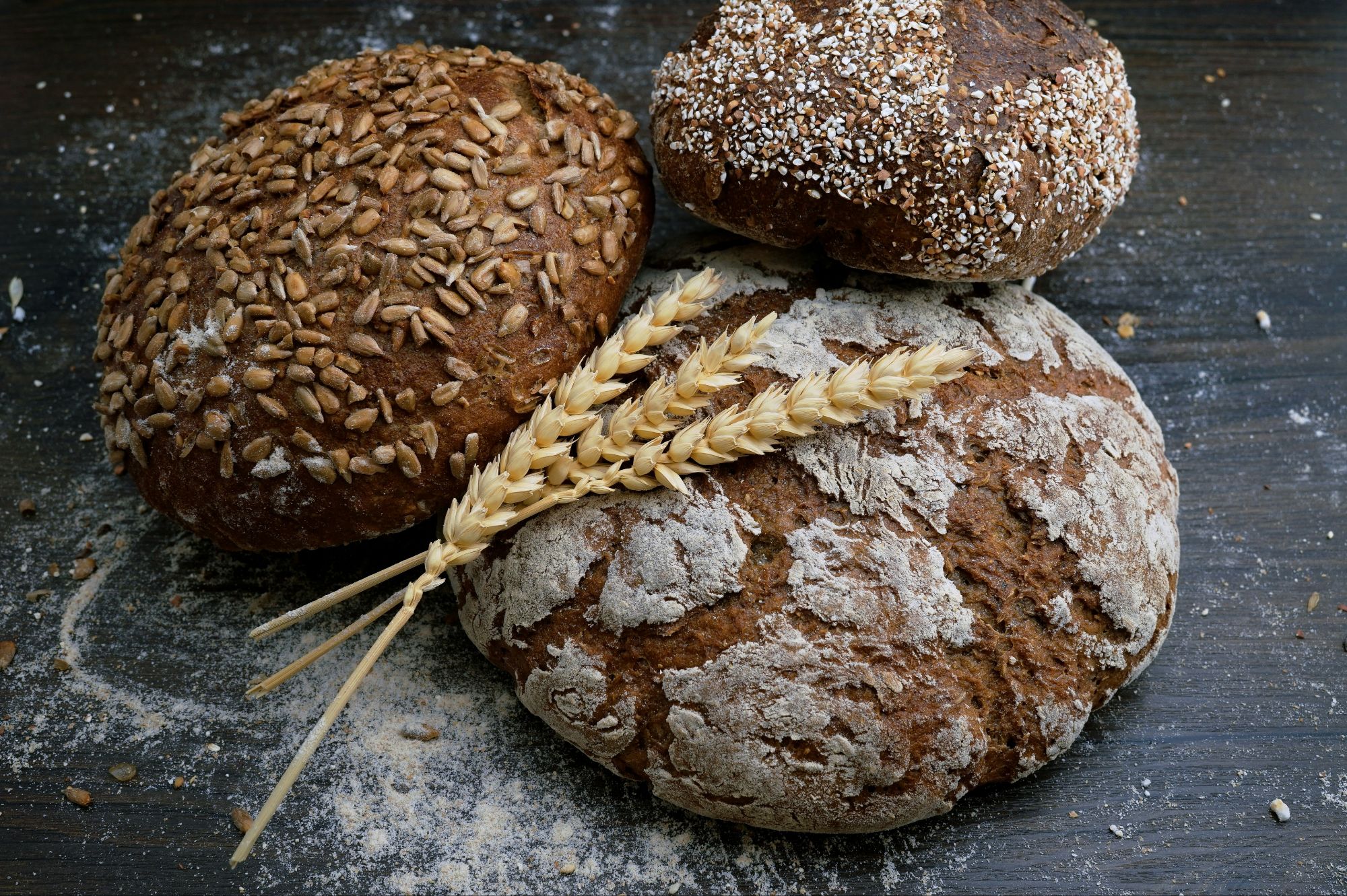
Exodus 16:15 – “This is the bread that the Lord has given you to eat.”

Photo credit: Kate Remmer

The things that God and Moses and Aaron have been talking about for our first two days of reading in Exodus 16 finally happen. In the evening, quail covers the camp. They can gather as much meat as they desire. God provides in abundance. But in the morning there is a layer of dew all around the camp. I imagine this looking like a very, very low-hanging layer of thick fog. It is enough to hide the “thin flakes” lying on the desert floor. The quail they recognized. There were quail in Egypt. But this flaky stuff? They ask one another, “What is it?”

The Israelites felt a need for food. They turned to their intermediary with their complaint. God also heard their grumbling too. Most of the time, we do not feel like we need a “Moses” to bring our prayers to God. We bring our prayers and our complaints, cries, and pleas directly to God. Sometimes we pray in community, trusting others to also lift our prayers to God. And sometimes we do want someone to pray for us on our behalf. But overall, we are good at bringing our prayers and petitions to the Lord our God.

But like the Israelites, we are not always good at seeing God’s answers to our prayers. Yes, they’d even been told that God would give bread in the morning. Moses still had to tell them, “This is the bread that the Lord has given you to eat.” While most of the promises to us in scripture are not this specific, we are told that God hears and responds to our prayers. But when the “bread” doesn’t look like what we’re used to or when it is not what we expected, we can misunderstand the answer or we can be disappointed in it. Sometimes we miss the answer altogether. And yet, God is faithful. When we too choose to remain faithful, we can consistently look back and we can see that God’s response was exactly what we needed in that moment. For these truths, we say, thanks be to God!

Prayer: Lord God, we are so willing to lay our wants and needs before you. Help us to be just as willing to see how you provide and to trust in your wisdom and plan. Guide us to seek your will and way just as eagerly as we await your answers to our prayers. Amen.


Leave a comment

Faithful Provider

Reading: Exodus 16:2-5

Exodus 16:2 – “The whole Israelite community complained against Moses and Aaron.”

As we begin a few days in Exodus 16 we join the Israelites in the desert or wilderness, depending on your translation. They haven’t been gone very long – just long enough to run out of the food they took with them as they hurried out of Egypt. Because of this, “The whole Israelite community complained against Moses and Aaron.” Finding themselves in an uncomfortable position, a mix of fear and anger and longing rises up. They look back at their time in slavery and wish that they were still there. At least there was meat and bread aplenty. They wonder if Moses brought them into the wilderness to “starve to death.”

We too will find ourselves in desert places or in the wilderness of life at times. This is never an easy place to be and it is seldom a place of our own choosing. Unwanted change or loss or death or illness creates these experiences. We feel out of control. We feel unease, discomfort, disorientation. We often cry out, complain , grumble, and/or question God.

In our text, God hears Israel’s complaint. God will rain down what they longed for and remembered from their time in slavery: meat and bread. Each day, God will provide what they need for that day. Day by day, Israel’s trust in God will grow. In the same way, God hears our cries, our grumbles, our questioning. And because God is faithful, God provides what we need. God usually does not yank us out of our desert places, but becomes present to us in these places. It might be through meat and bread brought by a friend or neighbor. It might be through the comforting presence of our faith community. It might just be the strength to get through one more day. When we turn to God, yes, God is faithful. God will provide.

Prayer: Lord God, you are always with us. We always need you – especially in our desert or wilderness moments. Thank you for your faithful provision in our times of need. Continue to work through these experiences, building us up, growing our faith. Amen.


Leave a comment

The Blood of the Lamb

Reading: Exodus 12:11-14

Exodus 12:13 – “The blood will be your sign… Whenever I see the blood, I’ll pass over you.”

We move deeper into the Passover story today. The lamb has been selected, watched over, slain, and roasted. Some of its blood has been placed on the door frames of their houses. The table is set. Beginning in verse 11, instructions are given for how to eat the meal. Equal parts anticipation and readiness, the Israelites are to eat the meal ready to go – sandals on, walking stick in hand. God then tells the Israelites what will happen: “I’ll pass through the land… I’ll strike down every oldest child… both humans and animals.” Knowing this, there must have been great fear and angst in their homes that night. To know that widespread death was occurring just outside your home would’ve been very unnerving. And to know that you and your family were saved by the blood of the lamb – amazing.

God reassures Israel, saying, “The blood will be your sign… Whenever I see the blood, I’ll pass over you.” Death will not visit their homes, families, or livestock. They have been marked by the blood of the lamb. This great act of salvation will be remembered “for all time.” Every year, Passover is celebrated. One of those years, thousands of years after this first one, Jesus and his disciples sat at a table in an upper room, celebrating Passover. Present were the lamb and bitter herbs, the bread and the cup. At this final Passover for Jesus, new instructions were given. His disciples are to remember this gift every time we take the bread and cup. Through the blood of the lamb, through Jesus’ sacrificial death, we are to remember that we are freed from the power of sin and death. The plagues of our day are power, greed, and selfishness. Jesus frees us from all of these, empowering us to live as people of love, grace, welcome, forgiveness, belonging, and community. Through our daily living, we carry the mark of Jesus. Because we bear the mark of Christ, we are saved daily from our sin and we will be saved one day into eternal life. For these acts of salvation, we say, thanks be to God!

Prayer: Lord God, thank you for marking us with the blood of the lamb. Accepting Jesus as Lord and Savior, we become a part of your family. The blood that protects also washes us clean, again and again. And through Jesus’ new, risen life we are shown the way to eternal life. Thank you for making us yours and for keeping us yours. Amen.


Leave a comment

Faith and Persistence

Reading: Matthew 15:21-28

Matthew 15:25 – “But she knelt before him and said, ‘Lord, help me.'”

Photo credit: Ben White

After clashing with the religious leaders, as our passage continues in Matthew 15, Jesus travels to the region of Tyre and Sidon. This is in Phoenicia, along the coast of the Mediterranean Sea. Jesus is west of Mount Hermon, a site in Psalm 133. Given the way Jesus initially interacts with the woman, perhaps this trip was intended for some time set apart. But even outside of Israel, Jesus’ reputation proceeds him.

A Canaanite woman from this area shouts out to the “Son of David,” seeking mercy. Her daughter is possessed by a demon. The title she uses for Jesus is a traditional Jewish confession of faith. Jesus is silent. She persists. The disciples want Jesus to address her – so that he can send her away. Maybe directed to the disciples, but certainly loud enough for the woman to hear, Jesus declares that he was sent “only to the lost sheep” – to Israel. Remaining persistent, she kneels right in front of Jesus. From this position of humility, she pleads, “Lord, help me.”

Insulting and/or testing her faith and persistence, Jesus says, “It is not good to take the children’s bread and toss it to the dogs.” Acknowledging the insult – “Yes, Lord” – she persists: “But even the dogs eat the crumbs that fall from their master’s table.” She acknowledges Jesus as “master,” as her Lord. Because of her great faith and persistence, Jesus is moved and he heals her daughter from afar. May we have such great faith and may we be so persistent with our trust in our Lord and Savior, Jesus Christ.

Prayer: Lord God, you alone are Lord. You alone have the power to meet all of our needs. To you alone may we turn. To you alone may we look to be our all in all. Amen.


Leave a comment

Rooted in Belief

Reading: John 6:25-35

John 6:29 – “Jesus replied, ‘This is what God requires, that you believe in him who God sent.'”

Photo credit: Marek Piwnicki

In today’s gospel reading Jesus redirects the peoples’ focus. The day before, this crowd had been part of the miracle known as “the feeding of the 5,000.” They have followed the disciples to Capernaum, hoping to find Jesus there, hoping for more bread. He quickly points out that they missed the work of the divine within the feeding miracle. All they “saw” was the food. Jesus tells them to quit working for that temporal “food” and instead to seek “the food that endures for eternal life.”

We too need to hear these words of Jesus because we often strive after temporal things. Even in our lives of faith, our striving can become like checking boxes. Yup, went to church on Sunday. Read my Bible this week. Check. Prayed for my neighbor in need. Check that one too! Hearing the call to the eternal, the crowd asks Jesus what we can ask: “What must we do?” Jesus’ response is a redirect. It’s not about doing at all. Jesus says to the crowd and to us: “This is what God requires, that you believe in him who God sent.” Faith starts with belief in Jesus and it grows from this foundational place.

Even though Jesus’ direction seems clear to us, the crowd again asks, “What sign will you do…” A million miracles in themselves will not lead to faith. The choice for faith, again, begins with belief in Jesus as the one who is “the bread of life,” the one who satisfies our eternal hungers and thirsts. In time, yes, faith through belief will lead to experiencing God’s power and presence in ways that feel miraculous and will lead to service in the kingdom of God. But faith must always be rooted in our belief in Jesus Christ as our Lord and Savior. May it be so for you and for me.

Prayer: Lord God, we can do easily get caught up in striving after things, in checking boxes to assure ourselves of our progress. Help us to understand that it is not in the doing that “things” happen. Instead, lead us to trust that you alone are the one “doing” the work, even when we are serving you and others. Grounded in our belief in you alone, may our faith in you witness to your powerful presence in our lives and in the world. Amen.


Leave a comment

What We Need

Reading: Matthew 7:7-11

Matthew 7:7 – “Ask, and you will receive. Search, and you will find. Knock, and the door will be opened to you.”

Today’s teaching on prayer comes in the middle of “The Sermon on the Mount,” a collection of Jesus’ core teachings found in Matthew 5-7. It is the largest block of Jesus’ teachings in the gospels. John Wesley, the founder of Methodism, called these words “the sum of all true religion.” Gandhi, a non-Christian, read the sermon every morning.

Jesus begins this section on prayer with these words: “Ask, and you will receive. Search, and you will find. Knock, and the door will be opened to you.” These words fall within the context of the larger sermon. Plucked out of this context, they can make God feel like a genie in a bottle – except with unlimited wishes. All of the sermon points towards how to love God and neighbor as God intends us to. The idea of asking, searching, and knocking fall within and are aligned with God’s intent for our lives.

This becomes clear as we read on. Addressing daily provision as his example, Jesus muses upon what a father would give a child who asks for bread or for a fish. These are basic staples of their diet. Recall the feeding of the 4,000 or the 5,000. What did the boy have in his lunch sack? Continuing, Jesus points out that no good earthly father would instead give their child a stone or a snake. Extending this idea, Jesus adds, “how much more will your heavenly Father give good things to those who ask him.” Yes, our good God will provide for our daily needs when we ask, search, and knock.

Prayer: Lord God, thank you being a good, good father. Thank you for watching over us and for providing what we need. And thank you for not spoiling us or granting our every whim. We know how that turns out. We, in turn, are called to love you and to love others through the same good and generous practices that you model. Lead us to care well for the needs of others as we are able. Amen.


Leave a comment

Here and Now

Readings: Luke 17:20-21 and 22:14-20

Luke 17:21 – “Don’t you see it? God’s kingdom is already among you.”

In Luke 17 some Pharisees ask Jesus when God’s kingdom is coming. Maybe they hope Jesus will turn into the kind of Messiah they’re looking for: strong, powerful, able to defeat the Romans. Or maybe they hope that since Jesus claims to be the “Son of Man,” then he’ll be able to tell their when their Messiah will come. Inviting these religious leaders into the present reality, Jesus says, “Don’t you see it? God’s kingdom is already among you.” Open your eyes and hearts, it is here and now.

This can be a question Christians can ponder too. One can think that accepting Jesus will be a cure for all that ails us. One can think that life will only be blessed because we’re following Jesus. No, all of life still happens. Jesus will and does walk with us, bringing peace and hope in the storms, comfort and strength in the trials… In turn, we offer these to others. This is the kingdom of God at work here and now.

Almost a week later, Jesus gathers in Jerusalem with his disciples. It is Passover and they are gathered around the table. Jesus shares two interesting things with the disciples. First, he “earnestly desires” to share this meal with them. Second, he tells them, “I won’t eat it until it is fulfilled in God’s kingdom.” Little did they know, this would be the next day. Jesus then share the bread as his “body… given for you.” Then the cup is shared as the “new covenant… poured out for you.” After Jesus fulfills these words and their promise, completing this act of sacrifice, followers of Christ will remember this gift by celebrating Holy Communion. Each time, in that moment, God’s kingdom is here and now.

Prayer: Lord God, thank you for your presence with us and through us. When we experience or share your light and love, your grace and peace, your hope and strength, the kingdom of God manifests itself here and now. We are reminded of the depth of your light and love… in the sacrifice you made on the cross. When we remember this act, we are made new again, here and now. Thank you for this gift. Amen.


Leave a comment

An Invitation to All

Readings: Mark 14:22-24 and Luke 22:19-21

Mark 14:24 – “This is my blood of the covenant, which is poured out for many.”

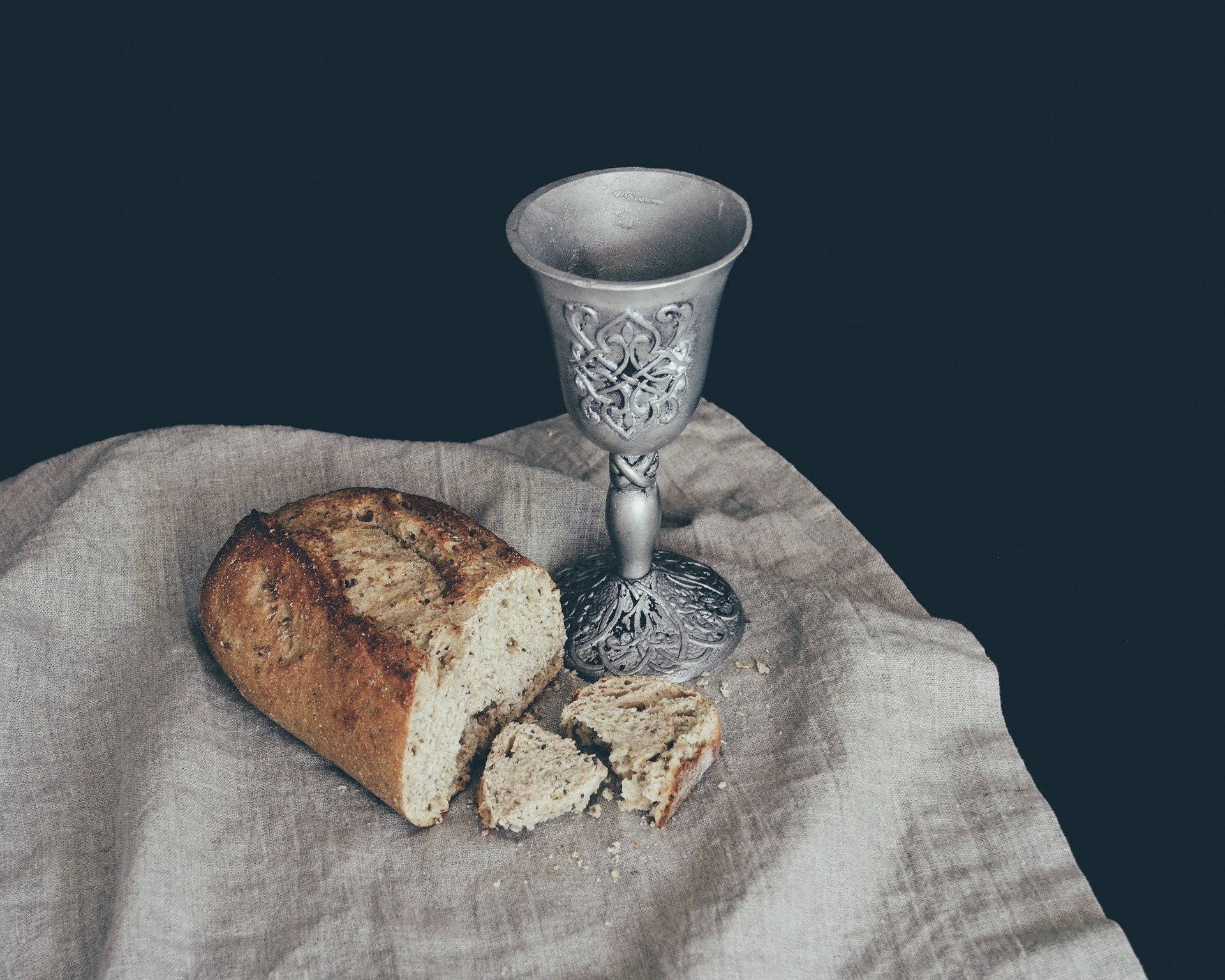
In both passages that we read today, we see Jesus instituting the sacrament of communion. This event is set within the context of the Passover meal. This meal was an annual event in which the Jews would remember and celebrate how God saved them as the angel of death passed over their houses. This final plague led to Pharaoh releasing Israel from bondage and slavery.

Mark and Luke both present Jesus offering the bread as symbolic of his body, broken for them and for us. Jesus’ body will be broken on the cross. In using the common element amongst the rich and the poor and all in between, Jesus takes the everyday and connects bread to himself and to us all.

Both gospels present the cup – representative of Jesus’ blood – as poured out for many, establishing the “new covenant.” Mark recalls these words of Jesus: “This is my blood of the covenant, which is poured out for many.” The new covenant is wrapped in mercy and grace, in forgiveness of sins. This common element of wine – again Jesus connecting the ordinary to his extraordinary gift.

In Mark’s gospel they sing a few songs and head to the Mount of Olives. But in Luke’s gospel, Jesus says, “But look! My betrayer is with me; his hand is on this table.” Jesus celebrates the first communion knowing that Judas will betray him. This is an invitation to us all – sinners each of us – to come to the table of grace. There we too will find welcome and forgiveness. Thanks be to God.

Prayer: Lord God, we humbly thank you for the gift of grace. Your Son did for us what we could not and cannot do for ourselves. It is only because of and through Jesus’ sacrifice that we are forgiven and made new, freed from the bonds of sin and death. Thank you, thank you, thank you. Amen.


Leave a comment

The Great Commands

Reading: Matthew 22:34-40 and 7:9-12

Matthew 7:12 – “Treat people in the same way that you want people to treat you.”

Photo credit: Shane

In Matthew 22 the Pharisees get together and decide to test or trap Jesus. Their religious rivals, the Sadducees, have just been left speechless after their attempt to trap Jesus in his words. The Pharisees send one forward to test Jesus with a question: What’s the greatest commandment? The Law has 613 (or 623) commands. Which is the most important one Jesus?

Quoting from the Law, Jesus identifies the Deuteronomy law to love God with all that you are. He quickly adds one from Leviticus: “love your neighbor as you love yourself.” For a devout Jew these are the two core commands. These two verses form the heart of a prayer offered each and every day, both morning and night. While the concept of loving God and neighbor is easy to understand, the actual execution of these commands can be very hard. To date, I believe that Jesus is the only one with a 100% success rate.

Jesus offers some practical application tips in chapter 7, verses 9-12. Here he uses parenting as the analogy. If your child asks for bread or fish because they are hungry, who would give them a rock or a snake instead? Well, no good parent would. Jesus then reminds us that the one who loves us as children will do the same and even more. He then generalizes this teaching on loving well to others, adding, “Treat people in the same way that you want people to treat you.” Give that person in need not just bread but some water too. Give that stranger not just a fish but a place to stay too. Just as the Lord our God is good and loving and generous, Jesus says, you do the same.

Prayer: Lord God, the call is clear: love well, love deeply, love genuinely. You have modeled this and your son Jesus modeled it. We have no excuses. We can’t play dumb. Yet we sure can struggle to love you with all that we are and to love others as we love ourselves. Lord, encourage and empower us today to love as you call us to love. When we waver, strengthen us by the power of your Holy Spirit. Thank you, God. Amen.


Leave a comment

The Spirit Gives Life

Reading: John 6:22-7:10

John 6:51 – “Whoever eats this bread will live forever, and the bread that I will give for the life of this world is my flesh.”

After feeding the 5,000, the crowd realizes that Jesus is “missing.” They follow the disciples by boat to Capernaum and find Jesus already there. They ask how he got there. Ignoring their question he implies they are looking for more bread. Jesus encourages them to work for “food that endures for eternal life” – the food that he will give. The crowd wants to know what to do to receive this bread. Just believe in the one sent by God. The crowd, though, wants a sign, something like the manna. Their hearts and minds are stuck in the concrete and tangible. Jesus tries to get them to understand the spiritual.

Jesus first reminds them that it was not Moses who gave the manna. He says that in the same way God has once again sent bread from heaven. The crowd desires this bread. To them Jesus says, “I am the bread of life.” Eat and never be hungry. Believe and have eternal life. Their ancestors are manna and died. Eat from Jesus and never die. He declares, “Whoever eats this bread will live forever, and the bread that I will give for the life of this world is my flesh.”

The crowd is lost. How can one literally eat his flesh and drink his blood? Jesus says this is necessary to remain in him and for him to remain in them. They are stuck in the literal. They grumble. This is a hard teaching. Jesus reminds them that the Spirit gives true life. He’s inviting them to think spiritually. The flesh cannot do this. God must enable people to believe in and to receive Jesus. Many cannot hear what Jesus is saying. Many turn away and no longer follow him.

Jesus asks the 12 if they want to leave too. Peter asks, “Where would we go?” Peter declares that Jesus holds the words of eternal life and is the one sent by God. The 12 believe. Jesus’ brothers struggle. They want him to go to Judea, to “show yourself to the world.” Jesus tells this his time has not come yet. Or has it come?…

Prayer: Lord God, sometimes we too get stuck, get hung up on something, fail to understand. Here we too can struggle with belief. In these moments, Lord, may the Holy Spirit lead and guide us, opening our hearts and minds to your will, your way, your plan, your purposes. You are truly the word of life. Thank you. Amen.