pastorjohnb

Thoughts and musings on faith and our mighty God!


Leave a comment

Forever… and Daily

Reading: Psalm 90:1-6

Psalm 90:2 – “Before the mountains were born, before you gave birth to the earth and the world, from beginning to end, you are God.”

The first part of our Psalm for this week celebrates God’s eternal nature. Enfolded within God’s eternity is our human existence. The psalmist rejoiced in this reality in verse 1, where Moses writes, “Lord, through all generations you have been our home!” Since Adam and Eve first walked the earth, God has sought us out for relationship and connection. While not everyone chooses to step into this relationship, God’s eternal love seeks to draw all people into a relationship. It is through this relationship that God becomes our “home,” our place of refuge, peace, belonging.

Reflecting deeper on God’s forever nature, Moses writes, “Before the mountains were born, before you gave birth to the earth and the world, from beginning to end, you are God.” Before the creation story began to unfold, God was. And now God is. And God will always be. God is eternal! As we turn to verses 3-6, though, we’re reminded that we are not. At some point, we will all “return to dust.” Moses compares our lives to grass that springs up in the morning and withers by evening. To be reminded of our fragile, short-term existence draws us to God, the one for whom “a thousand years are as a passing day.” This God seeks to continue to walk in relationship with us once we are turned to dust, bringing each of us into eternity.

Moses knew a God who walked with him daily, leading and guiding his 120 years. We too know a God who desires to walk with us each of our days. May we lean into God each day, seeking to walk faithfully in this life. May it be so.

Prayer: Lord God, your love shaped and formed the earth and it shaped and formed each one of us. Within creation and within each of us, the spark of the divine is present. Your love continues to create, to refine, to make things new. Guide us each of our days, however many we are blessed with. Lead us to walk closely with you, O Love, during this life and into the next. Amen.

Leave a comment

Transitions

Reading: Deuteronomy 34:1-12

Deuteronomy 34:9 – “Now Joshua son of Nun was full of the spirit of wisdom, for Moses had laid his hands on him.”

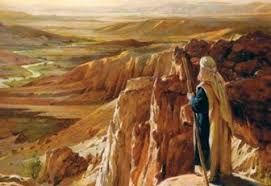
Moses has led the people of God to the very edge of the Promised Land. He has stood before Pharaoh and brought the plagues that led to release from slavery. He parted the sea, brought water from the rock, and was the conduit for the provision of manna and quail. Moses spoke often with God and taught the people all of what God instructed. Moses was a great leader. He was not without his faults, but “there never has been another prophet in Israel like Moses.” As Moses stands on Pisgah, overlooking the Promised Land, he is 120 years old yet still with clear eyesight and with good physical strength.

God has brought him to this place to show Moses the land – the land promised to Abraham, Isaac, and Jacob. The land that Moses has been leading the people towards for 40 years. The people are different physically and spiritually. Besides Moses, Joshua and Caleb are the sole survivors of the exodus from Egypt. God and Moses have shaped the people to be the people of God during 40 years in the wilderness. But the time has come for new leadership. Moses dies in Moab and is buried there.

Joshua will lead the Israelites through the Jordan River and into the Promised Land. Moses has prepared him well for this transition. In verse 9 we read about the culmination of this preparation: “Now Joshua son of Nun was full of the spirit of wisdom, for Moses had laid his hands on him.” Moses has finished strong so that Joshua can begin strong. Moses has finished well, blessing Joshua and doing all that he could to ensure Joshua’s success as a leader. As we consider and walk through transitions and changes in our lives, how can we lead well and finish strong, especially in matters of faith?

Prayer: Lord God, we can struggle at times of letting go, of moving on, of change. Our humanity – our pride, our ego, our need to be in control – they can get in the way of your next thing. Open our eyes and hearts to your working in and amongst us. Help us to trust your plans and your goodness for our lives. Use us as you will. Amen.


Leave a comment

What if?

Reading: Psalm 8:5-9

Psalm 8:5 – “You’ve made them [humanity] only slightly less than divine, crowning them with glory and grandeur.”

Yesterday as we read the first verses of Psalm 8, we were reminded of humanity’s smallness relative to God’s power and majesty. This realization is humbling, maybe even sobering. Then, in verse 5 we read, “You’ve made them only slightly less than divine, crowning them with glory and grandeur.” Reading these words can shatter that humility. In our competitive world, nobody really likes to be #2. Our fleshy part can take the reality that God is indeed almighty and all-powerful and… then say to ourselves, ‘Well, no one can be like God, so it’s almost like we’re #1!’ From that perspective, we’ll be utter failures with the role God gives us in the next verses in Psalm 8.

David writes of one of God’s biggest expectations of humanity in verses 6-8. Created in God’s image, “slightly” less than God, we’ve been tasked to “rule over your [God’s] handiwork” – that which was “very good.” Other translations use words like ‘dominion’ and ‘in charge of.’ In newer translations we begin to read words like ‘steward’ and ‘care for.’ These words better reflect the “created in God’s image” part of our story.

A few years ago, the WWJD bracelets… drew our minds and hearts to make Jesus’ life and example more a part of our daily life and decisions and actions. Those little “What Would Jesus Do?” silicone bands… caused us to pause before speaking, acting, or doing. What if we wrapped our care of creation – both the natural world and all of humanity – in WWGD thinking? What if?

Prayer: Lord God, yes, what if we treated the world and one another as you do? What if we loved it all as you love it all? The earth would not cry out. People would not be oppressed nor suffer violence. Nations would not wage war and quarrel. What if we ruled over this world as you would, O God? It is a beautiful and glorious thought. So Lord, use us, your children, to live and be in the world as you call us to live and be in the world. Amen.


Leave a comment

Intended and Designed

Readings: Genesis 1:26-31 and 2:1-4

Genesis 1:27 – “God created humanity in God’s own image… male and female God created them.”

Continuing with the first creation story today, we move into God’s three-in-one nature. The words become “let us” and “in our image.” There is cooperation and conversation around this last step of creation in the first story. Like the sea, air, and land creatures, humanity is directed to “be fertile and multiply.” But God adds another role: to take charge of creation. This task must be done as if God we’re doing it. Created in God’s image, we are to care for this world with love, careful thought, and goodness.

After God created humanity, both female and male, in God’s image, God looked at all of creation, not just humanity, and “it was supremely good.” Now that all was as it should be, all parts and components just as God intended and designed them to be, creation was complete and all of it was supremely good. Work finished in “six days,” God rested. Yes, God rested. This too is part of what God intended and designed for all of creation.

Humanity is most like God the rest of the week when we rest and make holy one day out of seven. The Sabbath, our day of rest, is made holy by turning away from work and other cares of this world, instead focusing on our relationship with and connection to the Lord God. As we delve into worship, prayer, meditation, and actual, physical rest on our holy day, we are renewed and re-energized – ready to care for one another and the rest of creation as if God were caring for it. May it be so for you and for me.

Prayer: Lord God, help us to be better image-bearers. In the creation story we see you giving again and again, creating a world that was supremely good. Lord, lead us, guide us, direct us to be a part of your plan to return our world and all of creation to one that is supremely good once again. Amen.


Leave a comment

Whole Being Praise

Reading: Psalm 104:24-35

Psalm 104:33 – “I will sing to the Lord as long as I live; I will sing praises to my God while I’m still alive.”

Our reading from Psalm 104 begins in the created world. The psalmist praises God for this earth that is “full of your creations.” From the dirt to the sea, from the valleys to the sky, God created our earth. In all of the earth’s beauty and diversity – from desert to rainforest, from rugged mountains to endless plains – God “made them all so widely” and filled these spaces with life abundant and diverse. The earth and all that are in and on it are amazing, like our God.

The psalmist then turns to these creatures that inhabit the earth. These “countless creatures” are another example of God’s creative nature at work. And we are reminded of God’s care and provision for all of creation. God gives food and each is filled. God gives life and breath. But when God “hides,” creation is terrified. In the end, the breath of life leaves and each returns to dust.

Without naming it, the psalmist is also describing humanity. We are scientifically one race yet are very diverse and unique. Seven billion of us are the same in almost endless ways, yet none are exactly alike. We can see great beauty in the canvas of humanity. And we also depend on God for life and blessing, given to us until we too return to dust.

In verse 31 the psalmist begins to praise God. He or she rejoices in creation – in all of it. The psalmist recognizes God’s power still at work. And they declare, “I will sing to the Lord as long as I live; I will sing praises to my God while I’m still alive.” Lifting voice, may our whole being praise the Lord, creator and sustainer for all.

Prayer: Lord God, you remain present in creation and in us. Open our eyes to see you and your fingerprints – in the sunrise or sunset, in the infant and in the elder. Fill us with wonder and awe, praise and rejoicing. Use us to help those who don’t see and don’t have a relationship with you to recognize your presence in and through us and all of creation, drawing them closer to you. Amen.


Leave a comment

The Questions of Lent

Readings: Genesis 2:15-17 and Genesis 3:1-7

Genesis 3:1b – “Did God really say that you shouldn’t eat from any tree in the garden?”

Our passage today begins with God giving Adam a purpose: to farm and take care of the garden. In this place of great abundance, Adam is given all that he needs. Of all the abundance, he is denied just one thing: “the tree of the knowledge of good and evil.” This scene made me wonder, how many “one thing” moments have I had? I quickly run out of fingers as I recall times when I’ve had all I needed yet chased after or at least really longed for that one thing I didn’t have. Almost always this was from a place or greed or lust or insecurity… How about you? How many moments can you recall?

As we turn to chapter 3, the serpent enters the picture. Viewed as Satan since the time of the earliest Jewish writers, the evil one says to Eve, “Did God really say that you shouldn’t eat from any tree in the garden?” Satan begins by planting a seed of doubt. Can you hear the emphasis on the word “really?” The seed is watered with half-truths until it grows into desire. Eve takes and eats the fruit that looks beautiful and delicious. Adam partakes too. Eyes opened, they see as Satan saw them. They felt vulnerable and naked and ashamed and they try to cover all this up. This scene feels too familiar.

The season of Lent is about looking within and honestly assessing that which must die within us so that we can live for Christ instead of for self. What looks beautiful and delicious that brings ugliness and bitterness instead? What do I long for or lust after that will never truly satisfy? These are the questions of Lent. In turn, what honest questions do you need to ask yourself?

Prayer: Lord God, Adam and Eve’s story is my story. It is the story of humanity, of us all. There is always a part of us that desires that which harms us or lessens us or leaves us empty. When Satan whispers into our ears or hearts, remind us that you are all we need. Your love, your care, your provision – all we need and more. Strengthen and encourage us to trust in these truths. Turn us to your Spirit when temptation rises. Guide us to place our whole self in your hands. Amen.


Leave a comment

Our Brother, Jesus Christ

Reading: Hebrews 2:10-18

Hebrews 2:17 – “He has to be made like his brothers and sisters in every way.”

Today’s reading from Hebrews 2 speaks of how and why Jesus is our “great high priest.” The author begins by declaring that it was “appropriate” for Jesus to experience suffering. These experiences prepared him to be our “pioneer of salvation.” Suffering is a part of our lives. Because Jesus in the flesh experienced this too, we can be confident that Jesus in Spirit will be present to us during our times of suffering. This common experience is one way that we are brothers and sisters with Jesus.

In verse 11 the writer of Hebrews declares that both Jesus and all who seek to walk in his ways “all come from one source.” Using three quotes from the ancient scriptures, the author reminds the Hebrews and us that we are all born of the divine, that we are all made in the image of God. This is the second way that we are brothers and sisters with Christ.

Our brother, in order to set us free from the power of death, sacrificed himself so that we too could be resurrected to new life. This death was for our benefit. Without fear of death we didn’t have to chase after the things of this world. Freed from this we can pursue the things of God instead. This freedom allows us to focus on joyful and complete obedience to the will and way of God.

In verse 17 we read, “He has to be made like his brothers and sisters in every way.” Jesus chose to spend time up close and personal with humanity. His time with us fallible and imperfect creatures led to two things. First, it is what led Jesus to die for us too. He paid the atoning price for our sins, freeing us from the power that sin can hold over our lives. Second, it is what allows Jesus to be our “merciful and faithful high priest.” Being made like us, experiencing the temptation and suffering that we experience, it is what empowers Christ to intercede for us before God. And it is what draws our brother to us during our difficult times in this life. For the freedom from sin and death, for the presence and strength in times of need, we say, “Thank you, Jesus!”

Prayer: Lord God, thank you for taking on flesh to better understand, to better connect, to better be our advocate before God in heaven. You know our joys and sorrows, our griefs and elations, our sufferings and our victories. You were made like us so that we could become more like you. Thank you. Amen.


Leave a comment

A Charge to Keep

Reading: Psalm 98:4-9

Psalm 98:9a – “He is coming to establish justice on earth!”

Continuing in Psalm 98 today, the new song kicks off. All the earth shouts triumphantly to the Lord. Humanity adds lyre, trumpet, and horn to their voices. The seas roar and humanity echoes. The mountains rejoice as the rivers clap along. There is a great rejoicing when all of creation joins together to praise God. Reading these five verses, one can sense the connection that God designed between humanity and the created world. If you’ve walked quietly in the woods or sat alone on the beach or looked peacefully out from the mountaintop, you’ve likely sensed this connection between self, creation, and God. In these moments, it is as God intended it to be.

Humanity has not always gotten this intention “right.” Often we tilt the relationship in our favor, exploiting creation and even one another for our own benefit. Even though we have gotten “better,” too often we fail to treat all of creation as an intimately connected part of who we are. God recognizes this. In verse 9 the psalmist declares, “He is coming to establish justice on earth!” Since the writing of this Psalm, the verb tense has changed. Jesus has come to establish justice. He walked among us, teaching humanity about living justly with one another and with creation.

Jesus’ dual purposes – to live amongst us to teach us how to love and to die for us to free us from the power of sin and death – these meant that he could not be here forever. So he left the task of establishing justice to his disciples. Eventually this charge fell to you and me. As I look at the world, it is far from a just place for all people and for all of creation. There is much work to do. The work must begin where we are – feeding the hungry family next door, comforting the grieving elder down the street, standing with the abused spouse and children who need protection, fighting for the just treatment of the vulnerable in our communities… A charge we have to keep. May it be so until all have justice.

Prayer: Lord God, one of us cannot fix all of the injustice in the world – or even in our smallest of communities. But together… Together with you, we are powerful and mighty. Lord, walk with us, using us to bring justice to creation and to one another. Amen.


Leave a comment

Take Hold of True Life

Reading: 1st Timothy 6:17-19

1st Timothy 6:17-18 – “Tell people who are rich… to do good, to be rich in the good things they do, to be generous, and to share with others.”

Photo credit: Shane

Continuing in 1st Timothy 6 today, Paul instructs Timothy on how to minister to those Christians who do have wealth, power, status… There were and are people that God has blessed with gifts and talents and legacies that has and have allowed them to be rich in the things of this world. Paul first addresses the dangers of this place in life. One can easily become prideful and arrogant. This often leads to isolating oneself from those who are seen as “less than.” From this place of heart and mind one can place their hope in their worldly riches instead of in God. Some falsely think, “Who needs God when I have all of this?”

Paul’s instruction to Timothy is this: “Tell people who are rich… to do good, to be rich in the good things they do, to be generous, and to share with others.” To do good and to be rich in good works is to engage the world around you. This counters the choices to isolate and to look down on those without wealth, power, status… To do good for others draws us into relationship and here we find our commonality, which leads to unity. To be generous and to share what we have lifts up those without and it grows one’s compassion and empathy, deepening one’s desire to practice generosity. To do good and to be generous draws us closer to God and to one another.

In verse 19 Paul states that these actions lay a “good foundation for the future.” This foundation is an ever-growing compassion and love for neighbor and a continual growth in one’s relationship with God. Living out our faith in these ways allows us to “take hold of what is truly life.” This is loving God and neighbor with all that we have and are. May it be so for you and for me.

Prayer: Lord God, lead us to be people of love and compassion. Guide us to people and places that need to experience these things. Open our hearts and hands to serve you through serving those in need. In these ways, use us to draw others closer to you. Amen.


Leave a comment

Love – Boldly and Completely

Reading: James 2:1-4

James 2:1 – “My brothers and sisters, when you show favoritism you deny the faithfulness of our Lord Jesus Christ.”

Photo credit: Shane

The letter of James focuses on Christian identity – what it means and looks like to live as a believer as a pilgrim in a foreign land. Christians were a very small minority, whether amongst the Jews in Israel or amongst the pagans in the Roman world. The pressures and challenges of living faithfully in these settings were great. The need for close community, unity within that community, and love amongst the brothers and sisters of Christ were all essential for James and for the churches that he wrote to.

For James, Jesus was the model of faithful living. Jesus set the example of love and he redefined who was welcome in the family of God. As we turn to chapter 2, we do so with these things in mind. In verse 1 James writes, “My brothers and sisters, when you show favoritism you deny the faithfulness of our Lord Jesus Christ.” These first few words remind the believers (and us) of their deep familial connections to Jesus and to one another. This impacts how one treats and acts towards others. James continues, condemning the practice of showing favoritism. This practice is counter to Jesus’ example, therefore it is counter to being a part of the family of God and to being a part of a church community.

Treating one who is well off differently than the one who is poor is simply not what Jesus modeled. To give the one in fine clothes a preferential seat while yelling the poor person to go stand far off or to sit at other’s feet – that is becoming an “evil minded judge.” It is allowing stereotypes and prejudices to impact how we practice loving our neighbor. It is wrong in every way. It denies the image of God in the other and in ourselves. All are beloved of God. All are worthy of our love. In thought, word, and action, may we love boldly and completely.

Prayer: Lord God, it can be tempting to show preferential treatment to one person or group. Our humanity is quick to evaluate potential gain and to evaluate potential cost. In the times when we are tempted, remind us of your love for all people, especially for the least of these. With this Holy Spirit reminder, guide us to act faithfully in the way of love. Amen.