Verse 4: “The Lord takes delight in God’s people; God crowns the humble with victory.”
Like many of the Psalms, 149 calls us to praise the Lord. God is so good to us in so many ways. Praise is a natural response to these blessings. The psalmist invites us to “sing a new song.” This reflects the beliefs that God is present and that God blesses us each day – therefore we have something new to sing about every day!
We are encouraged to rejoice and be glad in our God and king. We are invited to praise God with dancing and with music. There is a joy in today’s Psalm that beckons us into a place of joy too. The joy is not just ours, though. We are reminded that God delights in us, that we bring God joy. In response, God desires to crown the humble with salvation. Humility is a necessary part of truly praising God with all that we are. Without humility we reserve part of the praise for ourselves.
Today’s invitation to joy and to praise and to offer our thanksgiving to God is also an invitation to revisit yesterday’s focus on the personal times that God has drawn near and has touched our lives. These are occasions for song and praise and rejoicing. Today let us sing a new song of praise to the Lord!
Prayer: Lord God, beautiful singing might not be my gift, yet my prayer can be a song to you. In joy and praise and thanks I lift my voice to you, O maker of heaven and earth, O giver of all good things. Thank you for the many ways that you touch my life and encourage my faith. Amen.
Verse 14: “For the generations to come you shall celebrate it as a festival to the Lord — a lasting ordinance.”
a handful of many…
This week’s Old Testament reading is one of the core stories of the Jewish faith. The Passover is an event celebrated and remembered each year – much like Easter and Christmas for the Christian church. As we would not ever make a decision to skip one of these key events of the Christian faith, so too are the Israelites committed to this “lasting ordinance” of God. Ever since the day that the Lord passed over their homes, sparing the firstborn from death, the Jewish people have celebrated and remembered this event, this act of God.
To mark, to remember, to celebrate – these are part of our faith story. Whether Passover or Christmas or Easter or holy communion, people of faith are strengthened and encouraged when we remember what the Lord has done for us. While these are corporate remembrances, I believe that it is at least as important for us to personally remember the stories of what God has done for us.
For me there’s that time in the Promise Keeper’s prayer room, that time in the church balcony, that time on that mission trip… These are some of the key moments in my life when God drew near, when God acted in my life. What are your moments, your encounters?
Prayer: Lord, help us to remember the core events of our faith journeys and to regularly celebrate these divine encounters. By remembering we are strengthened and built up in our faith and in our relationship with you. By offering our thanks to you, we are humbly bowing before you in praise and adoration. To God be the glory! Amen.
Verse 2: “Sing to God, sing praise to the Lord; tell of all God’s wonderful acts.”
Today’s Psalm encourages us to praise God for all that God has done. The psalmist invites us to sing our thanksgiving to God as we recall the wonders, the miracles, and the judgments. While it is easiest to praise God for the wonders and miracles, it is also good to remember and offer praise for the judgments. In the lives of God’s people and in our lives these hard but necessary moments kept us aligned with or brought us back into living out God’s will and ways.
The Psalm recalls some of the important times when God acted on behalf of the people. These are certainly reasons to praise the Lord. Today, let us also recall our more recent but ancestral experiences that are worthy of praise. Begin with your family and your church(es). When was God faithful? When did God provide a way? How did God intervene on behalf of your church or family? Praise God!
And then take a step closer to home. Think about your own journey of faith to this point. What encounters with God come to mind? When did God draw near to lead or guide or provide? How has God redirected your path or choices? How has God’s presence brought you comfort or peace or grace or redemption? Praise God!
Pause and offer words of thanksgiving – in song or prayer – for all that the Lord has done. Yes, God is good!
Prayer: Lord God, pausing and reflecting I can see how you’ve led and guided in so many ways – both in the story of your people and in the lives of my family and churches. Thank you! And as I stop and look within my journey I can see your fingerprints there too. Again, thank you! Amen.
Verse 19c: “Let this people turn to you, but you must not turn to them.”
Chapter 15 begins as a dual lament. God laments the disobedience and hard hearts of the people. Jeremiah laments where he finds himself – cursed and rejected, abused and alone. This leads him to wonder if God even cares. Our passage today begins with Jeremiah asking for God’s care – via revenge on his enemies. That’s a snapshot into his current emotional state. He laments how taking in and proclaiming God’s word has led him to being an outcast. He asks God why his pain – both physical and emotional – is unending. And then he questions God’s reliability, equating God to “a spring that fails.” His pity party has him spiraling deeper and deeper.
God takes no offense. God understands how hard it is to speak truth to a people bent on evil. God understands how frustrating it is to offer true and abundant life to a people refusing these gifts to chase after the things of this world. God understands because God has been here before and because God is once again torn up about the people’s choices. In grace, God invites Jeremiah back to the task, back to right relationship, back to speaking “worthy” words, back to holy living. This is a great challenge to Jeremiah, to live in the world but not of it. We too wrestle with this challenge.
Much of life is spent living in the world. We too are called to a holy life. God promises to be with us too, to “rescue and save you.” In those moments of doubt and questioning, may we recall these words of truth: “Let this people turn to you, but you must not turn to them.” We know the words of life. We know God is with us. May we ever stand upon these truths.
Prayer: Lord God, when the steps are hard, whisper your words of love. When the temptation to lessen who I am to fit in or to avoid conflict arises, whisper your truths. Strengthen and encourage me for all that living in this world brings. Amen.
Verse 12: “Be joyful in hope, patient in affliction, faithful in prayer.”
Romans 12 begins with a call to be “living sacrifices.” This term and the words that Paul uses to flesh it out bring to mind Christ’s example and his instructions on loving one another well. In today’s passage we receive some specific and direct examples on how to love one another well. As was the case in verses 1-8, so is the case in verses 9-21: these ways of living are possible only through the power and grace of God.
Paul’s primary audience here is the church. This letter is written to the believers in Corinth, addressing some of the issues they’re facing. It is in the Bible because it has application for all believers. Most make perfect sense: “cling to what is good… honor one another above yourselves… share with those in need…” Some are a little harder: “keep your spiritual fervor… mourn with those who mourn… do not be proud… live at peace with everyone.” And then there are a few, to be honest, that make us pause: “bless those who persecute you… do not repay anyone evil for evil… do not take revenge…” All of these are interwoven and mixed together – just like in life. I think that’s because “easier” ones like “share with those in need” become a whole lot harder right after they’ve abused or persecuted you.
Today the key verse that stood out to me was verse 12: “Be joyful in hope, patient in affliction, faithful in prayer.” These three call us to God and to relying on God’s power and grace. Practically speaking, I think we need to work these backwards. Pray, pray, and pray some more. In difficult times, allow prayer to build your patience. Practice patience again and again. Then, through these two practices, we can be joyful in hope. May it be so for you and for me.
Prayer: Lord God, Paul tosses us quite the list. Even on a good day some can be quite challenging. Yet we are not called to this faithful way of living and loving just on good days. It has to be a 24/7 lifestyle. Lord, we need you. Pour out your power and grace over and over, filling us up again and again so that we can live daily as faithful examples in this world. Amen.
Having gone to the place that one expects to meet God, Moses does just that. Having been drawn to the burning bush so that he can receive God’s word, Moses is tasked with a mission. His first response is too often ours: “Who am I that I should go to __?” In those times when it feels like God is asking much of me, I am a regular asker of this question. How about you?
God promises Moses that God will be with him. Notice that God does not assure, lift up, or coddle Moses. If God has selected him, that means that God has equipped him. The same is true for you and for me. Moses is worried about whether or not the Israelites will accept his leadership. So he wants to go with some authority. He wants a name to drop when they ask who sent him. God tells Moses to tell the people that “I AM who I AM” has sent him.
This is the perfect name for God. It says that God is here right now. This name of God can also be translated as “I am what I am” – God’s past will be both now and future. God is steadfast and can be trusted. And this name can also be translated “I will be what I will be” – the future. God is the God of the past, the present, and the future. This God who was and is and always will be is a God that Moses and the Israelites can trust. The eternal God has heard their cry and is responding. This same God will hear our prayer and will respond. In this God, may we trust.
Prayer: Lord God, you are all-powerful and all-present. From forever and into forever you will always be. You are and have been and will be peace in the storm, strength in the battle, comfort in the pain, joy in the midst of life, hope for this world and the next. You are my all in all. Thank you God! Amen.
Verse 26: “What can anyone give in exchange for their soul?”
Today’s passage begins with Jesus offering a challenge and an invitation. He states that if one wants to follow him (that’s what happens after we profess him as our Lord and Savior), that one must do two things. First, one must deny self. Second, one must take up their own cross. In the reality of faith, I believe these are often repeated events and practices.
Professing Jesus as Lord is step 1 of denying self. In this confession we are declaring that Jesus is our top priority, that he is the #1, that he occupies the throne of our heart. The flip side is that we are none of these things. This is the beginning of denying self. Making the declaration is the easy part. It is often made in a moment of passion for Christ. We are “on fire.” The much harder and ongoing challenge is keeping the profession as we enter the world. These daily steps are the hardest. The ways, norms, and practices of the world often clash with our faith, causing us to evaluate our choices and decisions one by one in the light of faith.
In the same way, taking up our cross is not a once-in-a-lifetime act. It is not exactly the same as when Jesus took up the actual cross. It is the same in that taking up our cross involves sacrifice and it is on behalf of others. And, oh yes, there is usually also some suffering involved. As with denying self, there is a cost to this act too. One can take up the cross in many ways. Some efforts provide the arc of our faith journey. Think of a missionary in China or of Mother Teresa in India. For most of us, though, they are shorter term. Strung together they reveal the arc of our story of faith. We might stand against an injustice being done. This ends when justice prevails. We might befriend someone who is an outsider or outcast. This ends when our love leads others to love and include this person. We might commit to walking with someone experiencing addiction. This ends with long-term sobriety or recovery. Some of these can be lengthy but not forever.
Taken together these become our journey of faith. Casually speaking, these practices become our lifestyle. Lived out, we experience losing this earthly life and all of its attachments. In turn we gain true life – a life focused ultimately on the gift of eternal life, both for us and for all others. It is a day by day, moment by moment focus. Jesus asks, “What can anyone give in exchange for their soul?” Nothing but a day by day, moment by moment walk of faith. May it be so for you and for me.
Prayer: Lord God, you ask for all of me to be given, to be poured out for you. From the outside it seemed like such an ask. But now on the inside, it feels like the only possible choice, understanding what you did and do for me. Use me this day and every day in loving service to you and to my neighbors. Amen.
Verse 23: “You do not have in mind the concerns of God, but merely human concerns.”
Right after Peter’s amazing declaration of Jesus as the Messiah, I wonder if the disciples high-fived one another and got all excited – like rabid fans before the big game. Among the 12 were 2 zealots and probably 10 others who longed to see Rome sent home with her tail between her legs. The disciples, like 99.9% of the Jewish population, dreamed of being a great and powerful nation once again. We recall that Jesus ended that last messianic conversation with the stern warning not to tell anyone that Jesus is the Messiah. Tempering the emotions and expectations of the masses is never easy. A crowd can go from zero to 100 in a moment. (See the Palm Sunday passages.)
Jesus begins to temper the disciples’ messianic expectations by God explaining what his last few days will actually look like. He tells them that he will “suffer many things” and that he will be killed. Then he says, but on the third day he will be “raised to life.” All of this must’ve felt crushing and simply impossible to the disciples – especially the last part about rising to life after being killed. Jesus, dead is dead. There is no going back.
Peter can’t make any sense of it. He probably didn’t want to either. That’s why he reacts as he does, saying, “Never, Lord!” Peter thought he was being brave and courageous. He thought he knew better than Jesus. Jesus does not think so. He sharply redirects Peter’s thinking, inviting him away from “merely human concerns” and into “the concerns of God.” Peter, the rock, will get there.
That is Jesus’ hope for us too. We can easily lose our kingdom of God focus and regress into the ways of the kingdom of the world. Self can easily slip ahead of Jesus as the one who ruled the roost. In these moments when we begin to teeter – and we will – may we remember that Jesus is the king of love not hate, of humility not greatness, of peace not competition and comparison. May this be our king, our Lord, our Savior.
Prayer: Lord God, the things and ways of this world can so easily become a stumbling block. Soon enough we’ve fallen and are all bruised and broken. By the power of your Holy Spirit, intervene and intercede in our lives. Lead and guide us to walk in the way that leads to abundant life. Amen.
Verse 5: “Take off your sandals, for the place where you are standing is holy ground.”
Moses is living in a foreign land. He is an exile. Something is stirring in Moses so he travels with his flock to a place known for God’s presence. Moses is definitely not the first person to go to Mount Horeb. At times perhaps this has happened to you. Maybe that unease drove you to delve into the Bible. Maybe that unsettling circumstance brought you to a place of prayer – perhaps the sanctuary or chapel at your church. Or maybe it was a special place at the beach, in the woods…
When he arrives, Moses is alert, seeking, and probably a bit anxious. How and where will God show up? What will be the outcome of this encounter? It feels like Moses expects God to show up. In those times and places that I have earnestly sought God, the presence has come. Has that been your experience too?
God uses a burning bush to draw Moses closer. It is burning but not being consumed. God calls out to Moses. Here is his response: “Here I am.” There is purpose in these words – I came seeking you, you showed up, here I am. I love God’s first instruction: “Take off your sandals, for the place where you are standing is holy ground.” Yes, Moses, God is here to meet you. But God is still God. This is holy ground.
God speaks to Moses about connection: “I am the God of your father…” God speaks about relationship: “I have indeed seen the misery… heard them crying.” And then God speaks of mission: “So now go. I am sending you…” And if we read on a bit further, as Moses questions and frets, we meet the God who goes with us: “I will be with you.”
As we seek God, may we seek the God who met Moses. As we enter that holy or sacred place, may we expect God to meet us there, to connect with us personally, to understand the need, and to go with us as we are sent out to minister to others. May it be so.
Prayer: God, may we enter these sacred and holy places and spaces confident of your arrival. As we seek you out, may you be found. Give us the courage and strength not only to seek you, but to leave these encounters with willing hands and hearts. Amen.
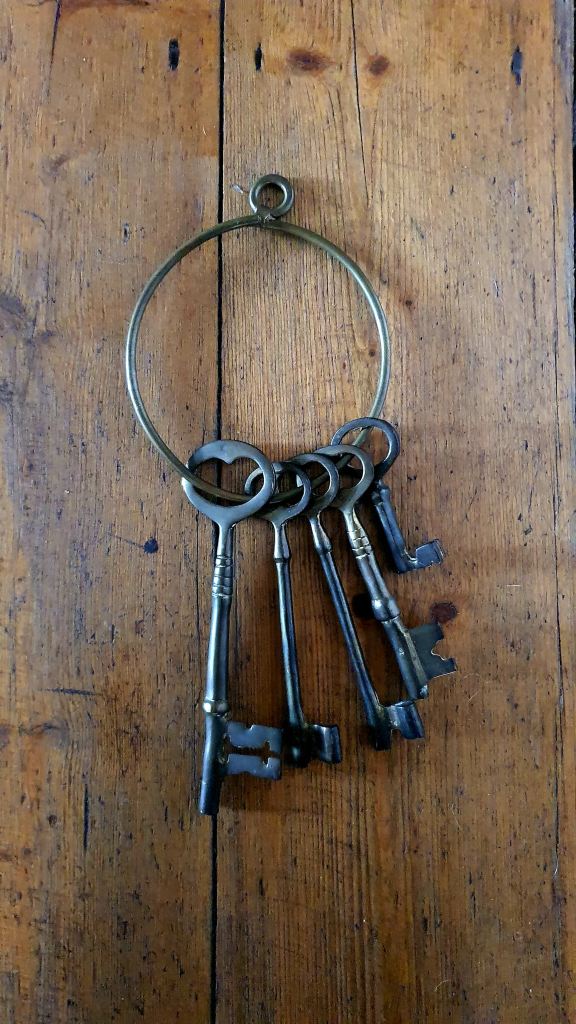
Verse 19: “I’ll give you the keys of the kingdom of heaven.”
Photo credit: Nerene Grobler
Jesus pauses to get a pulse on how things are going. He asks the disciples who people say he is. The response provides a pretty impressive list of prophets. Jesus has a good amount of respect from the general population. Then he turns to the 12, to his inner circle, to the ones who have been with him practically 24/7 for almost 3 years. He says, “What about you? Who do you say I am?” This is a personal question.
Simon answers first, declaring Jesus the Christ, the Messiah, the Son of God. Jesus recognizes that the Spirit has given him this answer and because of this he says that Peter is blessed. Continuing Jesus renames Simon to Peter, which translates “rock.” He then identifies Peter as the one upon whom Jesus will build his church. Peter will be the leader of the early church.
And then Jesus says, “I’ll give you the keys of the kingdom of heaven.” Keys represent access to knowledge. Peter – and all others who come to call on Jesus as Messiah and Lord – will receive all the knowledge necessary to bind or set free from bondage those struggling with or trapped in sin. Just as the Spirit revealed Jesus’ true identity to Peter, so too will the Holy Spirit reveal the words and actions needed to bring others to Christ, the one who sets us free from our sins. With a holy confidence may we witness to this good news!
Prayer: Lord God, thank you for all who have poured into me, building up my faith and my knowledge of you. Thank you for those that continue to do so, including the Holy Spirit. Continue to fill me. Continue to use me to share the good news with a world in need of Jesus Christ. Amen.








 pastorjohnb