pastorjohnb

Thoughts and musings on faith and our mighty God!


Leave a comment

Tears of Grief

Reading: Jeremiah 8:18-9:2

Jeremiah 8:21 – “Because my people are crushed, I am crushed; darkness and despair overwhelm me.”

Photo credit: Rainier Ridao

In today’s passage from Jeremiah it is difficult to determine if God is speaking or if it is Jeremiah speaking. Our verses today seem to be a mix of the two, with both God and prophet expressing their grief over Judah’s fate. For many years, God’s people have been unfaithful to their God. Their choice to abandon God has led to God’s choice to abandon them to their sin. At times we too can choose to separate ourselves from God. We too grieve God’s heart this deeply.

God seems to be the speaker in verses 19-21. The people are asking a question and implying another that are common in times of loss and pain and grief. Directly they are asking where the Lord is: “Isn’t the Lord in Zion?” This is a question often asked in grief. The second question is implied: Why, why is this happening to us? This is a question that we can ask when lost in our sin as well. When our sin that consumed us leads to a place of pain and suffering, we can forget that our choices brought us to this place. In the disorientation of grief, we do ask “Why?”

For God’s people , the answer is given: idol worship has led to this place. As the prophet that worked to turn Judah back to God, Jeremiah grieves too. In verse 21 we read, “Because my people are crushed, I am crushed; darkness and despair overwhelm me.” The tentacles of grief surround the prophet. He laments alongside the people who are far from God. This is a place we will also find ourselves. Walking alongside others in grief, feeling and taking on some of their pain and sorrow. Our tears join their tears as we offer love and comfort in the midst of their hurt and despair. Doing so, we bring God’s presence into the darkness and despair.

Prayer: Lord God, times of grief and suffering are sure to come – to ourselves, to those we love, to our neighbors. In these times, may we sense your presence and may we lean into your love and strength, whether for ourselves or as we walk with others. Be with us in our tears, O God. Amen.


Leave a comment

A Leader, A Remnant

Readings: 1st Kings 17, 1st Kings 18, 1st Kings 19

1st Kings 19:18 – “I have preserved those who remain in Israel, totaling seven thousand — all those whose knees haven’t bowed down to Baal.”

Photo credit: Paul Pastourmatzis

In today’s readings God returns to the scene in mighty ways. Suddenly Elijah is on the scene. His first act is to tell King Ahab that drought is on the way. Then he runs and hides. Elijah is filled with God’s Spirit and is very compassionate for the Lord. And he lacks confidence at times. His faith wavers between great and almost non-existent.

After providing for his needs in the wilderness, God then sends him to the widow at Zarephath. She is out gathering wood to prepare one last meal for her and her son. Elijah asks her for bread, asking her to trust God. She gives him bread and God provides for her faith. But her son grows ill and dies. She questions Elijah. He questions God. But then Elijah prays and asks God for help. God restores the boy back to life. The widow has faith in this man of God and in his God.

Elijah is then sent to Ahab – the one who has been searching for him. Obadiah reluctantly arranges a meeting. Ahab meets the “trouble maker” but Elijah counters, identifying Ahab and Israel as the ones who have deserted God. A contest is set up. The prophets of Baal prepare their bull and they pray and dance. Elijah teases them. They cut themselves and shout to Baal. Nothing. Elijah repairs the altar using twelve stones, prepares the sacrifice, and has water dumped upon it three times. Elijah prays to God. Fire falls and consumes everything. The people exclaim, “God is real!” The prophets of Baal die. He tells Ahab rain is coming. Six times Elijah’s servant looks for a cloud. On the seventh time, a small cloud has formed.

Jezreel is not happy about what happened at Mount Carmel. She threatens Elijah. He flees. Even though he’s ready to die, God provides as he makes his way to Mount Horeb. God asks, “Why are you here?” – Why are you afraid? God then teaches him an important lesson. God comes – not in the wind, not in the earthquake, not in the fire – but in the still and quiet. God has a plan. He tells the one who feels all alone, “I have preserved those who remain in Israel, totaling seven thousand — all those whose knees haven’t bowed down to Baal.” Elijah anoints Jehu as priest and Hazael as king. He goes to Elisha and throws his coat on him. Elisha accepts the invitation to follow. God is at work.

Prayer: Lord God, thank you for reminding Elijah and Israel and us of your presence, power, and might. Yet even with such reminders we can be like Elijah – our compassion for you quickly turning to fear and doubt. Help us to remember better. Lead and guide us to a sure and steady faith in you. Amen.


Leave a comment

Moving Forward

Readings: Numbers 15, Numbers 16, Numbers 17, Numbers 18

Numbers 18:29 – “You will present each gift offering to the LORD from all your gifts, from its best portions and its holiest parts.”

On the heels of choosing fear over faith and being doomed to wander the wilderness for 40 years, in chapter 15 God details the offerings to be given when they do enter the Promised Land. The wander is clearly a detour. God has a plan. So God reviews the offerings required for unintentional sins. God is clear that there is no reconciliation offering for deliberate or intentional sin. They are cut off. In the next chapter we will see what that looks like. The chapter closes with instructions to place blue fringes on all of their clothing. Blue represents holy. The fringes will remind them of the commitment to their holy God.

Chapter 16 contains challenges to Moses and to Aaron. Korah and his Levite clan want more power. Dathan and Abiram think Moses has too much power. Korah and his family are gathered. God plans to consume Korah’s entire household. Moses intercedes for the innocents. God relents. Dathan and Abiram refuse to appear before Moses. They and their families are swallowed up by the earth. Korah and his 250 followers are consumed by God’s fire. The community grumbles against these deaths and therefore against Moses and God. God sends a plague. Moses sends Aaron out into the community to stop the plague. Aaron stands between the dead and the living, halting the plague.

To reiterate God’s call on Aaron, the staffs of the 12 tribal leaders are gathered and placed with Aaron’s staff before the chest. Aaron’s staff buds, revealing God’s choice. The people lament. For now they fail to see the humility required to be in God’s presence. Today’s readings close with priestly duties and their compensation. It mostly reiterates earlier instructions but also adds a requirement of the priests. Since they belong to the Lord they will not be given a land inheritance. Instead they will receive the tenth of the crops and herds given to the Lord. In turn God will require them to give 1/10 of this to the Lord as their gift offering. It is to be “from its best portions.” May we too return to the Lord a portion from the best of our blessings.

Prayer: Lord God, in spite of the Israelites’ disobedience and rebellion and sin you keep the plan moving forward. You see and know the end results. In our lives we disobey and rebel and sin. You continue to work in our lives as well, leading and guiding, shaping and forming us into who and what you call us to be. In response, may we gratefully give our best to you in all situations. Amen.


Leave a comment

Holy and Just Lives

Readings: Leviticus 8, Leviticus 9, Leviticus 10

Leviticus 9:24 – “Fire flew out from before the LORD… All the people saw it. They shouted for joy and fell facedown.”

Today’s reading begins with the purification and ordination of Aaron and his sons as priests. They are washed, dressed in their priestly clothing, and are anointed with holy oil. The tabernacle and all in it are also anointed as holy. On Aaron and sons’ behalf, Moses offers a bull as a purification offering and then a ram as an entirely burned offering. Aaron and sons place their hands on the heads of each sacrifice. A second ram is sacrificed as an ordination offering. The breast of the ram and some bread is offered as an uplifted offering. Aaron and his sons stay at the entrance to the tent of meeting for 7 days, as required by the Lord.

Next Aaron performs all of the sacrifices. This act is both symbolic and practical. Moses oversees it all. Aaron first offers a bull and then a ram as the priest’s purification and wholly burned offerings. He then offers the same for the people, followed by the people’s grain and well-being offerings. This completes the entire set of sacrificial rituals. Moses and Aaron then enter the tent of meeting. Emerging from the tabernacle, “Fire flew out from before the LORD… All the people saw it. They shouted for joy and fell facedown.” This is a sign of God’s validation. All has been done exactly as the Lord commanded.

Another act of disobedience occurs as chapter 10 begins. Nadab and Abihu, two of Aaron’s sons, offer unauthorized fire before the Lord. Again fire flew out from the Lord. This time it consumes Nadab and Abihu. This is a sign of God’s disapproval. Aaron is stunned so Moses takes over. The bodies are removed and Moses gives instructions for mourning. He specifically prohibits two Canaanite mourning practices. After some instructions on priestly eating and drinking, Eleazar and Ithamar fail to eat their portion of a sacrifice. They erred on the side of caution and safety, so Moses anger relents.

Today we are reminded of the importance of living as the Lord commands. In our own calls to model and reflect God’s love and God’s holiness, may we strive to live holy and just lives.

Prayer: Lord God, by the power of the Holy Spirit lead and guide us to live lives that are pleasing to your sight. May our very lives be a pleasing aroma that brings joy to you, O Lord. Amen.


Leave a comment

Time and Space to Mourn

Reading: Matthew 14:22-23

Verse 23: “He went up on a mountainside by himself to pray.”

The first two verses of this week’s gospel lesson are a microcosm, a snapshot. Most often they are verses that we read and understand, but do not sit with. These two verses give a wonderful insight into Jesus’ humanity – and into ours.

After healing all day and then feeding the 5,000 Jesus sends the disciples off in the boat and then he dismisses the crowd. He is making time for what he needed to do before the huge crowd arrived. Jesus makes time to mourn the loss of his cousin and fellow prophet. In verse 23 we read, “He went up on a mountainside by himself to pray.” Going up the mountain is God-speak for finding time alone with God. For Jesus, going up the mountain is time to connect with God, just as it was for Moses and Elijah.

Caring for immediate needs can defer grieving. It happens to many of us when we lose a loved one. The immediate and necessary tasks of writing an obituary, of planning and attending a funeral… they consume our attention and energy, much as the healing and feeding of the crowd did for Jesus. This was the divine Jesus in action. Then the human Jesus needed care. He needed time and space to mourn and to be with God in that grieving. Jesus honored his grief. In our times of loss may we follow this example too.

Prayer: Lord God, it can be tempting to defer or ignore our grief. The initial days of autopilot, of getting necessary things done, they can trick us. When that flurry passes, remind us of the intentional choice that Jesus made. Draw us into your peace and consolation, for there we begin to find real healing. Amen.


Leave a comment

The Choice

Reading: Luke 16:10-13

Verse 13: “No one can serve two masters.”

Continuing on with his teaching about using earthly wealth for God’s glory, Jesus speaks in today’s verses about being faithful. In verses 10-12 Jesus takes aim at our trustworthiness. He says that if we are trustworthy with a little, then we will be trustworthy with a lot. Or if we are not trustworthy with a little, then we won’t be trustworthy with a lot. The little decisions and ways we prioritize and act indicate how we will choose and act when it really counts. Who and what we are and whose we are at our core will shine through, both in the big and in the small things.

Connecting to the parable, Jesus reiterates that if we are not trustworthy with earthly wealth, then why would we be trusted with eternal riches? If we can’t be trusted with using earthly wealth for God’s glory, then how can God give us something if eternal worth? But if we can and do use the things of this earth – which are all God’s anyway – to build the kingdom here on earth, then we will be given a place in eternity.

Driving the point of all this home, in verse 13 Jesus says, “No one can serve two masters.” He is drawing a hard line in the sand. Jesus is telling us we must choose: God or money? One will become our priority, our focus, that which drives all of our decisions and actions. One will come to consume us, to define us, to be our true love. What is my choice? What is your choice?

Prayer: Lord God, in many ways and with many voices, I am told to do more, to be more, to earn more. These are the din of the world. Yet your still, small voice rings true, telling me that you are more than enough. You call me to trust you and, in turn, to help others to choose you over all else. In the power of the Holy Spirit, may it be so. Amen.


Leave a comment

Learning to Walk

Reading: Matthew 22: 1-12

Verse 12: “Friend, how did you get in here without wedding clothes”?

This week’s gospel lesson is the second in a row from Jesus that focuses in on how he is rejected. They are stories of greed and arrogance and selfishness. These two parables are aimed at the religious leaders in their original context, but they certainly have application for us today.

As our passage opens, Jesus is clear that this parable compares the kingdom of God to a wedding banquet. Jesus begins by explaining that those originally invited refuse to come. A second invite is rejected as well. This time those invited mistreat and kill the servants. A voice had called out in the desert. Some came and heard the call to repentance. They were baptized as a symbol of readiness for the coming kingdom. But John’s call fell on many deaf ears as he ministered in the wilderness. Jesus himself came with a second invite, calling the Jews to really love as God commanded. Jesus’ message centered on the two great commandments: love God with all you heart, soul, mind, and strength and love your neighbor as yourself. The religious leaders refused to accept Jesus as the Messiah, so the call or invite extended past the Jews. Anyone that can be found will be invited to the wedding banquet.

The religious leaders went out and heard John’s call. They hung around and heard Jesus’ words, saw the miracles. Showing up is something about anyone can do. There are folks that show up on Sunday mornings. Simply sitting in a worship service does not make one into a practicing Christian. In our parable today, a man comes to the banquet, but he is not prepared. He chose to hear the call, but failed to ready himself. In Jesus’ day, to attend a wedding, one must dress in the required wedding clothes. These clothes were special and required effort and preparation. But this man just showed up. He was simply there to consume and indulge, not to really be a part of things, not to celebrate with the bride and groom. The Jews and the religious leaders in particular had received the invitations. They still showed up for the Sabbath, thinking they were honoring God simply be being there. They went about their lofty rituals and wore their fancy clothes. They loved these things, not God. They were arrogant and selfish, loving only self and not the many neighbors who needed both physical and spiritual care. They lived inside their self-constructed walls.

We too do this. We do it on Sundays when we show up and go through the motions instead of being open to and looking for God’s Spirit to change us on a Sunday morning. We do it each day when we rush off into our day without first connecting to God in word and prayer. We do it each time we think ourselves a Christian and then ignore the poverty, oppression, and injustices of our communities and our world. Simply put, it is easy to talk the talk. It is much harder to always walk the walk. May we all better learn to walk the walk as we seek to follow Jesus Christ, loving as he first loved each of us.

Prayer: God of all, help me to more fully love you and all people. Turn me from selfishness and self-righteousness, becoming more and more willing to give myself away, becoming more and more willing to risk for the gospel. Use me as you will. Amen.


Leave a comment

Into the Presence

Reading: Matthew 17: 1-9

Verse 2: “There he was transfigured… his face shown like the sun… his clothes became as white as light”.

Tomorrow is known in many denominations and churches as “Transfiguration Sunday”. The three disciples closest to Jesus are selected to go up the mountain with him. Peter, James, and John enter into the mystery of God atop the mountain. “There he was transfigured… his face shown like the sun… his clothes became as white as light”. In many ways these three men experience something totally unique and absolutely foreign to them. And yet they are drawn in. There is something powerful about the mystery of God.

Peter’s first reaction is to preserve the moment. He knows it is “good” for them to be there and he offers to build three shelters. Maybe his mind is not making sense of what he sees and he wants time to be in the moment and to wrap his head around it. Maybe he is connecting to the presence of these two Old Testament icons and that is what he wants to hold onto. Like many of us do with Jesus, perhaps Peter has some questions to ask Moses and Elijah. Whatever the cause for wanting to preserve it, Peter is a good example for us.

Peter first recognizes the sacredness of the moment. He is present to something wrapped in mystery and power and he sees that in the moment. He recognizes God in that space. Second, Peter does not shy away. Instead of being fearful or being paralyzed by the mystery, he invites its continued presence. Our first reaction may be to turn and hide or even to run. Being that close to the holiness of God may be challenging to us. It was a life-changing moment for Peter. That has been revealed in our reading and considerations on 2nd Peter 1 these past days.

When we find ourselves in God’s presence, within the mystery, do we seek to make it last? Do we step into that sacred space and allow the whole point of today’s passage to be what consumes us? Do we stop and become fully present to the presence of God? Do we listen to him?

Prayer: God, when you are present to me in those blessed moments, may I be like Peter. May I humbly step into that sacred place, inviting what you have for me to become my reality. May it ever be so. Amen.


Leave a comment

The Fire of God

Reading: 2 Kings 2: 1-2 & 6-14

Verse 11: “Suddenly a chariot of fire and horses of fire appeared and separated them… Elijah went up to heaven in a whirlwind”.

Elijah and Elisha are walking along, essentially waiting for God to act. Elisha has remained steadfast to his mentor. Both know this will be their last walk and talk. As they walk, Elijah uses his cloak to separate the waters of the Jordan so that they can pass over. Their walk will continue. He then asks Elisha what he can do for him before he goes. Elisha requests a double portion of Elijah’s spirit. Then God acts. In verse 11 we read, “Suddenly a chariot of fire and horses of fire appeared and separated them… Elijah went up to heaven in a whirlwind”.

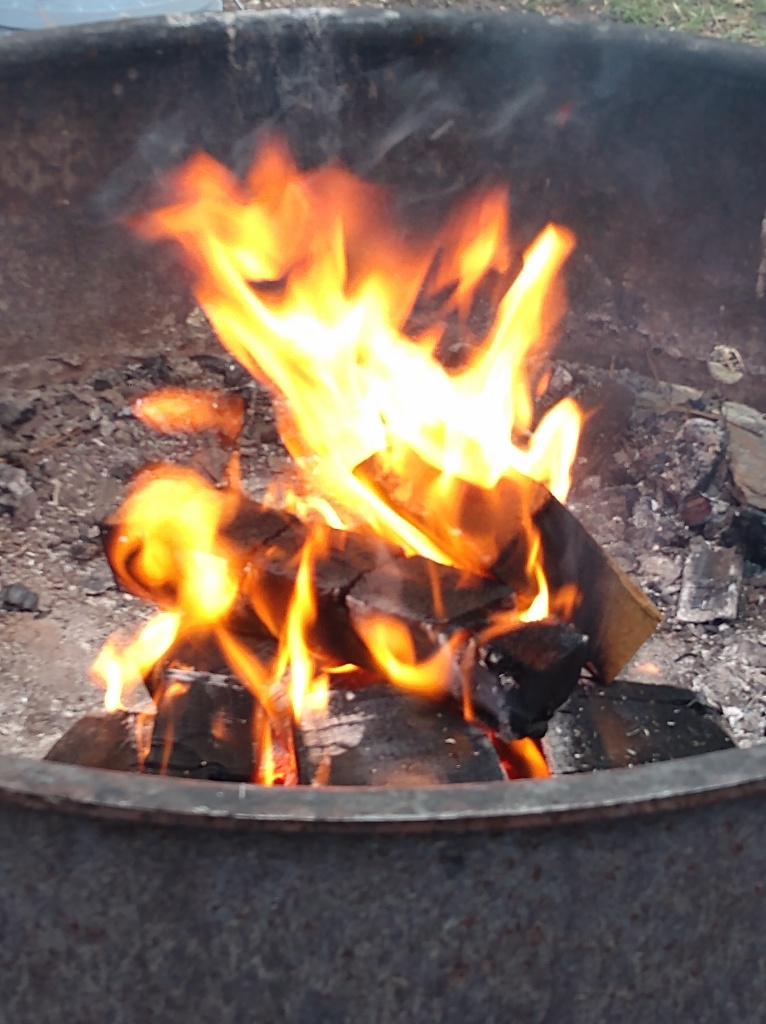
Fire is a common theme in the Bible and it is often associated with God. In the Old Testament God spoke through fire, led by fire, and revealed his power with fire. In the New Testament fire remains a symbol of God’s power – the Holy Spirit comes as a small flame, fire refines the believers, and in the end fire will consume many. It is a chariot and horses of fire that finally parts Elijah and Elisha as Elijah is taken straight to heaven.

In our lives we too experience fire from time to time. It can be caused by stress or by a situation that arises. This type of fire is usually uncomfortable and we want it to end quickly. But sometimes this fire refines, so it is allowed to linger for a while. We can also experience a faith that is like a fire burning within. It is one that we cannot quite keep ahold of and that we seek to share with others. Fire remains symbolic of God’s presence and activity in our lives.

All that is physically left of Elijah is his cloak. Elisha picks it up and begins the journey home. The fifty men of the company of prophets is still present. Elisha asks aloud if God is still present too. Like his mentor, Elisha touches the river with the cloak. It again parts for Elisha to pass through. The cloak is the physical mantle that has been passed from Elijah to Elisha. The revelation of God’s power confirms that this too has been passed to the next prophet of Israel. The fire of God will continue to burn brightly, now in Elisha.

That same fire of God, in the power and presence of the Holy Spirit, burns in each of us. It allows us to hear God’s voice in our lives and it empowers us to be God’s voice in our world. May we hear and exercise that voice today.

Prayer: God of fire, you are the light to my feet and you are the warmth to my heart. Shine bright in me so that I can share your light with my world today. Amen.


Leave a comment

Consuming Fire

Reading: 1 Kings 18: 20-39

What a contrast we have in today’s story.  One team builds their altar and places the sacrifice on it.  They dance about the sacrifice, they pray and shout to their god.  Then they resort to cutting themselves and crying out more urgently to gain their god’s attention.  Their god does not answer.  Their god does not satisfy their pleas.  All is done in vain.

We scrape together our dollars to buy a bigger house or a fancier car.  We work late every day as the announcement date for who will be promoted or made partner draws near.  We show up early with our neatly dressed little family and sit in the front pew so everyone can see we are there again this Sunday.

Then the other team steps to center stage.  But instead of a team of 450 it is a one man show.  He builds the altar and places the sacrifice on it.  The audience has seen this show before.  But then he digs a big trench around that altar.  Interest rises.  Then he has people dump bucket after bucket of water on the sacrifice and altar.  The trench fills with water.  The audience slides up to the edges of their seats.  Then he simply asks for his god to make it known that He is the Lord God, the one and only true God.  He trusts that God will answer.  He knows this God.  And fire falls from heaven and consumes it all – the sacrifice, the wood, the altar stones, the water.  The fire of God consumes everything.

Maybe the house is a little small but we are comfortable.  Maybe the car isn’t shiny and new anymore but it runs well and is reliable.  Maybe that project can get done tomorrow.  Maybe, maybe, maybe.

Maybe we could trust this God with all we have.  Maybe He really is able to do all things.  Maybe He loves us unconditionally.  When we pursue and place our trust in the one true Lord of life, then the gods of this world have no sway in our lives.  When we seek first the things of God, we do not have any desires left for the things of this world for His fire consumes us.  Consume us today, O Lord our God.