pastorjohnb

Thoughts and musings on faith and our mighty God!


Leave a comment

Go and Make Disciples

Reading: Matthew 27-28

Matthew 28:7 – “Now hurry, go and tell his disciples, ‘He’s been raised from the dead. He’s going on ahead of you to Galilee. You will see him there.’”

Jesus is brought before Pilate, the Roman governor. Seeing what’s happening, Judas is filled with regret. He returns the silver pieces and takes his own life. The silver is used to buy a field to bury strangers. Pilate asks Jesus if he is king of the Jews. Jesus does not respond to Pilate or defend himself. Because of his wife’s dream, Pilate tried to free Jesus. But the religious leaders invited the crowd. They call for Barabbas’ release and for Jesus’ crucifixion.

The Romans soldiers mock and abuse Jesus. On the way to Golgatha, Simon from Cyrene helps carry the cross. Jesus is crucified and his clothes are divided by casting lots. A sign above Jesus’ head reads, “Here is Jesus, king of the Jews.” The religious leaders, those passing by, and the criminals in Jesus’ left and right all mock and make fun of him. A handful of faithful women watch it all from a distance.

At noon it grows dark. Jesus shouts aloud at three, asking why God has left him. Then he shouts and dies. The inner curtain of the temple is torn in two. The earth shakes. A centurion declares, “This was certainly God’s son.”

Joseph of Arimathea asks for, received, wraps, and places Jesus’ body in his own new tomb. Mary Magdalene and the other Mary watch. A guard is set to prevent the theft of Jesus’ body. Early the next day Mary and Mary return to the tomb. An angel has removed the stone. He announces the resurrection and gives the women instructions, saying, “Now hurry, go and tell his disciples, ‘He’s been raised from the dead. He’s going on ahead of you to Galilee. You will see him there.’” The religious leaders fabricate one more lie, offering one more feeble attempt to control God’s narrative. The disciples do meet Jesus in Galilee. He commissions them, saying, “Go and make disciples of all nations, baptizing them in the name of the Father and of the Son and of the Holy Spirit, teaching them to obey everything that I’ve commanded you.” The mission continues. May it be so with us.

Prayer: Lord God, so much drives these events – fear, jealousy, deceit, betrayal, manipulation, insecurity. And then there is Jesus: obedient, faithful, courageous, humble. He remains above the house and the evil around him. In the end there is victory over evil and over death. The mission is given and it continues. Guide and strengthen us, O God, to walk as Jesus walked, carrying the good news to the ends of the earth. Amen.


Leave a comment

Ends with Hope

Reading: Ezekiel 6-11

Ezekiel 11:19a – “I will give them a single heart, and I will put a new spirit in them.”

Chapter 6 addresses the consequences of Judah’s idolatry outside the temple. God will slay most of these idol worshippers. Some will escape and go into exile. God was “crushed” by the people’s “roving hearts.” They will fall by sword, famine, and plague. Chapter 7 continues this story line. God will judge Judah according to her ways. God won’t shed a tear, won’t show any pity. Those outside Jerusalem will die by the sword. Those inside will die by plague and famine. “Violent intruders” will defile the temple. Then Judah “will know that I am the Lord,” declares God.

Chapters 8-11 contain Ezekiel’s “Temple Vision.” God’s glory is in the temple as his virtual tour begins. Ezekiel is shown “terribly detestable practices” – a huge idol, 70 elders worshipping engravings on the wall, women worshipping a Babylonian god, men bowing to the sun. God then calls the “guardians of the city.” One of the six, the one in linen, is sent out to mark the foreheads of the faithful. The others follow along behind, killing all without the mark. They begin in the sanctuary and move outward from there. Ezekiel questions the depth of the violence. God is holding them accountable.

The guardian in linen is then sent out with fire from the temple chariot. He scatters fire about, burning down the city. The chariot rises up and moves to the threshold of the temple. God’s glory is on the chariot throne. There is a final confrontation with some evil and wicked men. God declares that they will die by the sword. And then God offers hope.

The exiles will be gathered back. God says, “I will give them a single heart, and I will put a new spirit in them.” Israel will be obedient. God will be their God. Then the chariot leaves, flying east towards Babylon. The vision ends and Ezekiel tells the exiles all that God has shown him. The story ends with hope. Our story does too. Thanks be to God.

Prayer: Lord God, you are almighty and all-powerful. You are just and righteous. Just as you held Judah accountable, so too do you hold us accountable. So God, create in each of us a single heart, a heart fully aligned with you. Pour your Spirit into our hearts, leading and guiding us to walk faithfully with you. Be our God. Make us into your people. Amen.


Leave a comment

More and More God’s People

Readings: Nehemiah 8, Nehemiah 9, Nehemiah 10

Nehemiah 9:33 – “You have been just in all that has happened to us; you have acted faithfully, and we have done wrong.”

The people gather to have Ezra read the instruction scroll to them. Men, women, and children old enough to understand gathered. There is a real sense that this represents the whole community. Ezra reads for about six hours and then the Levites go out amongst the people to explain the reading. The people begin to weep. But Nehemiah, Ezra, and the Levites tell them not to weep – this day is holy. It is a day of great celebration.

The next day they gather again. Ezra reads about the Feast of Booths. The people make booths, remembering Israel’s time in the wilderness. This hasn’t been celebrated since the days of Joshua. Ezra reads for seven days. The Levites interpret. On the eighth day they put on “funeral clothes” and they fast. They confess their sins and the past sins of Israel. Then they worship God.

Most of chapter 9 is a beautiful retelling of the highlights of Israel’s history. The Levites go from creation to Abram and the covenant to the plagues… and right up to their own time. The cycle of sin, punishment, crying out occurs several times. Each time is followed by God’s mercy, patience, and faithfulness. Verse 33 is a great summary statement: “You have been just in all that has happened to us; you have acted faithfully, and we have done wrong.”

All of Israel then makes a written and sealed agreement – a covenant – to be faithful and obedient to God. They will be holy and set apart. They will honor the Sabbath and they will support the temple. The direction is set. Israel will be God’s people once again.

Prayer: Lord God, thank you for this beautiful picture of a faithful and committed family of God. Your word penetrated hearts and transformed them. As we read and study your word may we too be transformed. Make us more and more into who and what you want us to be. Amen.


Leave a comment

The Lord Will Fight

Readings: 2nd Chronicles 29, 2nd Chronicles 30, 2nd Chronicles 31, 2nd Chronicles 32

2nd Chronicles 32:8 – “All he has is human strength, but we have the LORD our God, who will help us fight our battles!”

Hezekiah is the focus of today’s readings. In the first month of his rule he reopens the temple and sets the priests to making it holy once again. After eight days the temple is purified. Early the next morning sacrifices are offered for all Israel, songs are sung, the Lord is praised. Hezekiah invites the people to bring thank offerings to God. The response is so great that the Levites have to step in and help.

Next Hezekiah reestablishes the celebration of the Passover. He sends word throughout all of Judah – and Israel. Some from up north laugh and make fun of the invitation, but some come from Israel. A huge crowd gathers and celebrates the Passover. So wonderful and joyous is the celebration, they decide to worship God for seven more days. Fueled by this celebration the people go out and cleanse Judah of all idol worship. The pillars, poles, shrines, and altars are all destroyed.

Hezekiah then calls for the resumption of the tithe to support the daily needs of the priests. The people bring their best in great abundance. Judah is at its high point in its relationship with God – the best since the days of Solomon. It is then that King Sennacherib of Assyria comes. Hezekiah trusts fully in God. He encourages the troops to be brave and strong. He says, “All he has is human strength, but we have the LORD our God, who will help us fight our battles!” Hezekiah trusts that the Lord will fight the battle. That very night God’s messenger comes and kills 185,000 Assyrian soldiers (2nd Kings 19.) Sennacherib goes home in disgrace.

A deadly illness then sets in on Hezekiah but he cries out to God and is healed. But in that moment he is too proud to properly thank God. He and Israel begin to feel God’s anger. They repent and God’s blessings return. Hezekiah dies and is buried in the “upper area” of the tombs with David’s sons. Gold star!

Prayer: Lord God, what a great reminder of the value of a long, steady, obedient faith. In the big and the small, your will and your ways were the focus. Trust in you was sure. Help us to live out this kind of faith. Amen.


Leave a comment

Good, Evil, Good, Evil…

Readings: 2nd Chronicles 25, 2nd Chronicles 26, 2nd Chronicles 27, 2nd Chronicles 28

2nd Chronicles 25:15 – “Why do you seek the gods of this people? They couldn’t even deliver their own people from you!”

Amaziah begins today’s readings about the kings of Judah. He did what was right in God’s eyes – mostly. In verse 2 we read, “but not with all his heart.” I think this is typical of most Christians today, myself included. We want to and try to follow God faithfully and obediently but the flesh inside each of us rises to the top now and then. This seems to be a part of being human.

Amaziah leads and administers well. He has successes. Then he decides to worship false gods. A prophet comes to him and asks, “Why do you seek the gods of this people? They couldn’t even deliver their own people from you!” Great questions. He gets angry at the prophet. In arrogance and foolishness he challenges King Joash of Israel. Judah and Amaziah are soundly defeated, humiliated, and looted. Amaziah is killed by his own people. Uzziah succeeds him. As long as the prophet Hezekiah is instructing him, Uzziah is faithful and has success. He becomes powerful and wealthy and famous. Arrogance sets in and he begins to worship false gods. The priest Azariah confronts Uzziah burning incense in the temple. Uzziah gets angry and God gives him a skin disease. Uzziah lives isolated the rest of his life. His son Jotham runs the kingdom.

Jotham becomes king next and does right by God. He rebuilds and wins battles. Ahaz succeeds him as king after 16 years. Ahaz is thoroughly evil. He worships Baal. He burns his sons alive in the altar of a pagan god. He suffers massive defeats. Israel shows great mercy and faithfulness, caring for and returning prisoners taken in battle. Even this faithful act does not change Ahaz’s evil heart. He instead aligns himself with Assyria, inviting disaster upon Judah. His reign ends by closing up the temple and the destruction of the temple equipment – by Ahaz. He is not buried with the other kings.

Prayer: Lord God, lessons learned: faithful -> good things… disobedient -> bad things. These are connections we know and understand. Yet we can struggle to be faithful and obedient. Lord, help us in our daily walks of faith. Strengthen us in our moments of weakness and temptation. Help us through. Amen.


Leave a comment

Truly Grateful

Readings: 2nd Samuel 5, 2nd Samuel 6, 2nd Samuel 7

2nd Samuel 7:16 – “Your dynasty and your kingdom will be secured forever before me. Your throne will be established forever.”

The rest of Israel comes to David at Hebron and makes the king of Judah the king over all Israel. They recognize that God has declared David to be the one to “shepherd my people.” David makes a covenant with them and they anoint him king. In his first move as king, David captures Jerusalem. In an action that works like a treaty or peace offering, the king of Tyre sends supplies and laborers to build a palace for David.

The Philistines gather and God gives them into David’s hands. They regather and come against David again. And again God has a plan, which David follows exactly, and victory belongs to Israel. David then decides to bring the chest of the Lord to Jerusalem. Along the way Uzzah touches the chest and dies on the spot. This scares David and the chest is left there in Obed-edom’s house. His house is blessed by the presence of the chest. After three months the journey resumes. The chest enters Jerusalem with great celebration. Michal is displeased with how David danced before the Lord with all his might. He says to her, “I may humiliate myself even more” before the Lord.

David, sitting in his palace, realizes that God’s chest is still dwelling in a tent. He thinks God needs a house. But, through Nathan, he learns that his son will build the temple. God then turns the tables, telling David that God will build him a house – a dynasty. Through Nathan, God tells David, “Your dynasty and your kingdom will be secured forever before me. Your throne will be established forever.” Our reading closes with a beautiful prayer to God. David is truly grateful for all that God has done and for all that God promises to do. May it be so for us as well!

Prayer: Lord God, your plans are always good. You lead and guide us when we are obedient and faithful to you. Guide our steps too, blessing us with your presence every day. Amen.


Leave a comment

Imperfect But Usable

Readings: Joshua 6, Joshua 7, Joshua 8

Joshua 6:38 – “Don’t be angry with me… Please let me make just one more test.”

Today’s chapters focus on Gideon. In Gideon we see faithfulness to God right alongside his battles with doubt, fear, anger, and pride. We experience these things in our walks of faith. Like Gideon, we want to obey God, but often stumble over our own will and ways. More than anything, though, in these chapters we see that God can use Gideon’s flaws to ultimately work out God’s plans for Israel. God can and will do the same for you and for me.

The people have sinned and God allows the Midianites to cruelly oppress Israel. They cry out. God sends a prophet who reminds them, “You have not obeyed me.” Then God’s messenger calls Gideon. He is reluctant. He has excuses. He tries God’s patience. At one point Gideon says to God, “Don’t be angry with me… Please let me make just one more test.” God works through all of his tests. Satisfied for now, Gideon calls for an army. Yet fear persists. God allows him to overhear a dream which restored his courage. God then tests Gideon, whittling his army of 32,000 down to 300. Credit must go to God. Pride rises up in Gideon as he gives the battle cry: “For God and for Gideon.” Following a wild plan of God, similar to Jericho, victory is won. God’s plan is complete. Yet Gideon chooses to pursue the enemy kings.

In Gideon’s pursuit he asks the people of Succoth and Penuel for bread. They deny Gideon and his army any bread. He threatens them. Soon he captures these two enemy kings and executes them – revenge for killing Israelites. He returns to Succoth and Penuel, exacting violent revenge here too. Pride and anger rule in his heart. Yet when asked later to be Israel’s ruler, he states, “The Lord rules over you.” Apparently he is not part of this “you” though as he collects gold earrings and makes a priestly vest. This trap leads straight to idolatry and the continuing downward spiral of Israel. More on that tomorrow.

Prayer: Lord God, help us to learn both from the good and the bad that we see in Gideon. Help us to be faithful and to follow your plans. Help us to see, though, when it becomes about us and our plans. Keep us from the perils of sin. Guide us to walk in your ways. Amen.


Leave a comment

As for Me and My House…

Readings: Joshua 18, Joshua 19, Joshua 20, Joshua 21, Joshua 22, Joshua 23, Joshua 24

Joshua 24:15 – “But my family and I will serve the LORD.”

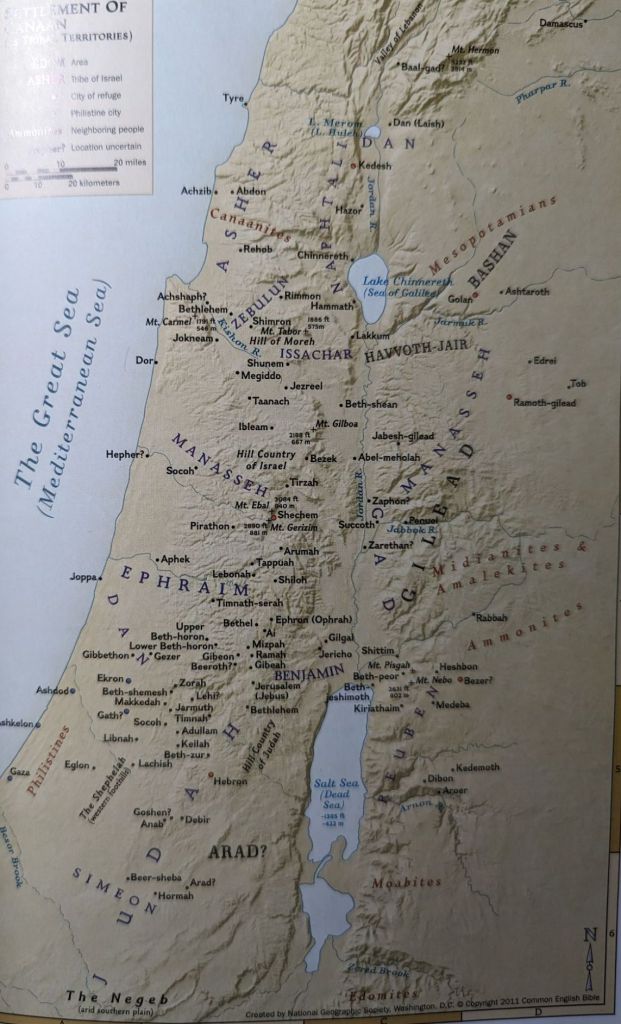
Today’s seven chapters close out the story about inheriting the Promised Land. It begins with a way to divide up the remaining land west of the Jordan. Lots are cast and land is allotted to the tribes of Benjamin, Simeon, Zebulun, Issachar, Asher, Nephtali, and Dan. Joshua also receives a legacy. Then, in chapters 20 and 21, the Levites are given cities and their surrounding pastureland. These 48 cities are spread out amongst the twelve tribes and they include the six refuge cities. God is preparing here for a day yet to come. God is good.

Now that the land legacies have been given and now that peace has come, Joshua summons the Reubenites, Gadites, and the half tribe of Manasseh. He thanks them for their faithful service and sends them home with a charge to be obedient and faithful to the Lord. At the Jordan these tribes build an altar as a witness to their belonging to the people of Israel west of the Jordan. It is a standing reminder.

Chapter 23 holds Joshua’s final words of warning. He first reminds the Israelites of all that God has done and then implores them to be faithful and obedient. Joshua warns them about mixing with the locals. They will be “a snare and a trap.” Joshua warns Israel that they will “vanish quickly” if they violate the covenant.

Chapter 24 closes Joshua’s story. He begins with a great review that takes Israel from Abram to this very moment. Joshua challenges Israel to decide “whom you will serve.” Joshua declares that he and his house will serve the Lord. So too will the people of Israel. May it be so for you and for me and for our households.

Prayer: Lord God, the story of another great leader and a meaningful period in Israel’s history comes to a close. Yet the choice at the end of Joshua remains our choice today. It’s a choice we make every day. So each day, O Lord our God, empower us to choose you. Amen.


Leave a comment

Choose God, Find Life

Readings: Deuteronomy 26, Deuteronomy 27, Deuteronomy 28, Deuteronomy 29, Deuteronomy 30

Deuteronomy 30:19-20 – “Now choose life… by loving the LORD your God, by obeying his voice, and by clinging to him.”

Chapter 26 begins by establishing a solemn oath to be taken when entering the Promised Land. The oath recalls the past and celebrates all that God has done. It reminds them of the important role that they will play upon entering Canaan – to obey God’s word. If Israel lives this way they will be God’s “treasured people.”

Moses instructs the people to set up giant stones and to write the Law upon them once they cross the Jordan. There is then a blessing-cursing ceremony in which Moses reviews a sampling of the Law. Failure to keep these brings curses. This is then followed by “future blessings.” If Israel carefully keeps all of God’s commandments, blessing will come in many ways. The other nations of the world will be in awe of Israel.

Next comes a long section on the curses that will come if Israel does not obey God. Death and destruction, plague and oppression and death, exile – it will be horrific. Much of this will come to pass. Chapter 29 halts this bad narrative and invites the people into a covenant relationship with God. The good and the bad have been laid out. Chapter 30 returns to reality. The sin cycle will be fully lived out. The curses will befall Israel. But… when you turn back to God, you will be restored. Israel will be gathered back up.

Our reading closes with words of encouragement. To obey – it’s not too difficult. These words, this God – “in your mouth and in your heart.” Life and death, blessing and curse, they have been set before Israel – and before us.“Now choose life… by loving the LORD your God, by obeying his voice, and by clinging to him.” May it be so.

Prayer: Lord God, you lay out the reality before us – life with you versus life without you. It is not a promise, though, of everything being good if we’re obedient. The promise is your presence. There we do find good in all things, even in the defeats and exiles. Thank you for being our constant God. Amen.


Leave a comment

Obedience and Faith

Readings: Exodus 1, Exodus 2, Exodus 3, and Exodus 4

Genesis 2:24-25 – “God heard their cry… God remembered his covenant… God looked at the Israelites, and God understood.”

Today we begin the story of the Exodus! It is the story of God’s deliverance from oppression and it is the story of the formation of God’s people. The story begins with the fulfillment of part of the covenant – Abraham’s descendants become numerous. Seventy quickly grows to be thousands upon thousands. Pharaoh fears them then enslaves the Hebrews. Growth continues. Faith is demonstrated by Shiphrah and Puah, thwarting plan A. Plan B is to drown all Hebrew baby boys in the Nile River. Moses is born and goes into the Nile – in a tarred basket. Providence has him rescued by Pharaoh’s daughter. He grows up largely as an Egyptian.

Turning to adulthood, Moses defends a slave, killing an Egyptian. Moses then flees to Midian where his rescue of some shepherdesses connects him to Jethro and family. Moses marries, settles down. The Israelites cry out. At the end of chapter 2 we read, “God heard their cry… God remembered his covenant… God looked at the Israelites, and God understood.”

Out tending the flock on Mount Horeb/Sinai, Moses is drawn to a burning bush. It is holy ground – God is present. God asks Moses to rescue the Hebrews. Moses has lots of excuses. Sound familiar?! The excuses: Who am I? Who are you? How will they know you sent me? But I can’t talk well! Can’t you just send someone else?! Only the last one angers God. Yet God relents and sends a long Aaron to help. Pharaoh’s stubbornness is foreshadowed, as is the final plague.

Obediently, Moses goes. Yet obedience must be complete. On the way, God appears and tries to kill “him.” Is Moses or his son Gershom? Either way this is about circumcision – the symbolic act that identities the Israelites as God’s people. Zipporah reads the scene correctly and she acts quickly. The chapter closes with Moses and Aaron’s initial meeting with the Hebrew elders. They believe and then they worship the Lord their God.

Prayer: Lord God, oh how we are like Moses! Raised in two worlds – yours and this place we call home. We too can be confused about who and whose we are. And when you come to us, we can make excuses with the best of them. Yet, in love you lead and guide us. You desire relationship. You are not a tyrant. You invite us to be co-creators with you, loving and caring for your intended world. Thank you for the invitation. May we respond with both obedience and faith. Amen.