pastorjohnb

Thoughts and musings on faith and our mighty God!


Leave a comment

Holy and Just Lives

Readings: Leviticus 8, Leviticus 9, Leviticus 10

Leviticus 9:24 – “Fire flew out from before the LORD… All the people saw it. They shouted for joy and fell facedown.”

Today’s reading begins with the purification and ordination of Aaron and his sons as priests. They are washed, dressed in their priestly clothing, and are anointed with holy oil. The tabernacle and all in it are also anointed as holy. On Aaron and sons’ behalf, Moses offers a bull as a purification offering and then a ram as an entirely burned offering. Aaron and sons place their hands on the heads of each sacrifice. A second ram is sacrificed as an ordination offering. The breast of the ram and some bread is offered as an uplifted offering. Aaron and his sons stay at the entrance to the tent of meeting for 7 days, as required by the Lord.

Next Aaron performs all of the sacrifices. This act is both symbolic and practical. Moses oversees it all. Aaron first offers a bull and then a ram as the priest’s purification and wholly burned offerings. He then offers the same for the people, followed by the people’s grain and well-being offerings. This completes the entire set of sacrificial rituals. Moses and Aaron then enter the tent of meeting. Emerging from the tabernacle, “Fire flew out from before the LORD… All the people saw it. They shouted for joy and fell facedown.” This is a sign of God’s validation. All has been done exactly as the Lord commanded.

Another act of disobedience occurs as chapter 10 begins. Nadab and Abihu, two of Aaron’s sons, offer unauthorized fire before the Lord. Again fire flew out from the Lord. This time it consumes Nadab and Abihu. This is a sign of God’s disapproval. Aaron is stunned so Moses takes over. The bodies are removed and Moses gives instructions for mourning. He specifically prohibits two Canaanite mourning practices. After some instructions on priestly eating and drinking, Eleazar and Ithamar fail to eat their portion of a sacrifice. They erred on the side of caution and safety, so Moses anger relents.

Today we are reminded of the importance of living as the Lord commands. In our own calls to model and reflect God’s love and God’s holiness, may we strive to live holy and just lives.

Prayer: Lord God, by the power of the Holy Spirit lead and guide us to live lives that are pleasing to your sight. May our very lives be a pleasing aroma that brings joy to you, O Lord. Amen.


Leave a comment

God Still Provides a Way

Readings: Leviticus 5, Leviticus 6, Leviticus 7

Leviticus 7:30 – “Your own hands must bring the LORD’s food gifts.”

Chapter 5 opens with a few more ways that we can sin – by withholding information in a trial, by touching something or someone unclean, by carelessly swearing. A purification offering is required. Access is also made available to the poor. If one cannot afford an animal from the flock, doves or pigeons are acceptable. If one can’t afford this, choice flour is acceptable. This provides all people with equal access to all parts of God’s mercy and forgiveness. Then the text turns to unintentional sin against the “Lord’s holy things.” In addition to the purification offering, one-fifth of the value of the holy thing is given as a compensation offering.

Chapter 6 begins as chapter 5 had, with some other sins we could and do commit. These sins are deception, cheating, lying, and swearing falsely in things dealing with property. Again the one-fifth compensation offering is added to the purification offering. The rest of chapter 6 and most of chapter 7 covers “Priestly Instructions.” It covers the priest’s roles in the various offerings. Detail is added in terms of how they perform their duties and in how they are to eat their portions that provide compensation for doing their priestly duties.

Chapter 7 closes with a few more instructions for the people. They are not to eat anything that has touched something unclean. They are not to eat the fat of the ox, sheep, or goat. They are not to eat blood. And they must bring their offering to the Lord with their own hands. While most of what we read today pertains to another time, this last one remains true. We must bring our own confessions to the Lord. We must repent of our own sins. We take responsibility for ourselves. So be it.

Prayer: Lord God, today’s readings remind me of two things. First, we can and do sin in many different ways. Some are intentional, some are unintentional. Second, you still provide a way to be reconciled and forgiven. Thank you for your unending grace and mercy. Amen.


Leave a comment

Holy and Perfect

Readings: Exodus 28, Exodus 29, Exodus 30

Exodus 29:45 – “I will be at home among the Israelites, and I will be their God.”

Today’s readings are mostly about the priestly clothing and their ordination into service. Reading these verses led me to reflect on the changes that have occurred around some of our “priestly clothing.” In some denominations today the clergy wear a robe whenever they are “on duty.” In other denominations robes are rarely worn, even in worship. Changes are also reflected in the peoples’ attire too. “Sunday best” also represents a wide spectrum in many of our churches.

In Exodus 28 instructions are given for how to make the priestly garments for Aaron and his sons. This uniform is to be worn whenever they are on duty. Instructions are given for the undergarment, the robe, the vest, the chest pendant, the flower ornament, and the turban. There is a strong connection to the twelve tribes of Israel and to the holy role that the priests will play in the life of Israel. We again see great attention to detail and we see meaning and purpose in all that God does.

In Exodus 29 and 30 we mostly read about the instructions for ordination. There is great ritual embedded in this process. This reflects the importance of the priest’s roles. We read about a daily sacrifice too – a “soothing smell,” a gift to the Lord. In our lives and in our faith we are to mirror this idea. We do so in our daily commitment to prayer, Bible study, and holy living. We read about the census and “temple tax.” We mirror this support too – in our gifts to God, both monetary and time/talents. On either side of this we read about the making of the incense altar, the washing basin, and the incense recipes. In even these small items we see detail, purpose, holiness.

In these three chapters we see a focus on being holy and perfect. This is for one purpose: “I will be at home among the Israelites, and I will be their God.” May all that we do and say and think also be ordered and ordained by God so that our heart too is a home for God.

Prayer: Lord God, today the detail of your plans amaze me. They reveal who you are and who Israel needed to be so that you could dwell among them and with them. You call us to live detailed, holy lives too. May it be so. Amen.


Leave a comment

Strength and Power

Readings: Exodus 12:30-51, Exodus 13, Exodus 14, Exodus 15:1-21

Exodus 14:13 – “Don’t be afraid. Stand your ground, and watch the LORD rescue you today.”

We begin with Pharaoh’s response to the death of the firstborn: “Get up! Get away from my people… Just go!” The Egyptians hurry their exit, giving the Israelites the gold and silvery jewelry and the clothing that they ask for. 600,000 men plus women, children, and livestock leave Egypt. There are non-Israelites that leave too. God’s power has attracted some of the local inhabitants.

God then reiterates the Passover regulations, reminding them of circumcision as a requirement. This will enable the “diverse group” that left with the Israelites to be a part of the yearly remembrance. Connecting to the final plague – as what will become known as a thank offering – the Lord requires that every firstborn male be dedicated to God. A provision is also established to “ransom” their firstborn sons with a sacrificial offering of an animal.

God then leads and guides the Israelites on a wandering yet safe path. Pharaoh changes his mind (with God’s help), rallying the troops to bring back Israel. As the enemy army approaches, the Hebrews immediately forget the mighty acts of God that literally just happened. They ask Moses, “Weren’t there enough graves in Egypt?” A brave and faithful Moses confidently responds, “Don’t be afraid. Stand your ground, and watch the LORD rescue you today.” The Lord does fight for them. The cloud provides protection, the sea parts, Israel passes through on dry ground, Egypt’s army follows but gets stuck, and the sea closes back in, killing every Egyptian soldier.

Our readings today close with two songs of worship. Worship is a natural response to what God has done. The songs celebrate the victory, God’s strength and power, the oneness of God, and the fear that this event strikes in the local tribes. Verse 18 states, “The Lord will rule forever and always.” Yes, God will and does. Thanks be to God for the victory brought to Israel and for the victories brought to the faithful today and always!

Prayer: Lord God, what a mighty and powerful God you are. These events at the sea – what an amazing corporate witness to your love for your people. God, please continue to part the seas that trouble and challenge our lives and faith. Continue to fight for us, your people. Amen.


Leave a comment

Connection, Belonging, Faith

Readings: Genesis 21, Genesis 22, Genesis 23

Genesis 22:7 – “Isaac said, ‘Here is the fire and the wood, but where is the lamb for the entirely burned offering?’”

Chapter 21 brings a shift in the family dynamics. Sarah gives birth to Isaac. Her laughter of doubt and shame turns to the laughter of joy and celebration. As Isaac grows so too does the tension over the inheritance. This leads to Hagar and Ishmael being sent away. God assures Abraham of their future too, so he is able to send his firstborn son away. Death soon feels near and Hagar and Ishmael cry out to God. Once again God sees her and hears their cries. God promises to make him into a “great nation.” The chapter closes with Abraham making a treaty with Abimelech. This secures water rights for an immigrant living in a foreign land. This reality comes up again in chapter 23.

In chapter 22 God tests Abraham. He is instructed to sacrifice Isaac – his one and only son, again in a place that God will reveal. Showing radical obedience once more, Abraham rises early, chops the wood, and heads out – the fire, the knife, and also Isaac in tow. Leaving the two servants behind, Abraham says to them, “The boy and I will walk up there, worship, and then come back to you.” Carrying the wood himself and seeing the fire, Isaac asks, “But where is the lamb for the entirely burned offering?” Abraham’s response – “God will see to it” – demonstrates his faith. Going so far as to raise the knife over Isaac then demonstrates his trust. God intervenes, providing a ram. Then God reiterates the covenant promise of many, many descendants.

Sarah dies at the beginning of chapter 23. After grieving for her, Abraham goes to the Hittites – the locals – to buy land to bury Sarah. He is at their mercy. Abraham is a temporary immigrant. After some culturally necessary back and forth, he buys land at a very high price. It provides a burial space and it begins a social relationship with the Hittites. To a small degree, they have now become “family.” There is connection and there is belonging, something we all need.

Prayer: Lord God, as the story progresses we see that you do not change. You are faithful, you provide, you are grace. Abraham experiences all of these things again and again as he walks faithfully and obediently with you. Encourage and guide us as we seek to walk this same walk. As we do, Lord, bless us too with your care, your provision, your grace. Amen.


Leave a comment

In Love and in Grace

Readings: Genesis 6, Genesis 7, Genesis 8, Genesis 9:1-17

Genesis 6:9b: “Noah was a moral and exemplary man; he walked with God.”

Today’s readings center on the great flood. God sees that humanity has become “thoroughly evil.” Every thought was “completely evil.” The world was so bad that God even regrets making human beings. This situation leaves God “heartbroken.” Things are almost as bad as they can get. Almost. There is Noah. In Genesis 6:9b we read, “Noah was a moral and exemplary man; he walked with God.” At least there is Noah. At least there is one person that is worth saving.

Today our world is not perfect. It is far from it. Noah was an Old Testament example of piety. I wonder, as God looks down on the earth today, who are the Noahs? Specifically, are you and I modern day examples of an exemplary relationship with God?

In obedience to God, Noah builds an ark and gathers up his family and the animals – a pair of some, seven pairs of others. This gathering up insures not just Noah’s salvation, but the salvation of all of creation. God then shuts the hatch and the rains come down and the “springs of the deep sea” open up. In 7:22 we read, “Everything on dry land with life’s breath in its nostrils died.” The loss of all life is catastrophic, horrific, complete.

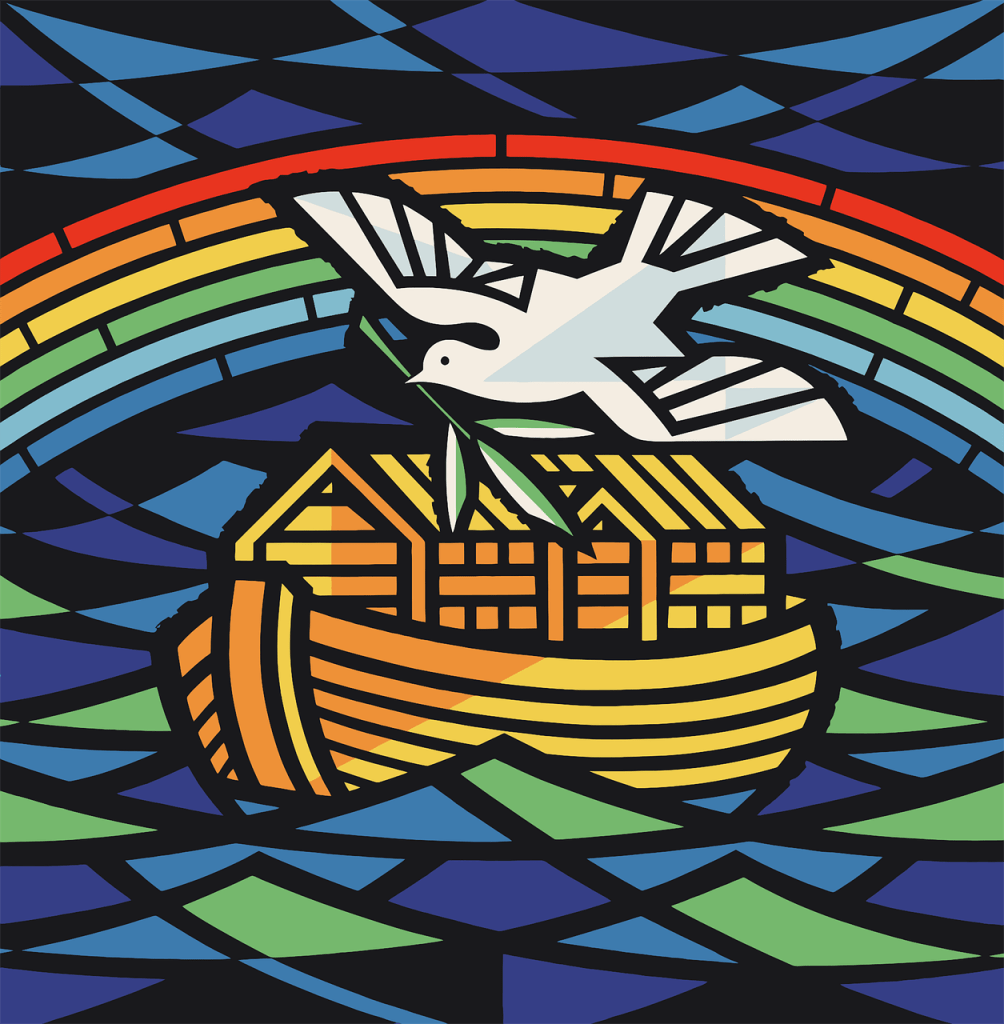
Eventually the waters recede. Noah sends out a dove to test the earth’s readiness for life. The third time the dove does not return. God tells Noah to exit the ark. Noah’s first acts on dry land are to build an altar and then to offer a sacrifice to God. This pleases God and moves God to make a covenant. There will never be another flood “to destroy the earth.” God placed “his bow” in the sky – it will be a frequent reminder to God of God’s commitment to stay in relationship with humanity. This is a gift that we rejoice in yet today.

Prayer: Lord God, what a horrible place the world became. Humanity broke your heart. Things deteriorated to the point that your justice required action. Thanks be to you, O God, that we had Noah – an example of faithful living. In your love you provided a way for the world to continue. In your grace you committed to us and to creation forever. Thank you, God. Amen.


Leave a comment

Transformed Not Conformed

Reading: Romans 12:1-2

Verse 2a: “Do not conform to the pattern of this world, but be transformed by the renewing of your mind.”

Paul shifts gears as we turn to chapter 12. The last 4 verses of chapter 11 are a doxology. This closing prayer of praise to God wraps up the focus of the last few chapters and shifts our thinking to the “how” of living as a believer. Paul begins chapter 12 urging us to “offer your bodies as a living sacrifice.” Paul, as Jesus often did, is using an old word in a new way. To the Jews a sacrifice was the lamb or dove or grain or oil that was brought to the altar in the temple. Often blood was spilled and life was lost. In other sacrifices the offering was poured out or burnt upon the altar. There was a finality to each particular sacrifice.

Paul’s call is to be “living sacrifices.” This is an ongoing giving of self to God and to others. In Jesus’ language it is dying to self again and again in order to truly love God and neighbor. So, how do we place ourselves in a position to do this? We make the intentional choice to live according to God’s will and way. It’s not easy. The world is always tugging at us. For the daily battle, Paul offers this advice: “Do not conform to the pattern of this world, but be transformed by the renewing of your mind.” Winning this battle requires an intentional choice to say “NO” to the ways and norms of the world. Saying “no” to the world allows us to say “YES” to God’s transformation of our minds. This renewing of our mind is an ongoing process. Day by day it shapes us more and more into God’s image. It brings us closer and closer to understanding and then living out God’s “good, pleasing, and perfect will.” May it be so for us all each day.

Prayer: Lord God, we need you so much in this battle to transform ourselves into who and what you call us to be. The voice of the world is so loud and so convincing at times. Elevate the voice of the Spirit over this constant buzz. Hearing the Spirit more clearly, lead us to be transformed more and more into the image and example of Christ. Amen.


Leave a comment

In All These Things

Reading: Romans 8:31-39

Verse 37: “In all these things we are more than conquerors through him who loved us.”

Our passage today begins with one great line! “If God is for us, who can be against us?” This is a great reminder once again that God is on our side. In the eternal sense we know this statement is true. But in our temporal, fragile, earthly state of being, we can question this at times. That is why these words from Paul are so vital to our faith and to our trust in God’s good plans for our lives.

Paul also reminds us that God “did not spare God’s own Son.” God actually gave Jesus up on the cross – for us. Paul then rhetorically asks, “How then will God not… also graciously give us all things?” If God loved us enough to sacrifice Jesus for our sins, won’t that great love also bless us in all other imaginable ways? Yes!

In response to a question about who or what could possibly separate us from God’s love Paul muses, “Shall trouble or hardship or persecution or famine or nakedness or danger or sword?” It is quite the list, but we could easily add to it: loss, disease, poverty… Paul really adds to it in verses 38-39. To all this and more he states in faith: “In all these things we are more than conquerors through him who loved us.” Yes, more than conquerors, more than survivors. Through Christ we are victors over this life and over all of its trials and struggles. We are victors because Christ has shown the way and because God loves us unconditionally. Thanks be to God.

Prayer: Lord God, your love is so great that it reaches far beyond the deepest grief, far past the most powerful loss, through the darkest times of our souls. It is a love so deep and wide that I cannot fully grasp its vastness, yet I can choose to stand upon your love. Thank you for this love, O Lord. Amen.


Leave a comment

Provision

Reading: Genesis 22:6-14

Verse 14: “So Abraham called that place ‘The Lord will provide.'”

In our Genesis 22 reading God provides the ram as the sacrifice. Isaac is lifted off the altar and he is replaced by this ram. It dies in his place, much as Jesus died in our place to pay the price for our sins. The ram does so that the child can live. In an act of gratitude and worship, Abraham names the place “Jehovah Jireh” – the Lord will provide.

God continues to provide for our needs. Sometimes it is by giving us the words to speak, sometimes it is by guiding us to the correct action to take. And sometimes words fail and God is directing us to simply provide presence. God provides in many other ways. A door can be opened, another closed. A meal or help in some other form can show up unexpected and meet a need.

We too can be used by God as the means of provision. Many years ago, for example, a family in our church was struggling financially. A group got together and left $1,000 in a blank envelope in their mailbox. Our financial blessings are often a way that we can be part of God providing a blessing for others. It can also be something as simple as a card or phone call – hearing “it came exactly when I needed it most” assures us of God’s hand guiding and providing.

The keys to both receiving from God and being used by God to provide for others begins with an open ear, followed closely by a willing heart. May we all be receptive to God’s working in and through us as God loves and provides for our needs.

Prayer: Lord God, use me today to accomplish your will. Use my words or my hands and feet, use my presence, O God, as you seek to love and care for our world and for all of your children. And when your will turns to me, may I humbly receive all that you have for me. Amen.


Leave a comment

Provision

Reading: Genesis 22:6-14

Verse 14: “So Abraham called that place ‘The Lord will provide.'”

In our Genesis 22 reading God provides the ram as the sacrifice. Isaac is lifted off the altar and he is replaced by this ram. It dies in his place, much as Jesus died in our place to pay the price for our sins. The ram does so that the child can live. In an act of gratitude and worship, Abraham names the place “Jehovah Jireh” – the Lord will provide.

God continues to provide for our needs. Sometimes it is by giving us the words to speak, sometimes it is by guiding us to the correct action to take. And sometimes words fail and God is directing us to simply provide presence. God provides in many other ways. A door can be opened, another closed. A meal or help in some other form can show up unexpected and meet a need.

We too can be used by God as the means of provision. Many years ago, for example, a family in our church was struggling financially. A group got together and left $1,000 in a blank envelope in their mailbox. Our financial blessings are often a way that we can be part of God providing a blessing for others. It can also be something as simple as a card or phone call – hearing “it came exactly when I needed it most” assures us of God’s hand guiding and providing.

The keys to both receiving from God and being used by God to provide for others begins with an open ear, followed closely by a willing heart. May we all be receptive to God’s working in and through us as God loves and provides for our needs.

Prayer: Lord God, use me today to accomplish your will. Use my words or my hands and feet, use my presence, O God, as you seek to love and care for our world and for all of your children. And when your will turns to me, may I humbly receive all that you have for me. Amen.