pastorjohnb

Thoughts and musings on faith and our mighty God!


Leave a comment

Service and Sacrifice

Reading: Mark 9-10

Mark 10:24 – “Children, how hard it is to enter the kingdom of God!”

Photo credit: Shane Rounce

The transfiguration of Jesus begins today’s readings. On a mountain top with Peter, James, and John, Jesus becomes “amazingly bright.” Elijah and Moses come and talk with Jesus. God speaks, saying, “This is my Son, whom I dearly love. Listen to him!” These words echo God’s words at Jesus’ baptism. Coming down the mountain Jesus finds a hubbub. The disciples were unable to cast out a demon. Jesus laments the lack of faith. The father begs Jesus for his son’s healing and admits his own lack of faith. Jesus casts out the demon. How do you think this affected the father’s lack of faith?

Jesus tells the disciples once again of his coming death. They, in turn, argue about who is the greatest among them. Jesus gathers the disciples and reminds them that the first will be the least, the servant. He explains that there is a cost to being a follower. It might cost a hand or foot or eye if that leads one into sin. Jesus is telling them to do anything to avoid sin and disobedience to God.

A rich man comes and asks about obtaining eternal life. He has kept the commands faithfully. After Jesus “looked at him carefully and loved him,” he is instructed to sell all that he has. The man goes away sad. Jesus goes on to say, “Children, how hard it is to enter the kingdom of God!” Much can get between us and Jesus. It’s not just our wealth or our possessions. When Jesus looks carefully at our hearts, what does he see that vies for the throne of our hearts?

Once again Jesus tells of his death. This time he is very clear. James and John come with a request: to sit at Jesus’ left and right in heaven. Power is their struggle. Jesus, with great patience, again tells the 12 that the greatest will be the servant and the first will be slave to all. Jesus again reminds them – and us – that he came not to be served but to serve and to give his life “to liberate many people.” May we too choose service and sacrifice.

Prayer: Lord God, humble servant, slave to all, keeping you #1 in our hearts – no, discipleship is not easy. We must first die to self – the greatest barrier to walking humbly and obediently. Guide us in this necessary and daily act of surrender. Grant us the faith and trust, the strength and courage to do so each day. Amen.


Leave a comment

“All is well…”

Reading: Jeremiah 5:1-8:16

Jeremiah 6:19 – “I’m bringing disaster upon my people, the fruit of their own devices, because they have ignored my words… rejected my teaching.”

Chapter 5 begins with a search for one just person. None can be found. Judah has forsaken God, they are “utterly faithless.” Incorrectly they think God won’t really punish their sins. But God proclaims that a distant army is coming. They will devour everything. Because God’s people have abandoned God, they will soon “serve strangers in a land not your own.” Exile is coming.

In chapter 6 God notes that all are eager for profits and notes that the prophets and priests “trade in dishonesty.” They tell themselves “All is well” but nothing is well. God invites them to turn to the ancient paths as they stand at this crossroads, to choose to walk “the good way.” Judah rejects the invitation. Therefore God says, “I’m bringing disaster upon my people, the fruit of their own devices, because they have ignored my words… rejected my teaching.” Judah is invited to put on funeral clothes, to wail and weep. Disaster is coming.

The scene shifts to the temple for chapter 7. Judah falsely believes that the temple will stand forever – it is God’s house. God longs to dwell with the people in the temple. But to be present with them, they need to radically change their ways. Only then will God dwell with them in the temple. A warning is given: don’t change your ways and God will make the temple like the tabernacle at Shiloh. It was totally destroyed by Israel’s enemy. This leads God to a lament. God recalls bringing the people out of Egypt, leading them in the wilderness, teaching them God’s ways, hoping for obedience. They too were stubborn and hard-hearted.

In chapter 8 God wonders why the people “persistently turn away.” God laments that “everyone turns to their own course.” This selfish, stubborn, rebellious, hard-hearted people are drawing closer to disaster. And they continue to tell themselves, “All is well.”

Lord God, just as you lament Judah’s ongoing patterns of selfishness, greed, lust, dishonesty, and oppression, so too do you lament these things in our day. We have changed very little. Yet a small remnant remains. Strengthen and encourage us, guide us to faithfully walk in your ancient ways. Empower us to be speakers of truth and to be bearers of love and hope, of grace and mercy. Amen.


Leave a comment

Confident and Trusting

Readings: Nehemiah 1, Nehemiah 2, Nehemiah 3, Nehemiah 4

Nehemiah 4:14 – “Don’t be afraid of them! Remember that the LORD is great and awesome! Fight for your families… sons… daughters… wives… houses!”

Nehemiah is the cupbearer to King Artaxerxes. He lives a comfortable life in the palace of the Persian king. One day some Jews returning from Jerusalem bring him news from Judah: “The captives are in great trouble and shame.” Moved by his God, Nehemiah fasts, weeps, and prays for days. Returning to work, he is still visibly upset. The king notices and inquires. In the end, Nehemiah heads to Jerusalem with letters of protection and support from the king.

The local officials are unhappy that he has arrived to rebuild Jerusalem. After rest, he secretly inspects the walls and gates at night. Gathering the Jewish leaders he basically says, ‘We’re in trouble.’ He calls them to rebuild and they respond enthusiastically. Chapter 3 contains a long list of the families that took part. The team effort and sense of connection is evident. It is based upon their identity found in God.

Sanballat and Tobiah and others oppose the work. Making fun of them turns to insulting them and then it becomes a plan to attack the Jews. News of this comes to Nehemiah and he responds by organizing the workers into family groups. He gives them this encouragement: “Don’t be afraid of them! Remember that the LORD is great and awesome! Fight for your families… sons… daughters… wives… houses!” Half the men work while half stand guard, weapons in hand. The people stay in Jerusalem overnight instead of going back home, thwarting an attack at night. Work continues to progress.

Nehemiah leads well, trusting in the God who stirred his heart to go to rebuild his ancestral home. When God or the Spirit or the Word stirs our heart, may we be as confident and trusting in the Lord.

Prayer: Lord God, what a sure faith Nehemiah had. He heard and responded and was then guided by you. Give us ears to hear, O Lord. Open our hearts to respond. Encourage our faith as we seek to serve you. Bless the work. Amen.


Leave a comment

As for Me and My House…

Readings: Joshua 18, Joshua 19, Joshua 20, Joshua 21, Joshua 22, Joshua 23, Joshua 24

Joshua 24:15 – “But my family and I will serve the LORD.”

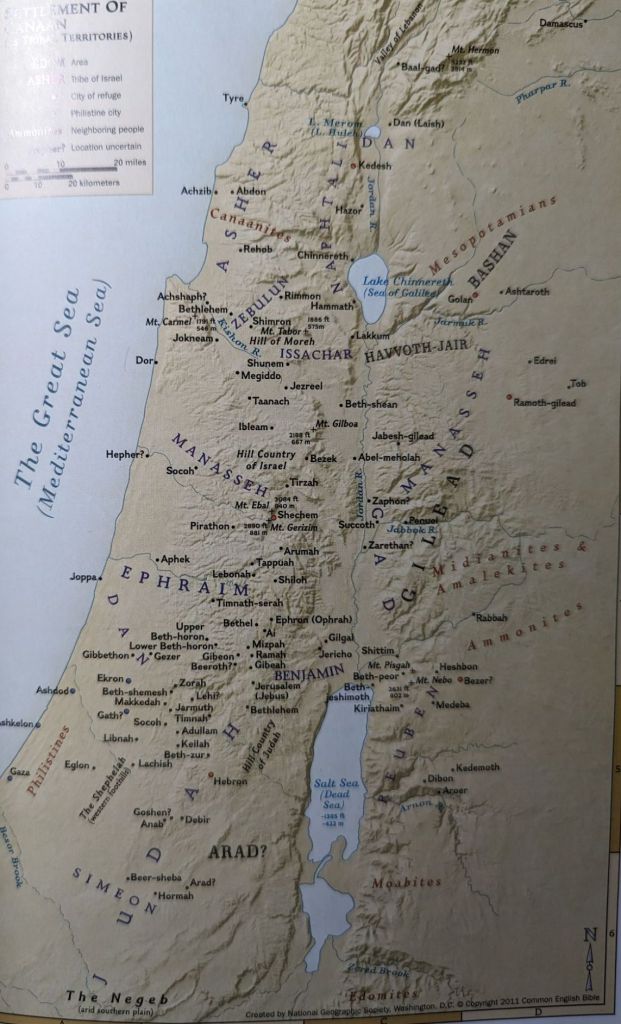
Today’s seven chapters close out the story about inheriting the Promised Land. It begins with a way to divide up the remaining land west of the Jordan. Lots are cast and land is allotted to the tribes of Benjamin, Simeon, Zebulun, Issachar, Asher, Nephtali, and Dan. Joshua also receives a legacy. Then, in chapters 20 and 21, the Levites are given cities and their surrounding pastureland. These 48 cities are spread out amongst the twelve tribes and they include the six refuge cities. God is preparing here for a day yet to come. God is good.

Now that the land legacies have been given and now that peace has come, Joshua summons the Reubenites, Gadites, and the half tribe of Manasseh. He thanks them for their faithful service and sends them home with a charge to be obedient and faithful to the Lord. At the Jordan these tribes build an altar as a witness to their belonging to the people of Israel west of the Jordan. It is a standing reminder.

Chapter 23 holds Joshua’s final words of warning. He first reminds the Israelites of all that God has done and then implores them to be faithful and obedient. Joshua warns them about mixing with the locals. They will be “a snare and a trap.” Joshua warns Israel that they will “vanish quickly” if they violate the covenant.

Chapter 24 closes Joshua’s story. He begins with a great review that takes Israel from Abram to this very moment. Joshua challenges Israel to decide “whom you will serve.” Joshua declares that he and his house will serve the Lord. So too will the people of Israel. May it be so for you and for me and for our households.

Prayer: Lord God, the story of another great leader and a meaningful period in Israel’s history comes to a close. Yet the choice at the end of Joshua remains our choice today. It’s a choice we make every day. So each day, O Lord our God, empower us to choose you. Amen.


Leave a comment

Set Apart

Readings: Numbers 5, Numbers 6, Numbers 7

Numbers 6:24-25 – “The LORD make his face shine on you and be gracious to you. The LORD lift up his face to you and grant you peace.”

Chapter 5 begins with how to keep the camp from becoming unclean and with how to restore relationships in the camp. These simple provisions hold them accountable to one another. The jealous husband case found in verses 11-31 is hard to relate to our world today. John Wesley saw the purpose of this law as twofold. First, it was a deterrent to a woman tempted by adultery. Second, it offered wives protection from the jealousy of hard-hearted husbands. No provision is made anywhere in the Law for a woman who suspected her husband of adultery.

Chapter 6 gives instructions for nazarites. These were non-Levites who wanted to commit a portion of their lives to serving the Lord. Because they were not Levites they could not perform tabernacle duties. They were set apart by following a strict behavioral code. Samson and Samuel are two examples of nazarites who served for life. Most nazarites would serve for a designated period of time. At the end of their service they would offer the standard cycle of offerings to the Lord.

Chapter 7 is a flashback. It recounts the gifts brought to the dedication of the tabernacle written about in Exodus 40. Oxen and wagons are given to enable the Levites to transport the structure of the tabernacle. Then one representative from each tribe brings the same set of gifts to dedicate the altar. The gifts are brought in the order established in Numbers 2.

Our reading closes with Moses entering the tent of meeting to talk with God. This scene connects back to God’s promise made in Exodus 25. Tucked in at the end of chapter 6 is a priestly blessing. We close with a portion today: “The LORD make his face shine on you and be gracious to you. The LORD lift up his face to you and grant you peace.”

Prayer: Lord God, we, like the nazarites, are called to be set apart from the world. Instead of physical practices we are called to spiritual practices that reflect your love, grace, mercy… thereby setting ourselves apart from the world. Empower us to live in your ways. Grant us peace as we seek to live as your disciples. Amen.


Leave a comment

Building God’s Dwelling

Readings: Exodus 35, Exodus 36, Exodus 37, Exodus 38, Exodus 39, Exodus 40

Exodus 40:33-34 – “When Moses had finished all the work, the cloud covered the meeting tent and the LORD’s glorious presence filled the dwelling.”

Photo credit: Kyle Johnson

Today’s six chapters cover the construction of the tabernacle. To accomplish this monumental task God and Moses call for a free will offering. So great is the generosity of the people that Moses finally has to say, “Stop!” In total the people brought 2,200 pounds of gold, 7,500 pounds of silver, and 5,300 pounds of copper/bronze – not to mention the cloth, yarn, gemstones, wood, spices… The census was taken. 603,500 men give their half shekel to the sanctuary of God.

Leaders are appointed and the work begins. Men and women contribute. It is a community effort. This project is like a lot of church projects. Generous hearts and willing hands are needed. As it was then so it is now: the people are the heart and soul of the community of faith. The work is done exactly as the Lord has commanded in Exodus 25-31. Every detail is done exactly as the Lord desired. What an example of obedience and attention to detail. In this way it reflects the creation story.

The work is done and the tabernacle is erected. Everything finds its place and the priests are blessed. Moses blesses the people for their work just as God blessed creation when that task was completed. In verses 33-34 of chapter 40 we read, “When Moses had finished all the work, the cloud covered the meeting tent and the LORD’s glorious presence filled the dwelling.” Exactly one year after Israel was delivered from Egypt, the tabernacle is finished and God’s presence comes to dwell among the people. This is the fullest expression of God’s presence in the Old Testament. It expresses God’s desire to be with all people. This desire continues today. Thanks be to God.

Prayer: Lord God, you were present in and through this magnificent process. You opened hearts and hands to give and serve. Through this your glory was revealed. Continue to be present in and through us, O God. Continue to open our hearts and hands in service to you, O Lord Almighty. In and through us may your glory be revealed! Amen.


Leave a comment

How God Does It

Reading: Joshua 24:16-25

Verse 24: “We will serve the Lord our God and obey God.”

After declaring that he and his house will serve the Lord, Joshua turns the focus to the people. In today’s passage the people respond to Joshua’s declaration with a recounting of God’s power and presence among them. This recounting ends with “We too will serve the Lord because he is our God.” Joshua challenges this statement. Maybe you’ve done this too with that friend who is less than stellar about walking the walk. They’re maybe quick to volunteer but seldom show. They’re great at committing to things but not so good on following through.

Joshua bluntly tells the people that they are not able to serve God. He tells them that God is jealous and holy. He tells them that God will not again and again forgive their rebellion and sin. The people say, “No! We will serve the Lord!” His challenge to their original commitment raises the bar. He is saying they can’t just talk the talk. That’s easy. Joshua then calls them as witnesses against themselves. He is doubling down, asking them if they’re really, really, really sure. Joshua then once more commands them to “throw away” their idols. In turn the people commit to God once again, saying, “We will serve the Lord our God and obey God.”

As I read this passage and note how Joshua questions their commitment again and again, I wonder how God does it. When I’ve struggled with a difficult sin, I come to God again and again with words of confession and repentance. Each time, yes, I’m a little more committed to actually changing. Each time God’s Spirit convicts me a little quicker, a little more deeply. Each time the Spirit increases my resolve, helping me to better walk the walk. How does God do it? Through unconditional love and unending grace. What an awesome God we serve.

Prayer: Lord God, as I consider the wilderness wanderings of the Israelites and as I think about my own wanderings, I am amazed at your continued presence. In my human understanding it is hard to fathom, hard to comprehend. So great is your love for us, so deep is your mercy, so wide is your forgiveness. I am humbled. I bow before you and say thank you, thank you, thank you. Amen.


Leave a comment

Convinced

Reading: Philippians 1:21-26

Verse 25: “Convinced of this… I will continue with all of you for your progress and joy in the faith.”

Paul writes to the Philippian church from prison. Being in a place like that can lead one to take stock of one’s life. Earlier in this chapter he notes that his current imprisonment has “really advanced the gospel.” He sees God’s plan at work and he embraces his role in that plan – even if he finds himself in chains. Picture that as we read and consider these words today.

Our text opens with Paul writing, “to live is Christ and to die is gain.” In prison, his life hangs in a delicate balance. He has been and is being used to advance the gospel. He also knows that to die is to gain heaven and to be in his beloved Christ’s presence once again. Paul is torn between the two. Going to be with Jesus “is better by far.” To remain on earth, however, “is more necessary for you.” Have you ever felt this tug of war in your soul?

Understanding his place in God’s plan, Paul writes, “Convinced of this… I will continue with all of you for your progress and joy in the faith.” He chooses God’s will over his own will. The needs of this church (and probably other new churches and Christians) takes priority over Paul’s desire to see Jesus Christ in eternal glory. The connective tissues of community and the call to serve God and one another is what convinces Paul of this commitment. Like Paul, we too have a role to play in God’s plan to advance the gospel. May we too be convinced of and committed to our role as we seek to build the kingdom of God in this time and place.

Prayer: Lord God, help me to better sense the call, as Paul so clearly did. Lead me to know your plans more assuredly and to step into them more fully. Use me day by day to build up your kingdom here on this earth, O Lord. Amen.


Leave a comment

Choose Grace

Reading: Romans 6:12-14

Verse 14: “For sin shall no longer be your master, because you are not under the law, but under grace.”

Photo credit: Jon Tyson

Paul writes to the Christians in Rome. It is a body of believers made up of both Jewish Christians and Gentile Christians. They are struggling with the place of the Law in the life of the church. Paul recognized that trying to be righteous through adherence to the Law was not sufficient. Through Christ he came to understand that grace was necessary in the battle against sin. With only the Law, the guilt and shame remained. One remained dead in their sin. Only through grace could one be made new again. Only through a saving relationship with Jesus would one die to sin’s power, becoming a new creation in Christ that was “no longer slaves to sin.”

In today’s text Paul recognizes the battle between sin and God. He saw this as a choice – certainly daily but more realistically moment by moment. The choice was whether we would let sin reign or let God reign. Paul encourages us “not to let sin reign in your mortal body.” The evil desires are there. Temptation is real. So too is the power of Christ to withstand these temptations. To that end, Paul instructs us to “offer ourselves to God” as we seek to be people of love and grace. Paul invites us to choose holy living.

Paul challenges the Romans Christians and all who would choose Christ to honor God with all of our choices. We are called to speak words of love, healing, and grace – not words of hate, gossip, and slander. We are to offer our hands in service to God and one another – not as instruments to take and hoard for ourselves. Following just the Law does not produce the love in our hearts that leads us to be Christ in the world. It is grace that produces love – a love that leads us to live as witnesses to Christ’s love and grace. It is a choice. May we choose grace.

Prayer: Lord God, the battle is a regular part of life. You know this well. You created us with the ability to choose life or death, sin or holiness. Fill us with the power of the Holy Spirit, Christ alive in us, so that our choices and our living bring you the glory. Amen.


Leave a comment

Expressing Gratitude

Reading: Psalm 116:1-2 and 12-19

Verse 12: “What shall I return to the Lord for all his goodness to me?”

Psalm 116 begins with an expression of love for the God who heard the psalmist’s cry. There is a recommitment of faith because God has turned an ear to the prayers of the psalmist. In our lives there are often times when we connect with God, when we feel that God has heard our prayers. Experiences such as these bolster our faith too.

In verse 12 the psalmist asks, “What shall I return to the Lord for all his goodness to me?” To me this is a natural response. When someone does something nice for us, for example, we seek an opportunity to do something nice for them. We want to return the favor. When we feel that God has answered a prayer, blessed us, or has somehow touched our lives, our natural response is to repay God or to return the favor in some way.

For the psalmist this response first took the form of service. It was praising God and fulfilling his or her vows. This can be and maybe is your response: to serve God. That may involve being a part of a ministry or volunteering at church or with another organization. It may involve doing something for a friend or neighbor.

The psalmist also gives a “thank offering.” For the psalmist this likely would’ve been an animal sacrifice in the temple. For us that might translate to giving a financial gift or into going above and beyond in meeting someone’s needs. There are many ways that we can offer our thanksgiving to our God who blessed us richly. This day and every day, may thanksgiving be a habit.

Prayer: Lord God, guide me daily to first see the many blessings in my life. Then, Lord, move me to respond with thanksgiving. Guide me to bring you the glory in whatever way I find to express my gratitude to you. Amen.