pastorjohnb

Thoughts and musings on faith and our mighty God!


Leave a comment

The Kingdom of God

Reading: John 18:33-38a

John 18:36 – “My kingdom doesn’t originate from this world.”

As we continue in John’s passion story, Jesus is before Pilate for a second conversation. Verses 28-32 hold the first exchange. In this encounter it is clear that the religious leaders want Jesus charged and killed. In the words John shares, there is no stated charge. It is clear that only Pilate has the power and authority to bring about Jesus’ death. As we turn to verse 33 we can infer that there must have been more to the conversation about Jesus. In this verse Pilate asks Jesus, “Are you the king of the Jews?” This is a question without a “yes” or “no” answer in this setting.

Jesus responds with a question. He is trying to force Pilate’s hand. As the conversation continues, Pilate shares that the Jews and chief priests have handed him over. Pilate’s “What have you done?” reveals his level of concern. Prior to this, Jesus was not on Rome’s radar. If Jesus is indeed a rebel with messianic claims then he is a threat to Rome. If not, Pilate has no issues with Jesus. Jesus confirms that he is not a physical threat to Rome, stating, “My kingdom doesn’t originate from this world.”

Pilate hears “kingdom” and asks Jesus if he is indeed a king. Again, not a yes/no question. Jesus tells Pilate that he came into the world “to testify to the truth.” Pilate scoffs at this answer but is sure that Jesus is no threat to him or to Rome. No, Jesus is not an immediate threat. But Jesus is a threat to all worldly kingdoms.

Jesus is a threat because of what “truth” is. Jesus came to fulfill God’s covenant plan. He revealed in word and deed what it looks like to love God and neighbor with all of one’s being. This impacts all of our relationships and all of our choices – social, religious, personal, vocational, political, economic. The world’s kingdoms run on selfishness, greed, power, pride. Yes, Jesus’ kingdom is a threat to the kingdoms of this world.

Prayer: Lord God, we feel the pull of both of these kingdoms. Part of us is human so we feel the call for more, for self. Yes we are also of your kingdom, brothers and sisters in Christ. Guide us to align our hearts, our words, our actions with your kingdom. Use us to build your kingdom here on earth. Amen.


Leave a comment

Do as I Do

Reading: John 13:12-17 and 34-35

John 13:15 – “I have given you an example: Just as I have done, you also must do.”

Photo credit: Felipe Correia

After washing the disciples’ feet, all twelve pairs, Jesus returns to the table. He asks them, “Do you know what I’ve done for you?” Jesus is not going for “washed our feet.” Acknowledging his role as Teacher and Lord, he calls them to also be willing to wash each other’s feet. A disciple was to model the sacrifices made by their teacher, to follow their example. Jesus reiterates this cultural norm when he says, “I have given you an example: Just as I have done, you also must do.” Do as I do.

Now, this is just an example. Foot washing isn’t the only act of service Jesus calls his disciples to. He intentionally chose the lowest, most menial task in their present setting to illustrate his call to serving one another. We will all face unpleasant, menial, low-level tasks and situations. Will we humbly and willingly choose to serve or will we look around to see who we can force to do said task…? Jesus says: do as I do.

Jesus then elevates the call as we get to verses 34-35. I, you, we can go through the motions. We can do the hard thing when others are watching. Here Jesus calls his disciples to an always command to “love one another.” Fleshing this command out, he says, “Just as I have loved you, so you must love one another.” His love was unconditional covenant love. It is a love that remains committed and obedient no matter what. Of this kind of love, Jesus says, do as I do. May it be so.

Prayer: Lord God, it would be easier to just kinda love like you love. Maybe we could pick and choose? Oh, but you loved Judas. You washed his feet, just like the rest. And Peter’s too. If there were any not to pick that night… Lord, help us to do as you do, to love as you love. Guide us to live out the love that you modeled 24/7. Help us to love this way. Amen.


Leave a comment

More Is Better

Reading: John 13:1-9

John 13:7 – “Jesus replied, ‘You don’t understand what I’m doing now, but you will understand later.”

The scene today is the celebration of the Passover meal. Present are Jesus and the twelve disciples. This is the fourth time in four weeks that we’ve read about this night. In Matthew, Mark, and Luke the focus is on the sharing of the bread and the cup, on the establishment of the new covenant. In all three the story then moves to the garden and on to arrest. In John’s gospel there is no bread or cup. John places the meal about half way through his story. Much is spoken by Jesus before his arrest happens in John 19. This is but one example of John’s disregard for time and historical sequence.

As chapter 13 begins we see that Jesus’ knows that “his time had come to leave this world.” Ever the one to love and serve, Jesus leaves the disciples one more tangible example of both. The meal is under way. Jesus knows that Judas will betray him. Jesus gets up, takes off his robes, and begins washing and drying the disciples’ feet. There is great symbolism in Jesus’ act. Taking off his robes is symbolic of taking off divinity to dwell in the flesh. Kneeling and performing this lowly, menial task is symbolic of how we are to serve others. The washing itself is symbolic of baptism, where our sins are washed away.

When Jesus comes to Peter, he protests. Jesus replies, “You don’t understand what I’m doing now, but you will understand later.” We also experience this is our faith journeys. Only later, through prayer or study or through the Holy Spirit’s presence do we come to understand what Jesus did for us. After some back and forth, the all-in Peter asks Jesus to wash his hands and feet too. If a little Jesus is good, more is better. While this is true, often it is only later that we, like Peter, truly understand what it is that we are asking for.

Prayer: Lord God, thank you first for the call to love and serve. It is who and what we are called to be as followers of Jesus. Grant us the courage and the willingness to do even the lowest things in our efforts to love and serve the other. And, Lord, lead us to seek to be more and more like Jesus. Empower us to do whatever you place before us. Amen.


Leave a comment

The King of…

Reading: John 12:12-19

John 12:13 – “They took palm branches and went out to meet him. They shouted, ‘Hosanna!'”

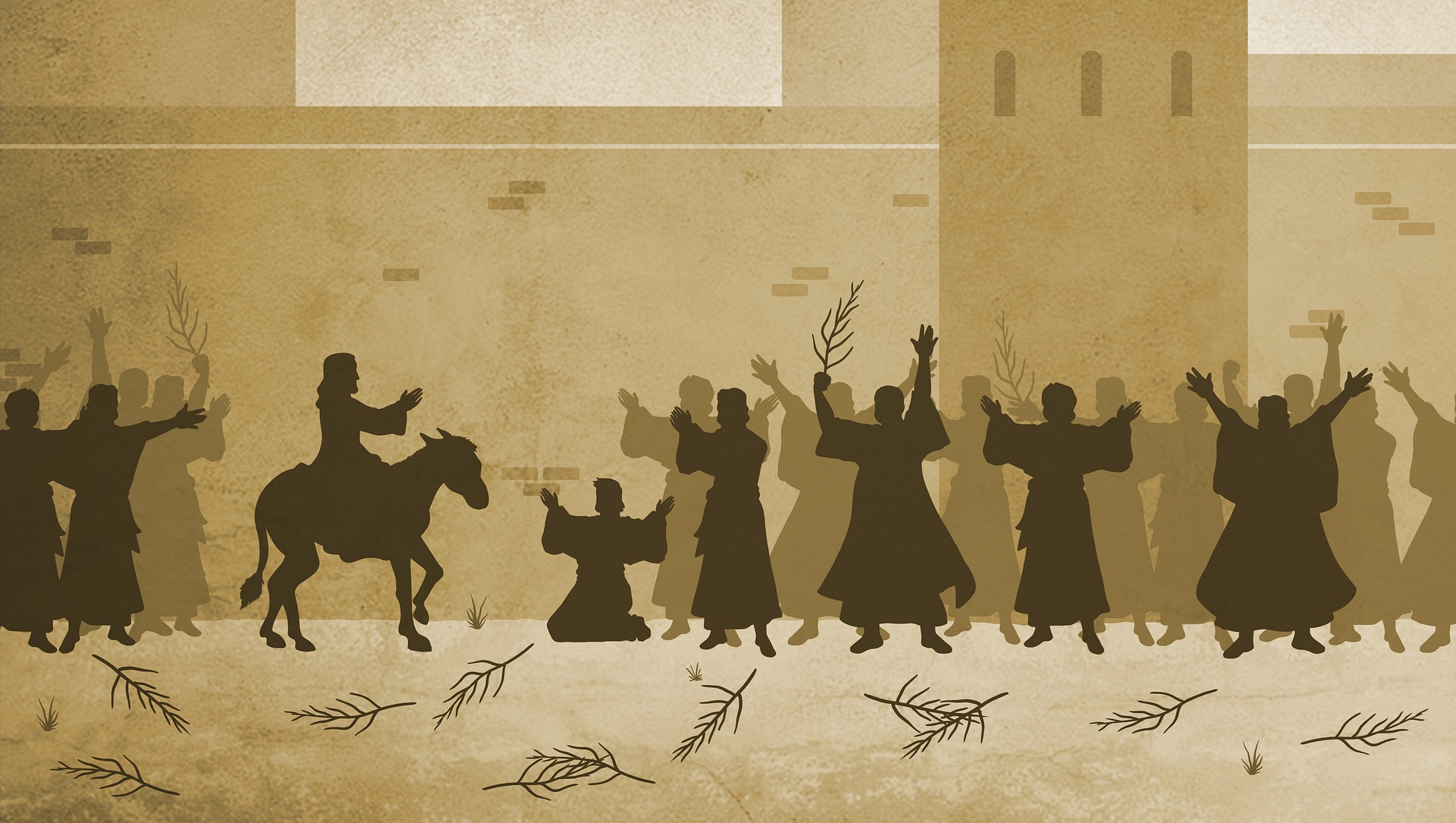
Entering into Holy Week in the gospel of John, we begin the passion of the Christ with Jesus’ triumphal entry into Jerusalem. Unique to his gospel, John gives a reason for the large crowd that celebrates Jesus. People were buzzing over Jesus calling Lazarus out of the tomb after being dead for four days. In 12:10 we read of the jealousy caused by this miracle: “The chief priests decided that they would kill Lazarus too.” This jealousy shows out in verse 19 too, where the Pharisees pettily says, “Look! The whole world is following him!”

In verse 12 we read that the “great crowd” in town for the Passover festival heard that Jesus was coming. So, “They took palm branches and went out to meet him. They shouted, ‘Hosanna!'” The word “hosanna” translates to “save us, we pray!” Also from the Psalms, the crowd offers blessings to “the one who comes in the name of the Lord.” The crowd identifies Jesus as “the king of Israel.” Mid-story Jesus finds a young donkey and begins riding it. He too claims the title of “king,” quoting from the prophet Zechariah.

John admits, in verse 16, that the disciples didn’t connect the dots at first. John and his fellow disciples wouldn’t understand the meaning and connections until after Jesus died and rose. The indwelling presence of the Holy Spirit would help with this. In the same way, the Holy Spirit leads and guides is in our faith if we are willing to listen and obey.

Prayer: Lord God, we see a crowd caught up in the miracle Jesus offered. They cheer and shout. We too can do these things. We can come to Easter and shout “He is risen!” Then the Monday after is like any other Monday. Lord, may it not be so. Draw us deeper into our faith. Through the power and presence of the Holy Spirit, bring us understanding and obedience too. Lead and guide us to see and follow Jesus as the one who sits on the throne of our hearts. Amen.


Leave a comment

He Came to Save

Reading: John 3:13-17

John 3:17 – “God didn’t send his son into the world to judge the world, but that the world might be saved through him.”

As we turn to the gospel of John for the week ahead, today we read one of this gospel’s most well known verses: “God so loved the world…” This verse is seen on signs at ball games, on T-shirts, on artwork in homes and houses offices. It is an important reminder of the depth of God’s love for us and of the gift that Jesus’ sacrifice was for you and for me.

In verse 13 we’re reminded of the incarnation, itself a sacrifice. Paul reminds us that Jesus emptied himself, giving up his divinity to come to earth in the flesh. Coming from heaven also allowed Jesus insight into what he would die for: so that we could one day join him there.

Connecting to the healing and life that the Israelites received in the wilderness when Moses lifted the golden serpent (Numbers 21,) Jesus declares that he must be lifted up for us to receive eternal life. Is he referring to being lifted up onto the cross, being lifted up out of the grave, being lifted up into heaven, or all three?

Jesus’ death and resurrection defeated the powers of sin and death. We are forgiven and raised to new life through these actions of Jesus on our behalf. In verse 17 we read, “God didn’t send his son into the world to judge the world, but that the world might be saved through him.” Jesus did not come to judge or to condemn. He came to save – to save us from ourselves, from the lies of the world, and, yes, from the powers of sin and death. Thanks be to God.

Prayer: Lord God, thank you for your great love for us. It was revealed first in your taking on flesh. It culminated in sacrificing that flesh as the atonement for our sin. All so that you could save us. What a deep love you have for us, your sons and daughters. Thank you, Lord. Amen.


Leave a comment

Today

Reading: Luke 23:32-43

Luke 23:41 – “But this man has done nothing wrong.”

Photo credit: Thanti Nguyen

Most of Luke’s account of Jesus’ crucifixion takes place in our reading for today. In some ways Jesus is treated like a common criminal. He is crucified between two. His charge is placed above his head: “This is the king of the Jews.” Like the crucifixion itself, the posting of the charge was also a deterrent.

Almost everyone present mocks or insults Jesus. The religious leaders mock the one who saved others. If he really was who he said he was then he’d save himself. The soldiers mock his kingship. If he really was a king, he’d surely be able to save himself. One of the criminals being crucified insults Jesus for not saving himself – and his fellow criminals. All of these people understand “save” in a different, more limited context. The immediate situation is all they are thinking about. Perhaps that is part of the reason Jesus prays at the outset, “Father, forgive them, for they don’t know what they’re doing.”

The second criminal sees beyond this moment on the cross. He rebukes the other criminal, admits that they are “tightly condemned,” and states, “But this man has done nothing wrong.” Grasping who Jesus truly is, this man asks Jesus to remember him “when you come into your kingdom.” This repentant man is told, “Today you will be with me in paradise.” Today. Not some distant, future date. Today. The same is true for us. When we ask Jesus to remember us, he is present with us today. The kingdom of God is here and now. Jesus is with us here and now. Thanks be to God.

Prayer: Lord God, help us to see and to live into your kingdom here on earth. Open our hearts to feel your presence. Open our eyes to see you with and among us. And, Lord, use us to build your kingdom here on earth as we seek to be love and light to the world. Amen.


Leave a comment

The Upside-down Kingdom

Reading: Luke 16:25-26

Luke 16:25 – “Child, remember that during your lifetime you received good things.”

Photo credit: Ricardo Gomez Angel

Today we step into the middle of the parable of the rich man and Lazarus. We read two verses from the middle of the story. If unfamiliar with this parable, for greater context please read verses 19-31. Today, though, we focus on the two verses that speak to the nature of God’s upside-down kingdom.

Speaking to the rich man who is being tormented in hell, Abraham says, “Child, remember that during your lifetime you received good things.” Abraham’s referring here to the rich man’s wealth and all the fine things that entrapped the rich man, blinding him to the beggar outside his door. That beggar, Lazarus, lived a terrible life on earth. He begged for his survival. He suffered illness. Now, by Abraham’s side, Lazarus is being comforted.

Of this parable John Wesley writes, “It is no more sinful to be rich than to be poor. But it is dangerous beyond expression.” In the kingdoms of this world, wealth and extravagance are valued, sought. This can lead to greed, hoarding, selfishness. These tend to isolate one from the world right outside ones gated properties. It was easy for the rich man to ignore Lazarus and his desperate needs.

In verse 26 Jesus addresses the impassable separation between heaven and hell. There is absolutely no crossing over. Having wealth – or power or status or anything else the world values – is of no consequence in God’s upside-down kingdom. Having a heart that feels and eyes that see and hands that respond to the other – these are what matter to God. These absolutely matter in God’s kingdom – here and in the life to come.

Prayer: Lord God, so many of us are richly blessed. We have the “conveniences of life” that Wesley warned of. Lord, ever turn our hearts and eyes away from our stuff. Ever guide us to see and respond to the immediate needs right before us. Lead us to live daily as your love expressed in the world. Amen.


Leave a comment

Radical Love

Reading: Luke 6:27-31

Luke 6:31 – “Treat people in the same way that you want them to treat you.”

Photo credit: Christopher Beloch

Today’s passage begins with “But I say to you.” This is a familiar phrase Jesus uses, especially in the Sermon on the Mount. As Luke employs this phrase, he adds to it. His phrasing includes “to you who are willing to hear.” This is Luke’s way of getting his readers, including us, ready to take in and wrestle with a difficult teaching.

In verses 27 and 28 Jesus encourages us to “love your enemies… do good to those who hate you… bless those who curse you… pray for those who mistreat you.” This kind of love is counter-cultural. It calls the followers of Christ to act in a way that surprises the world. Instead of returning hate for hate, which is the norm, do good instead. Radical.

The next two verses provide real world examples. To offer the other cheek, to give your shirt too, to not expect repayment – these too run against the cultural norms. Our culture teaches us to hit back, to hold tightly to all that is ours, to charge high interest. Not so with Jesus. Here he call his followers to a self-sacrificial, others first kind of love. This kind of radical behavior is something that also surprises the world.

Our reading closes with a well known maxim: “Treat people in the same way that you want them to treat you.” This kind of love is given regardless of who the other person is or isn’t, regardless of what they’ve done or not done. This radical love comes from within us. It is motivated by Christ’s example and it is empowered by his Spirit. It is a love for all people. May this be a live we embody and practice daily.

Prayer: Lord God, what a call we hear today: love all people, especially when it is hard or costly or both. Your counter-cultural and counter-instinctual call to sacrificial love is challenging, but so powerful. Walk with us and enable us to overcome evil with good, hate with love, greed with generosity. Use us to change the world. Amen.


Leave a comment

Kingdoms

Readings: Luke 22:6-12 and 13:31-33

Luke 13:32 – “Go, tell that fox, ‘Look, I’m throwing out demons and healing people today and tomorrow, and on the third day I will complete my work.'”

As Jesus’ path to the cross continues, there is a detour in Luke’s gospel. Hearing that Jesus is from Galilee, Pilate sends him to Herod Antipas, the ruler of that region. Pilate is trying to extricate himself from this sticky situation, thrusting it upon his political enemy. But Herod is happy to see Jesus – at first. He’s wanted to see Jesus for a long time. Herod has heard the stories and hopes that Jesus will “perform a sign” for him.

Jesus refuses to answer any questions and Herod’s curiosity turns to anger and mockery. Dressing Jesus in “elegant clothes,” he sends Jesus back to Pilate. This wasn’t Herod’s first exposure to Jesus, though. In chapter 13 the religious leaders warn Jesus that Herod wanted to kill him. Herod was notoriously violent and unstable, especially against anyone he saw as a threat to his power. The bad blood with Pilate began long ago when Herod and his brothers had Pilate charged and punished by Tiberius Caesar. And Pilate ruled over the land once ruled by Herod the Great, Herod Antipas’ father.

In chapter 13, in response to Herod’s threat, Jesus says, “Go, tell that fox, ‘Look, I’m throwing out demons and healing people today and tomorrow, and on the third day I will complete my work.'” The Jews saw foxes as destructive and worthless pests. This was not a compliment. The casting out and healing were signs of God’s kingdom amongst the people. Jesus’ finished work on the third day, resurrected to life, would validate his claims of bringing the kingdom to earth. Working together against this perceived threat to their power, Pilate and Herod became friends that day. So it is with the kingdoms and powers of this world.

Prayer: Lord God, in Pilate and Herod we see two men with power willing to do anything to hold onto or to build that power. We see this in our world today as people strive and connive to gather more power, wealth, status… Jesus’ kingdom runs counter to these ways of the world. His is a kingdom of healing, giving, and pouring out of self. O God, draw us into this kingdom and use us to build your kingdom in our time and place. Amen.


Leave a comment

The Lord Reigns

Readings: Luke 22:67-69 and Acts 7:56

Luke 22:69 – “But from now on, the Human One will be seated on the right side of the power of God.”

Photo credit: Fuu J

As the passion of the Christ continues to unfold in Luke’s gospel, the religious leaders ask Jesus if he is the Christ, the Messiah. Jesus begins by addressing their hard hearts. No matter what Jesus says or even asks the religious leaders they will not believe that he is God’s Son. If they did or even thought that he might be, Jesus would not be standing trial before them. Jesus is calling out the hypocrisy of their question.

To answer their question, Jesus paraphrases from Psalm 110:1. In verse 69 he says, “But from now on, the Human One will be seated on the right side of the power of God.” This Psalm of David reaffirms the messianic promise of God, offering hope for Israel’s future. David refers to this coming Messiah as “my Lord.” In claiming to fulfill the words of David, Jesus infuriates the religious leaders. For them this seals Jesus’ fate.

Fast forwarding a few years, we turn to Acts 7. The apostles and followers of Jesus Christ have been spreading the good news in both word and deed. The church is growing. This has heightened the tension and conflict with the Jewish religious leaders. Overcome with jealousy, the religious leaders began harassing the church. Stephen “stood out among the believers.” God’s grace was clearly at work in his life. There is a conflict and false charges are made up. Stephen is arrested and finds himself before the ruling council. Stephen outlines Israel’s history for these religious leaders, greatly angering them. Empowered by the Holy Spirit, Stephen declares, “Look! I can see heaven on display and the Human One standing at God’s right side!” In anger, the religious leaders stone Stephen..The truth is too hard to hear.

Prayer: Lord God, from the lips of David to the lips of Jesus to the lips of Stephen, the message remains: Jesus is Lord. This day we humble ourselves and ask that you would reign in our hearts and in our lives, Lord Jesus. Amen.