pastorjohnb

Thoughts and musings on faith and our mighty God!


Leave a comment

Faithful Love

Reading: Psalm 118:1-2 and 19-24

Psalm 118:22 – “The stone rejected by the builders is now the main foundation stone!”

Psalm 118 is a song of praise that celebrates God’s deliverance. Originally used as a song that was sung after the Passover meal, it celebrated Israel’s exodus from slavery in Egypt. These words, however, also carry a broader meaning. This song extolling God’s love and goodness can be applicable at other times.

Verses 1 and 2 would’ve been used call-response style. The leader would declare verse 1: “Give thanks to the Lord, because he is good, because his faithful love lasts forever.” The gathered people would respond: “God’s faithful love lasts forever!” What a great reminder as one begins to offer a response to the Lord.

Skipping to verses 19-24, the scene shifts to the temple entrance. The writer asks for the gate to be opened. The response reminds the people that only the righteous may enter the Lord’s gate. Qualifying and entering the temple, the psalmist thanks God for answering his or her prayers. This prayer is about restoring Israel. In verse 22 we read, “The stone rejected by the builders is now the main foundation stone!” Restoring what was once held in slavery and oppression, Israel is once again God’s people, living in the Promised Land. Israel rejoices in and celebrates this time of salvation.

These verses also connect to Jesus. On this Holy Saturday we can rejoice and celebrate that the one who was rejected and killed by Israel’s religious leaders has become the cornerstone. In and through his death we’ve been freed from our slavery to sin. Tomorrow we celebrate the salvation given to us through his resurrection. Thanks be to the God whose faithful love lasts forever and ever!

Prayer: Lord God, we celebrate and rejoice in your great love for us. Walk with us and draw us into your righteousness. Lift our voices in praise and our lives in faithful witness to your saving grace. Amen.


Leave a comment

Our Great High Priest

Reading: Hebrews 10:19-24

Hebrews 10:19 – “Brothers and sisters, we have confidence that we can enter the Holy of Holies by means of Jesus’ blood.”

Hebrews 10 begins with a description of Christ’s “once-for-all” sacrifice. The author explains that Jesus, through his sacrificial death, put an end to the old sacrificial system. This system was unable to “take away our sins.” In addition, the mechanics of the system prevented a personal connection to God. The priest heard your sin and offered the atoning sacrifice on your behalf. There was also a second barrier to God. The Holy of Holies, the space which held the ark (God’s presence,) was separated off by a huge curtain. The high priest alone entered this most intimate and sacred space just once a year, seeking forgiveness and blessing for the people of God.

Verses 19-24 are a summary of what Christ’s sacrifice means for us. In the first verses we read, “Brothers and sisters, we have confidence that we can enter the Holy of Holies by means of Jesus’ blood.” As Christ breathed his last breath the curtain in the temple was literally torn in two, top to bottom. The physical barrier was removed. Christ opened the way, “a new and living way,” so that we could have a personal relationship with God. Christ is our new “great high priest” that invites us to draw near to God with a genuine, cleansed heart. Forgiveness and cleansing are ours every time we confess and repent of our sins. Jesus’ blood was and is the “once-for-all” sacrifice that stones for our sin. Hebrews also reminds us that we can “hold onto the confession of our hope,” because Jesus is faithful. We have confessed Jesus Christ as our Lord and Savior. It is only in and through him that we can remain faithful too. Thanks be to God.

Prayer: Lord God, thank you for the new covenant, one written on our hearts because Christ’s Spirit dwells in our hearts. This personal and intimate connection is a great gift. You are with us always. Lord, lead and guide us to live out our faith, encouraging one another in love. May this love lead us to be and do good in the world, drawing others into the new and living hope that we have in you. Amen.


Leave a comment

What God Has Done

Reading: Psalm 22:19-31

Psalm 22:22 – “I will declare your name to my brothers and sisters; I will praise you in the very center of the congregation.”

Photo credit: Robert Linder

Returning to Psalm 22 today we pick up on the desperate tone that dominated yesterday’s verses. David invites God, his strength, to come quickly and to help and deliver him. He pleas for rescue from the dogs, lion, and wild oxen that surrounded and threatened him. At the end of verse 21, though, there is a shift: “you have answered me!”

In verses 22-31 David offers a hymn of praise. In verse 22 David writes, “I will declare your name to my brothers and sisters; I will praise you in the very center of the congregation.” God’s rescue and restoration are worthy of his praise and worship. In the New Testament, in Hebrews 2:12, the author claims these words for Jesus. Jesus’ life and ministry declared who and what God was and is. His “work” was done in Israel, then center of God’s people.

David also sees a widening of the circle in verse 29. Here he declares that both the rich and powerful and the lowly and downtrodden will worship and kneel together before God. The inclusion of all peoples is a theme begun by Jesus and expands as the church moves out into the world. As the Psalm concludes, David looks to the future. He foresees a time when future generations will learn of the Lord. From Jesus’ life and example people will declare God’s righteousness, “telling them what God has done.” This is the sharing of the good news. As it was for the disciples and apostles, may it be for you and for me as we share our faith.

Prayer: Lord God, thank you for the rescue from those things that surround and assail us too. Thank you for your answers to our pleas. Lead us to declare what you have done. Guide us to speak of the rescues and transformations that you have worked in our lives again and again. Each day use us to witness to your love and grace. Amen.


Leave a comment

All for Us

Reading: Psalm 22:1-18

Psalm 22:7-8 – “All who see me make fun of me… ‘He committed himself to the Lord, so let God rescue him ‘”

Photo credit: Emily Crawford

In these words of David there is lament, sorrow, pain, abandonment. As we read these words we can feel what David was going through. Perhaps you, like me, connected back to an experience in your life when you felt these emotions. Jesus felt them. Throughout this Psalm we see connections to the passion of the Christ.

David begins with words Jesus echoes from the cross: “My God, my God, why have you left me all alone?” Taking the sin of the world upon himself, God could not look at Jesus. David then recalls times – both personal and corporate – when God rescued, saved, answered the prayers and cries for help. That trust and faith still wants to be there. The pain and suffering just makes it hard.

David is being “insulted by one person, despised by another.” On the cross, Jesus endured taunts, insults, mocking. In verses 7-8 we read, “All who see me make fun of me… ‘He committed himself to the Lord, so let God rescue him.'” The gospels echo these last words, spoken by the religious leaders who orchestrated Jesus’ crucifixion. In verses 9-11 there is a slight reprieve to the difficult emotions. David recalls a life committed to God. He asks for God’s presence. In the garden there are moments of intimate prayer between Jesus and God. Reflecting his own commitment and obedience, Jesus says, “Not my will…”

On the cross, as it was in the Psalm for David, it must’ve felt like everyone was against Jesus. He must’ve felt surrounded. Jesus’ life was poured out like water for us. The soldiers cast lots for Jesus’ clothes. Jesus was pierced in the hands and feet. All for us. All for us. Thanks be to God.

Prayer: Lord God, you truly hold it all in your hands. In these words that you inspired in David we see Christ’s story, played out a thousand years later. Your plan is grand. Yet you also hold each of us in your hands. You created us in the womb, designed to bear that image to the world. You walk with us daily. You are our God. Thank you. Amen.


Leave a comment

Professing Faith

Reading: John 19:38-42

John 19:42 – “Because it was the Jewish preparation day and the tomb was nearby, they laid Jesus in it.”

Even though the disciples, the 11 men who had spent three years with Jesus, were hiding behind closed doors for fear of the Jewish religious leaders, two men step up in faith. The first is Joseph of Arimathea. He was a man of wealth. He was a member of the Jewish ruling council. He was a man of status and power. Up to this point he was a “secret disciple” of Jesus. In a profession of faith, Joseph goes to Pilate and asks for Jesus’ body.

Nicodemus was also there. He also has wealth, status, power. Nicodemus first met Jesus back in John 3, when he came under cover of night. Then he did not want to risk much, but he was drawn to Jesus. Although he left that conversation likely more confused and conflicted, Jesus must’ve continued to work on Nicodemus’ heart. Here he is now, in the light of day, professing his faith in Jesus as he brings myrrh and aloes to begin to prepare the body for burial. 75 pounds is extravagant – a gift fit for a king.

Beginning the process for a proper Jewish burial, Joseph and Nicodemus wrap the body in linen clothes, along with myrrh and aloes. Time was an issue. Sunset and the start of Sabbath were drawing near. Joseph and Nicodemus laid the body in a nearby tomb, planning to return on Sunday to finish the burial process. Two men, recently declaring their faith in Jesus, did what they could in the moment to honor their Jesus.

Prayer: Lord God, thank you for the brave witness of Joseph and Nicodemus. They risked much as they stepped forward to care for Jesus’ body. Joseph has the platform to gain an audience with Pilate. Nicodemus has much to lose too. May we see in these men an example of faith without fear of the world, of faith filled with trust in you. Lead and guide us, O Lord, to live out loud this kind of faith. Amen.


Leave a comment

Loving Others, Giving of Self

Reading: John 19:25-27 and 33-35

John 19:34 – “One of the soldiers pierced his side with a spear, and immediately blood and water came out.”

Photo credit: Milo Weiler

On the day of Jesus’ death there are a handful of women and “the disciple whom he loved” at the foot of the cross. The women include Jesus’ mother, her sister, Mary the wife of Clopas, and Mary Magdalene. John is there too, the beloved disciple. Looking down from the cross, Jesus employs a Jewish law, entrusting his mother’s care to John. Jesus created not only a new family but also the community of faith. Loving and caring for one another as a family does will be a mark of the early church. It is the mark of Christ-following communities today.

In the second part of our reading the soldiers are making sure that Jesus is dead. The religious leaders were concerned that the killing of an innocent man was completed before sundown – so that they could properly honor God and the Sabbath. In verse 34 we read, “One of the soldiers pierced his side with a spear, and immediately blood and water came out.” John, a gospel rich in symbolism and meaning, keeps Jesus’ legs unbroken, an unblemished lamb slaughtered for our sins. The water and blood that flow – like the living water of Jesus Christ that we experience in baptism and throughout our journeys of faith. The blood, like the blood poured out for many, cleansing us of our sin.

Today, as we remember the palm parade, joyously celebrating the Messiah, the one who came in the name of the Lord, let us also remember this Jesus in the cross, the one who died as he lived: loving others, giving of self.

Prayer: Lord God, thank you for the faithful witness of John, for his presence in these moments and so many others in Jesus’ life. He testifies to the truth and shares his Jesus with others. May we do the same, O God. Amen.


Leave a comment

A Saving Faith

Reading: John 20:24-31

John 20:29 – “Do you believe because you see me? Happy are those who don’t see and yet believe.”

On the first Sunday, when Jesus came to the disciples, Thomas was not with them. After the disciples tell Thomas about it, he declares, “Unless I see the nail marks…” Thomas wants physical proof. We’ve been there. We’ve heard something that was too amazing to believe. In response, we say or think, “When I see it with my own eyes…”

A week later the disciples are gathered , still hiding behind closed doors. It is again a Sunday. (At this point, in their culture, they counted that day too.) Jesus enters into their midst – a sign of Jesus’ divinity and his risen nature. After greeting the disciples, Jesus offers Thomas his hands and side. It is the physical proof that Thomas demanded. Jesus then says to Thomas, “No more disbelief. Believe!” Thomas responds with a confession of faith: “My Lord and my God!” Thomas connects to the human and divine natures of Jesus, recognizing both as worthy of following and worshipping, respectively.

Jesus, speaking to those present, to us today, and to all who will read this story, says, “Do you believe because you see me? Happy are those who don’t see and yet believe.” Generation after generation will come to faith in one not physically seen. In summary, in what some scholars believe to be the original ending to John’s gospel, he writes, “These things are written so that you will believe that Jesus is the Christ, and that believing, you will have life in his name.” May it be so for you and for me.

Prayer: Lord God, even though we do not physically see Jesus, his presence can be “seen” everywhere in our lives. As we love our neighbors, as we serve those in need, as we walk with one another through the valleys, evidence of your Son’s presence is manifested in and through us. Use our witness to draw others to a saving faith. Amen.


Leave a comment

Embolden and Empower

Reading: John 20:19-23

John 20:21 – “Peace be with you. As the Father sent me, so I am sending you.”

Following the risen Lord’s encounter with Mary Magdalene, Jesus goes to the disciples later that first day. They have heard the news from Mary. But simply hearing these words does not change their current reality. No one has ever been resurrected in this way. What it means is totally unknown. Fear is what the disciples primarily know at this point. They just killed Jesus. What is in store for his followers?

Standing amongst the disciples, Jesus says, “Peace be with you.” This standard Jewish greeting meant more now. For example, we casually say, “How’s it going?” to friends today. Or, to a friend struggling with grief, we can look them in the eye and ask, “How are you doing?” After showing the disciples physical signs of his identity, Jesus says, “Peace be with you. As the Father sent me, so I am sending you.” The disciples are to continue the work of Jesus. To make this possible, Jesus breathes on them and says, “Receive the Holy Spirit.” This indwelling presence of Christ himself will lead and guide, strengthen and encourage, embolden and empower the disciples as they return to the world.

Jesus also reminds the disciples of what that work looks like. As people of peace, they are to work at reconciliation. This task involves reconciling people to God and to one another. Our sin is what separates us from both. As people of peace, this work of reconciliation continues to be our task. Emboldened and empowered by the Holy Spirit, may it be so.

Prayer: Lord God, breathe anew the Holy Spirit into our lives this day. Guide us to claim the Spirit’s power and Christ’s peace as we seek to bring healing and wholeness to our sinful and broken world. May this work begin within as we reconcile ourselves to you and to one another. Amen.


Leave a comment

The Kingdom of God

Reading: John 18:33-38a

John 18:36 – “My kingdom doesn’t originate from this world.”

As we continue in John’s passion story, Jesus is before Pilate for a second conversation. Verses 28-32 hold the first exchange. In this encounter it is clear that the religious leaders want Jesus charged and killed. In the words John shares, there is no stated charge. It is clear that only Pilate has the power and authority to bring about Jesus’ death. As we turn to verse 33 we can infer that there must have been more to the conversation about Jesus. In this verse Pilate asks Jesus, “Are you the king of the Jews?” This is a question without a “yes” or “no” answer in this setting.

Jesus responds with a question. He is trying to force Pilate’s hand. As the conversation continues, Pilate shares that the Jews and chief priests have handed him over. Pilate’s “What have you done?” reveals his level of concern. Prior to this, Jesus was not on Rome’s radar. If Jesus is indeed a rebel with messianic claims then he is a threat to Rome. If not, Pilate has no issues with Jesus. Jesus confirms that he is not a physical threat to Rome, stating, “My kingdom doesn’t originate from this world.”

Pilate hears “kingdom” and asks Jesus if he is indeed a king. Again, not a yes/no question. Jesus tells Pilate that he came into the world “to testify to the truth.” Pilate scoffs at this answer but is sure that Jesus is no threat to him or to Rome. No, Jesus is not an immediate threat. But Jesus is a threat to all worldly kingdoms.

Jesus is a threat because of what “truth” is. Jesus came to fulfill God’s covenant plan. He revealed in word and deed what it looks like to love God and neighbor with all of one’s being. This impacts all of our relationships and all of our choices – social, religious, personal, vocational, political, economic. The world’s kingdoms run on selfishness, greed, power, pride. Yes, Jesus’ kingdom is a threat to the kingdoms of this world.

Prayer: Lord God, we feel the pull of both of these kingdoms. Part of us is human so we feel the call for more, for self. Yes we are also of your kingdom, brothers and sisters in Christ. Guide us to align our hearts, our words, our actions with your kingdom. Use us to build your kingdom here on earth. Amen.


Leave a comment

Do as I Do

Reading: John 13:12-17 and 34-35

John 13:15 – “I have given you an example: Just as I have done, you also must do.”

Photo credit: Felipe Correia

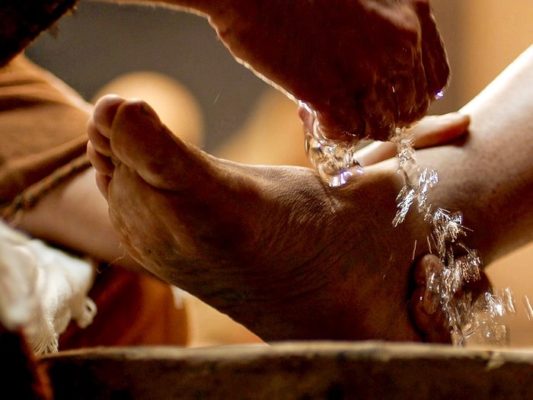
After washing the disciples’ feet, all twelve pairs, Jesus returns to the table. He asks them, “Do you know what I’ve done for you?” Jesus is not going for “washed our feet.” Acknowledging his role as Teacher and Lord, he calls them to also be willing to wash each other’s feet. A disciple was to model the sacrifices made by their teacher, to follow their example. Jesus reiterates this cultural norm when he says, “I have given you an example: Just as I have done, you also must do.” Do as I do.

Now, this is just an example. Foot washing isn’t the only act of service Jesus calls his disciples to. He intentionally chose the lowest, most menial task in their present setting to illustrate his call to serving one another. We will all face unpleasant, menial, low-level tasks and situations. Will we humbly and willingly choose to serve or will we look around to see who we can force to do said task…? Jesus says: do as I do.

Jesus then elevates the call as we get to verses 34-35. I, you, we can go through the motions. We can do the hard thing when others are watching. Here Jesus calls his disciples to an always command to “love one another.” Fleshing this command out, he says, “Just as I have loved you, so you must love one another.” His love was unconditional covenant love. It is a love that remains committed and obedient no matter what. Of this kind of love, Jesus says, do as I do. May it be so.

Prayer: Lord God, it would be easier to just kinda love like you love. Maybe we could pick and choose? Oh, but you loved Judas. You washed his feet, just like the rest. And Peter’s too. If there were any not to pick that night… Lord, help us to do as you do, to love as you love. Guide us to live out the love that you modeled 24/7. Help us to love this way. Amen.