pastorjohnb

Thoughts and musings on faith and our mighty God!


Leave a comment

Answered Prayers

Reading: Joshua 4:20-24

Joshua 4:21 – “In the future your children will ask their parents, ‘What about these stones?'”

As the Israelites crossed into the Promised Land, they passed through the waters of the Jordan River much like their ancestors passed through the Reed (or Red) Sea. This time, when the feet of the priests who carried the ark of the covenant touched the water, it parted. What has been at flood stage stopped flowing and backed up to the north so that the nation could cross over on dry land. Imagine what the people of Jericho thought as they heard reports of what happened that day.

Joshua commanded each tribe to pick a man, a representative. These men picked up a large stone from the middle of the river as they crossed over. In verse 20 we’re reminded that Joshua set up the twelve stones as a memorial marker of what had just happened. Then he says to the Israelites: “In the future your children will ask their parents, ‘What about these stones?'” Joshua is not just talking about their actual children. He is also speaking of the generations and generations after who will ask the question. The basic response follows in the rest of our reading for today.

To make it a good story it would need some context and perhaps a little build up. One would certainly include the “why” of the story: to fulfill God’s covenant promise to Abraham. And if it were an honest retelling, they’d tell if the prayers they prayed to God – before, during, and after. They are prayers we would have all prayed. To look at a river at flood stage and to think about walking through it -> prayer. To walk through with water piling up beside you -> prayer. To look back as the rushing water returned to its bed -> prayer. Yes, the whole story would’ve held stories of God’s power and might. And it certainly would’ve included stories of how God answered their honest prayers.

Prayer: Lord God, when you move in our lives or in the lives of those we know, open our eyes to see. Just as you parted the Jordan, you continue to make a way for us when only you can. Guide us to connect our honest prayers to your actions, building our faith. Amen.


Leave a comment

Professing Faith

Reading: John 19:38-42

John 19:42 – “Because it was the Jewish preparation day and the tomb was nearby, they laid Jesus in it.”

Even though the disciples, the 11 men who had spent three years with Jesus, were hiding behind closed doors for fear of the Jewish religious leaders, two men step up in faith. The first is Joseph of Arimathea. He was a man of wealth. He was a member of the Jewish ruling council. He was a man of status and power. Up to this point he was a “secret disciple” of Jesus. In a profession of faith, Joseph goes to Pilate and asks for Jesus’ body.

Nicodemus was also there. He also has wealth, status, power. Nicodemus first met Jesus back in John 3, when he came under cover of night. Then he did not want to risk much, but he was drawn to Jesus. Although he left that conversation likely more confused and conflicted, Jesus must’ve continued to work on Nicodemus’ heart. Here he is now, in the light of day, professing his faith in Jesus as he brings myrrh and aloes to begin to prepare the body for burial. 75 pounds is extravagant – a gift fit for a king.

Beginning the process for a proper Jewish burial, Joseph and Nicodemus wrap the body in linen clothes, along with myrrh and aloes. Time was an issue. Sunset and the start of Sabbath were drawing near. Joseph and Nicodemus laid the body in a nearby tomb, planning to return on Sunday to finish the burial process. Two men, recently declaring their faith in Jesus, did what they could in the moment to honor their Jesus.

Prayer: Lord God, thank you for the brave witness of Joseph and Nicodemus. They risked much as they stepped forward to care for Jesus’ body. Joseph has the platform to gain an audience with Pilate. Nicodemus has much to lose too. May we see in these men an example of faith without fear of the world, of faith filled with trust in you. Lead and guide us, O Lord, to live out loud this kind of faith. Amen.


Leave a comment

Embolden and Empower

Reading: John 20:19-23

John 20:21 – “Peace be with you. As the Father sent me, so I am sending you.”

Following the risen Lord’s encounter with Mary Magdalene, Jesus goes to the disciples later that first day. They have heard the news from Mary. But simply hearing these words does not change their current reality. No one has ever been resurrected in this way. What it means is totally unknown. Fear is what the disciples primarily know at this point. They just killed Jesus. What is in store for his followers?

Standing amongst the disciples, Jesus says, “Peace be with you.” This standard Jewish greeting meant more now. For example, we casually say, “How’s it going?” to friends today. Or, to a friend struggling with grief, we can look them in the eye and ask, “How are you doing?” After showing the disciples physical signs of his identity, Jesus says, “Peace be with you. As the Father sent me, so I am sending you.” The disciples are to continue the work of Jesus. To make this possible, Jesus breathes on them and says, “Receive the Holy Spirit.” This indwelling presence of Christ himself will lead and guide, strengthen and encourage, embolden and empower the disciples as they return to the world.

Jesus also reminds the disciples of what that work looks like. As people of peace, they are to work at reconciliation. This task involves reconciling people to God and to one another. Our sin is what separates us from both. As people of peace, this work of reconciliation continues to be our task. Emboldened and empowered by the Holy Spirit, may it be so.

Prayer: Lord God, breathe anew the Holy Spirit into our lives this day. Guide us to claim the Spirit’s power and Christ’s peace as we seek to bring healing and wholeness to our sinful and broken world. May this work begin within as we reconcile ourselves to you and to one another. Amen.


Leave a comment

The Kingdom of God

Reading: John 18:33-38a

John 18:36 – “My kingdom doesn’t originate from this world.”

As we continue in John’s passion story, Jesus is before Pilate for a second conversation. Verses 28-32 hold the first exchange. In this encounter it is clear that the religious leaders want Jesus charged and killed. In the words John shares, there is no stated charge. It is clear that only Pilate has the power and authority to bring about Jesus’ death. As we turn to verse 33 we can infer that there must have been more to the conversation about Jesus. In this verse Pilate asks Jesus, “Are you the king of the Jews?” This is a question without a “yes” or “no” answer in this setting.

Jesus responds with a question. He is trying to force Pilate’s hand. As the conversation continues, Pilate shares that the Jews and chief priests have handed him over. Pilate’s “What have you done?” reveals his level of concern. Prior to this, Jesus was not on Rome’s radar. If Jesus is indeed a rebel with messianic claims then he is a threat to Rome. If not, Pilate has no issues with Jesus. Jesus confirms that he is not a physical threat to Rome, stating, “My kingdom doesn’t originate from this world.”

Pilate hears “kingdom” and asks Jesus if he is indeed a king. Again, not a yes/no question. Jesus tells Pilate that he came into the world “to testify to the truth.” Pilate scoffs at this answer but is sure that Jesus is no threat to him or to Rome. No, Jesus is not an immediate threat. But Jesus is a threat to all worldly kingdoms.

Jesus is a threat because of what “truth” is. Jesus came to fulfill God’s covenant plan. He revealed in word and deed what it looks like to love God and neighbor with all of one’s being. This impacts all of our relationships and all of our choices – social, religious, personal, vocational, political, economic. The world’s kingdoms run on selfishness, greed, power, pride. Yes, Jesus’ kingdom is a threat to the kingdoms of this world.

Prayer: Lord God, we feel the pull of both of these kingdoms. Part of us is human so we feel the call for more, for self. Yes we are also of your kingdom, brothers and sisters in Christ. Guide us to align our hearts, our words, our actions with your kingdom. Use us to build your kingdom here on earth. Amen.


Leave a comment

Kingdoms

Readings: Luke 22:6-12 and 13:31-33

Luke 13:32 – “Go, tell that fox, ‘Look, I’m throwing out demons and healing people today and tomorrow, and on the third day I will complete my work.'”

As Jesus’ path to the cross continues, there is a detour in Luke’s gospel. Hearing that Jesus is from Galilee, Pilate sends him to Herod Antipas, the ruler of that region. Pilate is trying to extricate himself from this sticky situation, thrusting it upon his political enemy. But Herod is happy to see Jesus – at first. He’s wanted to see Jesus for a long time. Herod has heard the stories and hopes that Jesus will “perform a sign” for him.

Jesus refuses to answer any questions and Herod’s curiosity turns to anger and mockery. Dressing Jesus in “elegant clothes,” he sends Jesus back to Pilate. This wasn’t Herod’s first exposure to Jesus, though. In chapter 13 the religious leaders warn Jesus that Herod wanted to kill him. Herod was notoriously violent and unstable, especially against anyone he saw as a threat to his power. The bad blood with Pilate began long ago when Herod and his brothers had Pilate charged and punished by Tiberius Caesar. And Pilate ruled over the land once ruled by Herod the Great, Herod Antipas’ father.

In chapter 13, in response to Herod’s threat, Jesus says, “Go, tell that fox, ‘Look, I’m throwing out demons and healing people today and tomorrow, and on the third day I will complete my work.'” The Jews saw foxes as destructive and worthless pests. This was not a compliment. The casting out and healing were signs of God’s kingdom amongst the people. Jesus’ finished work on the third day, resurrected to life, would validate his claims of bringing the kingdom to earth. Working together against this perceived threat to their power, Pilate and Herod became friends that day. So it is with the kingdoms and powers of this world.

Prayer: Lord God, in Pilate and Herod we see two men with power willing to do anything to hold onto or to build that power. We see this in our world today as people strive and connive to gather more power, wealth, status… Jesus’ kingdom runs counter to these ways of the world. His is a kingdom of healing, giving, and pouring out of self. O God, draw us into this kingdom and use us to build your kingdom in our time and place. Amen.


Leave a comment

Shining the Light

Reading: Luke 22:39-53

Luke 22:53b – “But this is your time, when darkness rules.”

On the Mount of Olives, in the Garden of Gethsemane, Jesus goes to God in prayer. This was a place Jesus went to regularly. He invites the disciples to pray too, so that they “won’t give in to temptation.” Moving away from them, Jesus prays earnestly, so much so that he sweats profusely and needs angelic strengthening. His prayer reveals both his humanity and his understanding of his purpose. In this hardest moment, Jesus ponders if the “cup of suffering” can be taken away. Then, in obedience, he prays, “not my will but your will must be done.” He returns to the disciples and finds them sleeping, “overcome with grief.”

At times we will struggle or waver. The thing God is asking of us is hard, maybe feels risky, possibly includes a cost. So we teeter. At times we do step forward. Other times we choose the easier way. In our own way we too “sleep,” giving in to the temptation of non-obedience. As we grow in our faith, as we mature, we come to better understand our purpose in the kingdom of God. While we’ll still fail, the frequency lessens.

The story continues as the mob arrives to arrest Jesus. A disciple starts to defend Jesus. He quickly halts the violence, healing the injury, reminding the disciples of who he is and who he is not. Jesus questions the mob – the swords and the clubs. He reminds them of his daily presence in the temple. The implied question is, “Why didn’t you arrest me there?” Jesus answers this unspoken question: “But this is your time, when darkness rules.” In an isolated place, under cover of darkness, Jesus is arrested.

Prayer: Lord God, thank you for this look into Jesus’ humanity, into his struggle. In our battles with obedience, remind us of this moment. May we draw upon strength moving forward, upon grace in failure. Encourage us to be people of the light, shining your love and power into the darkness of this world. Amen.


Leave a comment

Fear, Shame, Guilt…

Readings: Matthew 26:69-75 and 27:3-10, 15-26

Matthew 27:24 – “So he took water and washed his hands in front of the crowd.”

Photo credit: Falaq Lazuardi

Today’s readings contain denial, betrayal, and giving in to social pressure. These actions are driven by fear, shame, guilt, regret, greed, power. These are actions and emotions that we too wrestle with as we try to walk faithfully with our Lord and Savior, Jesus Christ.

Peter had followed the mob who had arrested Jesus – at a distance. He feared being caught up in what was happening. In the high priest’s courtyard, Peter is accused three times of being with Jesus. Each time Peter’s denial of Jesus grows stronger as the fear rises. His fear turns to shame as the rooster crows. When was the last time that you denied Jesus, either in word or deed? What “crowed” to lead you to tears?

Judas agreed to betray Jesus for thirty pieces of silver. Seeing that Jesus is condemned to die, Judas feels “deep regret” for betraying “an innocent man.” The religious leaders refuse to change course. Guilt and regret lead Judas to take his own life. When have you felt deep regret because you betrayed Jesus? How did you resolve your inner turmoil?

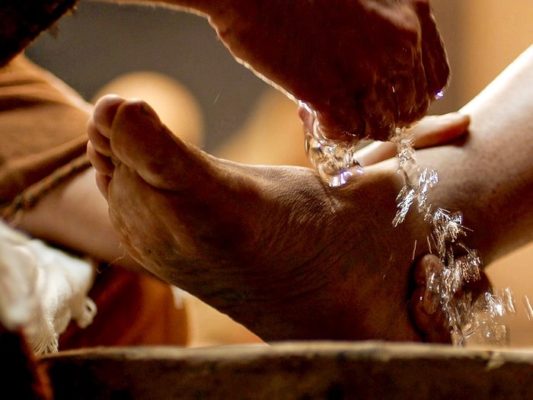
Pilate has the power of life and death in his hands. He tries to free Jesus. His wife tells him to “leave that righteous man alone.” Tension builds and Pilate gives in to the mounting social pressure. To try to relieve his guilt and regret, he “took water and washed his hands in front of the crowd.” Pilate allows the power to slip through his fingers like the water slips through. We’ve all given in to the crowd, turning away from Jesus. What do you do to relieve your guilt and regret?

Prayer: Lord God, it is hard to admit, but at times we’ve played the roles of Peter, Judas, and Pilate. When we’ve failed you, we’ve felt what they feel. It is our human nature rising up to protect self, position, status… In our next moments of testing, Lord, raise up the voice of your Holy Spirit. May it be louder and stronger than our fear, shame, guilt… And when we fail, remind us of your unconditional love and endless grace. Amen.


Leave a comment

Power Under, Not Over

Reading: Mark 10:32-45

Mark 10:45 – “The Human One didn’t come to be served but rather to serve and give his life to liberate many people.”

As Jesus makes his way towards Jerusalem, Mark makes an observation. The disciples are amazed with Jesus, but the others following him were afraid. The “insiders” – the disciples – have no clue what potentially lies ahead. For the third time in Mark’s gospel Jesus tells them that he will be handed over and condemned, will be killed by the Gentiles (Romans,) and will rise after three days. The “outsiders” following Jesus understand that going to Jerusalem is a risky and dangerous place for Jesus.

Continuing the journey, James and John demonstrate the blindness of the disciples. Jesus has just told them what’s about to happen. Instead of being sad or reflecting somberly on this news, these brothers ask to sit at Jesus’ right and left hand in glory. They envision Jesus “coming in glory” with a powerful army to defeat the Romans. They want to be #1 and #2 in Jesus’ chain of command. Jesus tells James and John that they will indeed “drink the cup” and will one day experience suffering. But right now they are blind. One day they will see and understand the words Jesus speaks. Their request maddens the other disciples. Are they made that they didn’t think to ask first? A patient and kind Jesus gathers them up for a lesson.

Jesus tells them that they will not be “power over” leaders. They will not be like the current rulers who dominate others with their power. No, that’s not God’s plan or way. True power comes from service. This is “power under” – power that lifts others up. It is so with Jesus: “The Human One didn’t come to be served but rather to serve and give his life to liberate many people.” May it be so with us too.

Prayer: Lord God, today we are reminder that although Jesus held all the power in his hands, he chose the path of humble servant. When we are tempted to grab for power or to use the powe that we do have to lord it over others, remind us of Jesus’ words and example. Lead and guide us to be “power under” people, lifting others up, bringing you the glory and praise. Amen.


Leave a comment

Blessings and Peace

Reading: Luke 19:28-39

Luke 19:38 – “Blessings on the king who comes in the name of the Lord.”

As our passage begins, Jesus prepares to enter Jerusalem. He is just east of the city itself. He gives instructions to two disciples to go and get a colt. Following Jesus’ directions, all unfolds just as Jesus said it would. Even this is a demonstration of his power.

In verses 35-38 we see the actions of others taking over. It is the disciples who place their coats and then Jesus on the colt. It is the disciples who place clothes on the road and rejoice as they near Jerusalem. The crowd begins to praise God because of the “mighty things they had seen” Jesus do. They begin to shout, “Blessings on the king who comes in the name of the Lord.” Why do they do and say all of these things?!

The disciples, the crowd, the Pharisees, and even Jesus – they knew the scriptures, the words of Isaiah, the Psalms written for such a day as this. Prophecy was being fulfilled. Their actions, their words – they were following the script. These events, this fulfillment brought joy and excitement to the people.

Another entry also occurred, on the other side of the city. Each year, at the Passover and other major festivals, Herod would ride into Jerusalem. He would ride in on a mighty warhorse with an entourage of Roman soldiers. This demonstration of force was a reminder to Jerusalem and its leaders: Rome is the power. The counterpoint is Jesus. He brings blessings and peace. What a contrast between the ways of the world and the way of Christ.

Prayer: Lord God, thank you for the way of Jesus – the way of joy and blessing, of humility and peace. This stands in such stark contrast to the ways of the world: force and power and might. This divide continues today. O God, give us the courage and the faith to go into places of darkness and evil, empowered by the light of Christ, challenging these harmful and destructive ways. May our light be fueled by love, bringing blessing and peace. Amen.


Leave a comment

A Regular Practice

Reading: Isaiah 56:1, 3-5, 7-8

Isaiah 56:1 – “Act justly and do what is righteous because my salvation is coming soon.”

The opening of Isaiah 56 is about keeping the Sabbath. The idea of Sabbath originates in the creation story. After creating the heavens, the earth, and everything in and on them, God rested. When God began to formalize who and what God’s people would be, the practice of Sabbath was included in the Ten Commandments. During the time in exile and the period that followed, the keeping of the Sabbath was especially important. It set the Jews apart from the rest of the world. To be Sabbath-keepers remains counter-cultural.

In today’s reading Isaiah is reminding Israel that Sabbath is not just for the Jews. The idea of including immigrants and servants has been a part of Sabbath ever since Moses received what we identify as Exodus 20:8-11. Animals and the earth itself are part of Sabbath rest. Isaiah includes the eunuchs and other outcasts in his words that declare that God’s family and home are places of welcome and inclusion for all people who honor the covenant, who live according to God’s will and ways.

As I reflect on these words today I am struck by how wide open God’s heart is for all who seek to walk as a child of God. I’m also becoming aware that Sabbath is aimed at creating a just world. Rest is part of God’s design for all things – people and all of creation. This concept of rest and shalom, of blessing and renewal also reveals the wideness of God’s love for all people and for all of creation. It is in these times of not doing that we can foster our relationships with God and with one another. This investment of time builds connection and it builds community. May Sabbath be a regular practice for you and for me as we seek to build God’s kingdom here and now.

Prayer: Lord God, thank you for the gift of Sabbath. This time set apart has the power to deepen our love for you and our love for each other. Open us to the wideness of your heart and your love as we practice this discipline. Lead and guide us in this regular practice, O God, so that holiness and justice, and peace and righteousness abound in our lives and in our world. Amen.