pastorjohnb

Thoughts and musings on faith and our mighty God!


Leave a comment

This Jesus

Reading: Luke 19:1-6

Luke 19:6 – “So Zacchaeus came down at once, happy to welcome Jesus.”

“Zacchaeus was a wee little man, and a wee little man was he.” Did your brain jump to the next line? The children’s song and the story are familiar to most followers of Jesus. While we only read the first part of the story in today’s text, we know what happens when Zacchaeus comes down out of that sycamore tree.

One day Jesus was passing through town. The chief tax collector is curious. He wants to see this man that lots of people are talking about. Wild stories of healings and of profound teachings circulate amongst the Jews in Galilee and beyond. Zacchaeus was short – both physically and in statute amongst the local people. Collecting the burdensome taxes for the hated occupying force did not win him any friends. So he has to resort to climbing a tree so that he can simply see this Jesus as he walks through Jericho.

We will encounter people like Zacchaeus – sinned and flawed like us, curious about this man they’ve heard about. We are other believers are the stories the curious have heard and seen. The abnormal kindness, the ever present grace and peace, the contentment, the care and concern for those others ignore or shun – there is something attractional about this Jesus we follow and strive to emulate. This Jesus noticed, stopped, and talked with Zacchaeus. In verse 6 we read about the results: “So Zacchaeus came down at once, happy to welcome Jesus.” May we too be willing to engage those seeking, opening the door of their hearts to welcome this Jesus home.

Prayer: Lord God, first, walk with us daily, filling us with your Spirit and your presence, empowering us to be a good example of your love, grace, compassion… Second, prepare us for the conversations that come with living our lives for you and for others. By the power of your Holy Spirit, give us the words to say to those seeking, drawing them deeper in their curiosity about this Jesus, the life changer. Amen.

Leave a comment

Live Humbly

Reading: Luke 18:13-14

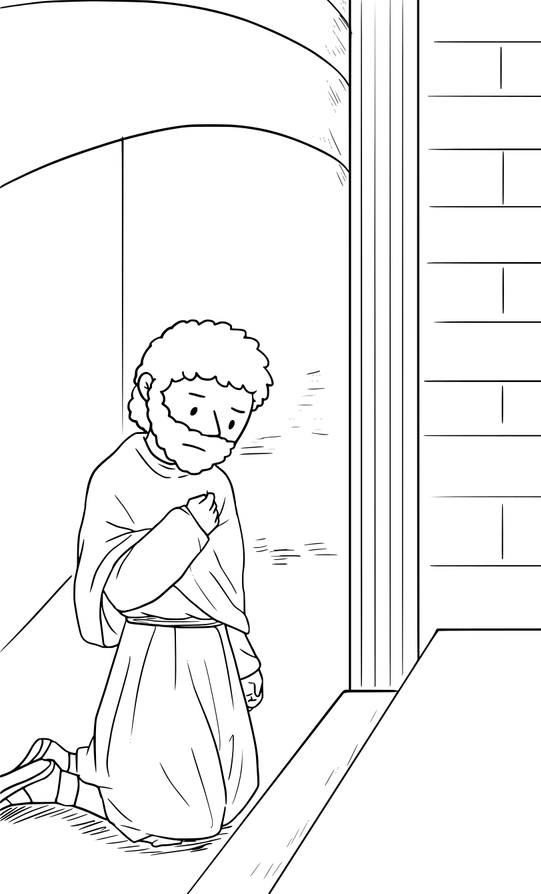
Verse 13: “But the tax collector stood at a distance… beat his breast and said, ‘God, have mercy on me, a sinner.'”

Today we focus on the second of the two men who “went up to the temple to pray.” In the opening verse we read that the tax collector “stood at a distance” and that he “would not even look up to heaven.” We learn also that he “beat his breast.” All of these are signs of one who knows that he needs God. He is one who is humble before the Lord God. The tax collector recognizes that he is far short of the glory of God. He enters the temple knowing that God can grant him mercy, but not quite sure that God will.

Have you ever come before God in this way? At times I’ve known in my head that God is love and mercy, grace and forgiveness. But, because of what I’ve done or failed to do, in my heart I’ve wondered if God can forgive even this. Maybe this is what it is for the tax collector or maybe it has been a long time since he has come to God. Whatever the case, he cries out to God: “God, have mercy on me, a sinner.” What a humble and sincere heart.

The parable finishes with these words from Jesus: “I tell you that this man went home justified before God.” The tax collector was made right by God through his honest and humble confession. Continuing Jesus drives home his point to those who were “confident in their own righteousness” saying, “For everyone who exalts themselves will be humbled, but they who humble themselves will be exalted.” May we come humbly before God and may we live humbly with all of our neighbors.

Prayer: Lord God, have mercy on me too, a sinner. Restore me to wholeness once again. Lead and guide me to think less of self so that I can love you and neighbor more and more. Amen.


Leave a comment

Heed the Warning

Reading: Luke 18:9-12

Verse 11: “The Pharisee stood up and prayed about himself.”

Today we will look at the first part of Luke’s telling of Jesus’ parable about the Pharisee and the tax collector. Let us begin with the audience. Luke shares that Jesus tells this story to those who were “confident in their own righteousness and looked down on everybody else.” Jesus is not talking with some Pharisees or other religious leaders here. He is talking to a group of his followers. This tendency towards feeling superior and towards judging others remains strong today. These words very much apply to our lives, to our churches, to our world.

As Jesus begins we learn that two men go to the temple to pray. Going to pray – an personal and private time with God. Prayer is a good thing – like going to church or serving on a mission project. Two men go to pray. One is a Pharisee and one is a tax collector. Jesus is intentional with these characters. These two men represent the opposite ends of the spectrum. One was highly respected. One was deeply despised. In Jesus’ day these men were seen as the most and least connected to God and to faith.

In the parable Jesus offers the Pharisee’s prayer first. He begins by standing up, praying aloud to be heard. It is not a conversation between him and God. He first thanks God that he “is not like other men” and then goes on to name them. They are the bottom rung, the lowest of low. He gestures over and adds the tax collector to the list. The Pharisee clearly thinks that he is on the top rung. As proof he shares that he fasts twice a week and that he tithes. Like prayer, these two spiritual disciplines are good things. They are practices that express our gratitude to God. But, like almost all things, these too can be twisted and turned, used for personal glory instead of to bring God the glory.

For the Pharisee, it is all about him and how holy and righteous he is. In his life and in his prayer, there is no humility, no compassion or kindness, no faith that moves a heart closer to God. We can fall into thinking we’re high and mighty. So may we heed Jesus’ warning today. When we are tempted to compare ourselves to others, when we are tempted to think about how religious we are, may this Pharisee remind us of the dangers of elevating self over others and over our relationship with God.

Prayer: Lord God, is it so easy to slip into feeling superior, judgy, critical. When self and ego rise up, draw me back down. Knock me down if necessary! Focus me back to the call to love as you first loved us. Amen.


Leave a comment

Fringes and Edges

Reading: Matthew 9: 9-13

Verse 11: “Why does your teacher eat with tax collectors and sinners”?

Photo credit: Marten Newhall

Our passage today opens with Jesus calling another disciple as he walks along the road. The man he calls us named Matthew. He was sitting in his tax collector’s booth when Jesus said, “Follow me”. It’s hard to say what an equivalent calling would be today. Tax collectors were almost universally disliked and hated. They worked for the occupying force, the Romans, collecting taxes to pay for the enemy to stay in power. Most tax collectors gathered well above and beyond what the Romans required. Becoming rich was a side perk of this government job. Being wealthy was nice but the occupation limited one’s circle of friends. Matthew’s crowd would be limited to other tax collectors and others who took advantage of others. Money lenders, prostitutes, slave traders… would have been among the crowd at Matthew’s house as Jesus joined them for dinner.

Upon seeing the crowd that Jesus has chosen to become a part of, the Pharisees ask, “Why does your teacher eat with tax collectors and sinners”? Why would Jesus call one of these to discipleship, to following him? Why would Jesus sit amongst this crowd of sinners? I suppose some people today think the same thing when they see their pastor emerging from the hymn sing at the local brewpub or when they see members of the outreach team exiting the local strip club. In response Jesus says, “It is not the healthy who need a doctor, but the sick”. Jesus did not come to just sit around the temple or local synagogues chatting with the faithful about the scriptures. Yes, Jesus did this and this habit continues to be a very important part of our faith journey. But Jesus also spent the majority of his time doing ministry out in the world – among the tax collectors and sinners, among the hurting and broken, among the Gentiles and others who were marginalized by the religious establishment. These are the ones in need of a “doctor”. These are the ones in need of healing, wholeness, love, a sense of community.

Who are the tax collectors of your neighborhood or community? Who are those on the fringes and edges? How can you minister to these that Jesus surely would have?

Prayer: Lord God, make my heart and will more like yours. Guide my feet to those in need of your love and care. Bring me past the barriers and fears in my mind, trusting more fully in your guidance and direction. Amen.


Leave a comment

Practicing #1 and #2

Reading: Matthew 23: 1-12

Verse 3: “Do not do what they do, for they do not practice what they preach”.

Jesus has been ministering for about three years at this point. He has had ample opportunities to interact with and to observe the scribes and Pharisees. Jesus and these religious leaders have the same audience, teach from the same source materials, live in the same society. Much like today, when you can get two radically different approaches from two medical experts concerning the safest way to live in these pandemic times, Jesus and the religious leaders had so much in common, but they differed radically in how best to follow God.

The religious leaders occupy a place – “the Moses seat” – that calls for respect and gives them authority, a platform from which to speak into the people’s lives. But this is an earthly platform, given to them by other earthly people. As is the case with many earthly positions of power, they were beholding to others. The leader of the group, the high priest, was appointed by the Romans. There were certain expectations that came with the appointment. The religious leaders were subject to the high priest, which also connected them to the political power of the day. Because these religious leaders held a place of authority, they could exert control over the people. Jesus acknowledges this place of authority. While he recognizes their place of authority, he does not agree with their practices. To this point, in verse three he says: “Do not do what they do, for they do not practice what they preach”. They say one thing and do another. They pick and choose what to say based on their current situation. For example, the religious leaders preach about loving your neighbor, but there are many they do not see as neighbors – the Gentiles, the sinners, the sick…

Jesus, by contrast, teaches and practices the belief that everyone is your neighbor. Jesus teaches it and then goes out and live it, loving the lepers and the blind, the tax collectors and the prostitutes… Jesus practices what he preaches, with love as the greatestest commandment of his faith. The religious leaders would cute law #217 or good old #359 (the one that previous religious leaders had made up) to avoid loving certain people. Jesus, instead would preach and practice #1 and #2, loving God and loving neighbor, in their rightful place: first and foremost. As we consider Jesus’ example, may we also do the same as we seek to live out, to actually practice, loving God and loving neighbor above all else. May we be love in the world today.

Prayer: God of love, when I look at Jesus, I see one who did as he taught. He loved one and all, yes, but he loved you most of all. Each day, guide me to live this out, loving you with all that I am, allowing that to lead me to really love others more than myself. Amen.


Leave a comment

The Harvest

Reading: Matthew 21: 33-41

Verse 38: “This is the heir. Come, let’s kill him and take his inheritance”.

Today’s reading comes as part of a quick succession of stories. Chapter 21 begins with the triumphal entry into Jerusalem followed by Jesus clearing the temple, which had been turned into a marketplace, a “den of robbers”. This is a challenge to the religious leaders’ authority. After Jesus curses the fig tree for not producing fruit, the chief priests and elders question Jesus’ authority. He does not answer their question directly. Instead he tells two parables. In the first one son agrees to work in the field but does not. The other son says “no” but ends up working in the field. The religious leaders identify the one who does the will of the father as the son who obeyed. Jesus then points out that the tax collectors and prostitutes, those who originally said no to God, are entering the kingdom of God ahead of the chief priests and elders because they listened and repented. To further illustrate God’s displeasure with their hard hearts Jesus tells the parable we read today.

In the parable of the tenants, the tenants harvest a vineyard they did not plant. At harvest, a share is due to the owner of the vineyard. Twice the tenants abuse, kill, and stone those sent to collect the owner’s share. Then the owner sends his son. As the tenants see him approaching they say, “This is the heir. Come, let’s kill him and take his inheritance”. Indeed they do kill him. Jesus then asks the religious leaders how the owner will respond. They say that the owner will bring those wicked “wretches to a wretched end”. In our reading for tomorrow, Jesus quotes from Psalm 118. These verses would have triggered a connection for the religious leaders. Verses 19-21 speak of a triumphal entry and the Lord bringing salvation to those who believe. The religious leaders would not have missed what Jesus, the capstone being rejected, was implying. We will explore this further tomorrow.

The religious leaders and Jews often rejected the ones sent by the one who establisheded them in the Promised Land – a place they did not plant or build. Some of the prophets were rejected, beaten, even killed by leaders who did not want to hear God’s truths. These leaders would continue the pattern, this time crucifying the one who had come to save. Our question to consider is this: what do we do when the Lord gives us opportunity to produce a harvest? Do we hold tightly to all we have, refusing to let some go to build up the kingdom of God?

When the owner comes looking for us to contribute to the harvest, may we be a part of a fruitful harvest. May we be faithful tenants, giving unto the Lord, as we are led, to build the kingdom of God here on earth.

Prayer: Lord of all, as you give me opportunity to plant seeds or to nourish growth, lead me to be faithful and obedient. Guide me to step forward into those opportunities as I seek to be a part of building your kingdom in this time and place. Amen.


Leave a comment

Undeserved? YES!

Reading: Matthew 20: 1-16

Verse 1: “The kingdom of God is like a landowner who went out early in the morning to hire men to work in his vineyard”.

Today’s parable in Matthew is the second in a row where Jesus teaches about God’s upside-down kingdom. If we were the workers who were hired early in the morning, we too would be upset when we received the same pay as those who worked only one hour. Like these workers, it would not matter a whole lot to us that we agreed to our pay before we even started working or that it was a fair days wage. Similarly, those who worked nine hours would be pretty upset, those who worked six hours would be kind of upset… On the surface level we struggle with this story just as we can sometimes struggle with the story of the thief on the cross found in Luke 23.

Jesus’ actual behavior also reflects this upside-down feel. He did not spend most of his time in the temple. He did not recruit his followers from elite rabbi schools. Jesus himself was not even trained as a professional rabbi. The religious leaders were much like the full day workers in our parable. They cringed and recoiled when Jesus forgave the sins of adulterous women and greedy tax collectors and the lame and deaf and mute – those obviously carrying the lifelong burden of some unrepentant sin. Like the thief on the cross and the workers who only came at the last hour, people like these do not deserve such easy grace, such free flowing forgiveness.

Do we sometimes cringe and recoil at who God continues to invite into the kingdom of God? Do we ever walk into church on a Sunday morning and wonder, Who let them in? If so, we need to check the inner religious snob hiding inside of us too.

I do not know about you, but I am glad that God is the God of late in life professions of faith and death bed confessions of Jesus as Lord. That expression of generous and unconditional grace is the same exact grace that forgives my struggle with pride for the zillionth time. Yes, yes, we rejoice at that grace. Whether one comes at the first hour or at the last hour, may all hear about and come to experience that same extravagant and wonderful grace.

Prayer: Loving and generous God, it is so wonderful to live within your abundant and generous grace. Even though I may not deserve to experience it over and over, you continue to pour it over me time and time again. Thank you for your love of a sinner like me. Amen.


Leave a comment

Deeper

Reading: 1st Samuel 16: 1-13

Verse 7: “Man looks at the outward appearance, but the Lord looks at the heart“.

In today’s passage, David is anointed to be the next king of Israel. At the time, Saul is the king. He is in good health and will remain the king for some time. David is going to learn and grow and mature before stepping into this role that God has selected him for. It is a process. The process will be guided by God. In verse thirteen we read, “from that day on the Spirit of the Lord came upon David”. From God’s perspective this all made sense. After all, it is his plan.

From the human perspective, it was confusing at best. Once the hurdles were all crossed and Samuel is present with Jesse and most of his family, the parade of prospects begins. One by one Jesse’s sons pass before Samuel, horn of oil at the ready. The oldest son is Eliab. Seeing him Samuel immediately thinks he is the one. Eliab must have been tall and handsome, muscular and refined. But God tells Samuel “no”. I imagine the horn of oil dropped a little bit just then, going further and further down as each son passes by, until at last it dangles by his side.

We too can fall into the trap that Samuel and Jesse and probably all the elders and sons fell into. We too judge by appearance. The appearance may be physical, it may be based on the college they attended, it may be by the car they drive or the home they occupy, it may be by the title that hangs outside their office door, it may be by the position they play on the team. These would be valid tools for judgment if all that mattered was their drive to get to the top. Sadly, though, when we judge by what we can first see, then we often fail to go any deeper. Too often that first judgment prevents us from going deeper and prevents us from seeing who and what someone really is. God had a word for us today when this is our first tendency: “Man looks at the outward appearance, but the Lord looks at the heart“.

Tying this thought into the model set by the one we follow, we see what this good word from God looks like lived out in the world. Jesus never ever stopped at tax collector or Samaritan or woman or leper or prostitute or blind or possessed or… Jesus always pressed deeper, developing a relationship that went far beyond some surface-level label. Going deeper, the labels always fell away. May we too strive to go deeper, to go way past labels and first appearances. May we too strive to get to know the heart of each we meet, for there we begin to see as God sees. May it be so.

Prayer: Father God, help me to practice you counter-cultural and counter-intuitive love today. Help me to see those needs that you place before me and to fill them with your love. Amen.


1 Comment

Tax Collector Witness

Reading: Luke 18: 9-14

The tax collector is honest and direct with God: “God, have mercy on me, a sinner”.  As this man who stands at a distance and won’t even look up towards heaven utters these words, it is easy to imagine tears running down his cheeks and a little crackle in his voice.  He comes to the temple with his sins heavy upon him.  He comes to simply do what he needs to do: to lay his sins before God.  This tax collector knows that God’s mercy alone can remove these sins from his life.  He is humble and honest before God.  He recognizes God’s sovereignty and God’s love.

The tax collector is a great witness to the faith for us.  First, he realizes who he is, honesty admits it before God, and acknowledges that God alone can restore him.  Too often we instead live with ‘secret’ sins in our lives.  Access is easy to many addictions.  We rationalize our greed and jealousy as simply wanting the best in life.  The line of excess and gluttony is easily crossed.  The pull of gossip and being judgemental is great.  Like the tax collector, our guilt often weighs down upon us.

Second, the tax collector knows his great need for God.  In our independent, free choice, I’ll do what’s best for me culture, it’s easy to think that we are the center, that we are in control.  Yet, like the tax collector demonstrates, only in God do we find true power and love.  It is only when we enter humbly into God’s presence that we find true healing for our brokenness.  It is only when we admit that we have no power to remove the guilt and shame of our sin that God can restore us, can make us new again.

O merciful God, allow us to see the sins in our lives.  Make us humble as we enter into your presence, pour out your power and grace upon our lives.  Like the tax collector, restore us to a right relationship with you.