pastorjohnb

Thoughts and musings on faith and our mighty God!


Leave a comment

Hearts Turned

Reading: Mark 9:11-13

Mark 9:13 – “Elijah has come, but they did to him whatever they wanted.”

Following the transfiguration (when Peter, James, and John saw Jesus changed into a more divine form who chatted with Moses’ and Elijah’s spirits) the “inner three” ask Jesus about the second coming of Elijah. Here they are connecting with their Jewish upbringing. In Malachi 4 the prophet writes about Elijah coming back “before the great and terrifying day of the Lord.” The understood purpose of his return? To “turn the hearts of the children to their parents” and vice versa.

Experiencing this moment on the mountaintop, hearing talk about Messiah and death and resurrection, it is natural for the disciples to try and make some sense of all of this. They do the natural thing: they try to connect this new information to what they already knew. To help do this, they ask about the second coming of Elijah. The understanding was that Elijah would return to “restore all things.” Jesus pushed back a bit. If one held to the fullest way that this could happen, he asks, then why would he have to suffer and die? This is Jesus’ question in verse 11. Clearly there is some disconnect or misunderstanding.

Answering their question, Jesus says, “Elijah has come, but they did to him whatever they wanted.” Preaching and baptizing in the wilderness, John the Baptist did change hearts. Through his baptism of repentance the children of God’s hearts were turned back to God’s heart and vice versa. John’s work of restoring all things was cut short, though, like many of the prophets who came before him. The pagan powers arrested and beheaded John. Not all Jewish hearts turned to God either. Many rejected John’s invitation and Jesus’ as well, “just as it is written.” In spite of humanity’s selfish and stubborn hearts, God’s plan will continue to unfold as Jesus walks the path to Jerusalem and to the cross.

Prayer: Lord God, we, like the people of Jesus’ day, know the scriptures, can see the signs unfolding, and still choose not to believe. We can cling to our selfish and evil ways, refusing to confess and repent. When our eyes are mostly closed and our hearts are pretty hard, once again empower your indwelling prophet, the Holy Spirit, to open our eyes, to soften our hearts. Bend us to your will and way. Amen.


Leave a comment

An Invitation to All

Readings: Mark 14:22-24 and Luke 22:19-21

Mark 14:24 – “This is my blood of the covenant, which is poured out for many.”

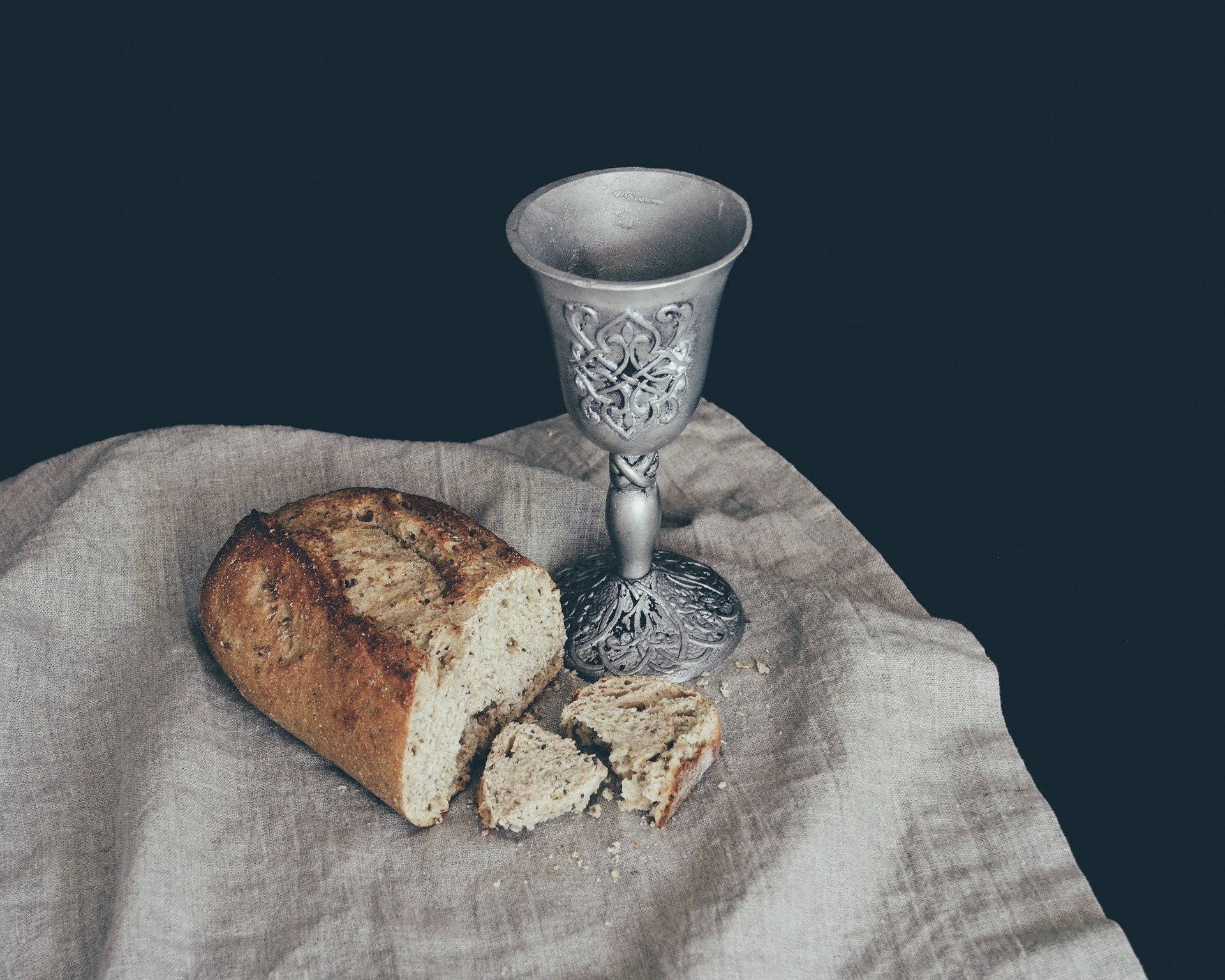
In both passages that we read today, we see Jesus instituting the sacrament of communion. This event is set within the context of the Passover meal. This meal was an annual event in which the Jews would remember and celebrate how God saved them as the angel of death passed over their houses. This final plague led to Pharaoh releasing Israel from bondage and slavery.

Mark and Luke both present Jesus offering the bread as symbolic of his body, broken for them and for us. Jesus’ body will be broken on the cross. In using the common element amongst the rich and the poor and all in between, Jesus takes the everyday and connects bread to himself and to us all.

Both gospels present the cup – representative of Jesus’ blood – as poured out for many, establishing the “new covenant.” Mark recalls these words of Jesus: “This is my blood of the covenant, which is poured out for many.” The new covenant is wrapped in mercy and grace, in forgiveness of sins. This common element of wine – again Jesus connecting the ordinary to his extraordinary gift.

In Mark’s gospel they sing a few songs and head to the Mount of Olives. But in Luke’s gospel, Jesus says, “But look! My betrayer is with me; his hand is on this table.” Jesus celebrates the first communion knowing that Judas will betray him. This is an invitation to us all – sinners each of us – to come to the table of grace. There we too will find welcome and forgiveness. Thanks be to God.

Prayer: Lord God, we humbly thank you for the gift of grace. Your Son did for us what we could not and cannot do for ourselves. It is only because of and through Jesus’ sacrifice that we are forgiven and made new, freed from the bonds of sin and death. Thank you, thank you, thank you. Amen.


Leave a comment

Putting on the Yoke

Matthew 11:29 – “Put on my yoke, and learn from me. I’m gentle and humble. And you will find rest for yourselves.”

John the Baptist is the focus of the start of chapter 11. He sends his disciples to Jesus (he is in prison), asking, “Are you the one?” The response Jesus gives is to tell John what they see and hear. The blind see, the dead are raised… The fruit of his ministry is the proof: Jesus is the Messiah. John was an important one too, Jesus says: “He is the Elijah who is to come.” Jesus then laments this generation. They misunderstood John and they’ll misunderstand Jesus. This leads Jesus to lament about the places that he has ministered. They saw the miracle and did not change hearts or lives. He later declares that Nineveh will condemn this generation. They heard Jonah’s message and changed hearts and lives.

At the end of chapter 11 Jesus praises God for keeping “these things” hidden from the wise and intelligent (the religious leaders). He issues an invitation to those who are struggling and carrying heavy loads (the poor): “Put on my yoke, and learn from me. I’m gentle and humble. And you will find rest for yourselves.” What a contrast to the Pharisees. They and Jesus both called for a devout adherence to the Law. For one, though, the Law was a heavy weight to carry. For Jesus, “my burden is light.” Here one finds rest, not weariness.

Sabbath adherence is the focus of the beginning of chapter 12. These two encounters highlight the heavy/light contrast. Eating when famished and doing good supersedes the “do no work” mandate. Mercy trumps sacrifice. Love always wins. These clashes begin the Pharisees down the road to snuffing out this threat. The next clash centers on healing a demon-possessed mute man. The Pharisees attribute the healing to Jesus working with Satan. He rebukes this idea, claiming it is by the Holy Spirit that he heals. Jesus condemns them for their “useless words.” They demand a sign. Remember Jonah?, he asks. Jesus tells them he will be in the “heart of the earth for three days and nights.” What a surprise ending that story will have too! Even better than Jonah’s!

Today’s reading closes with Jesus calling his true family his disciples. They have taken on his yoke and are walking with Jesus. The disciples are Jesus’ “brothers, sisters, mothers.” May it be so for us as well.

Prayer: Lord God, you continue to speak the words of life. Some hear and understand, some do not. Give us ears to hear. You continue to invite us to change our hearts and lives, growing deeper and more connected to you. Give us a spirit that is ever willing. Draw us more completely into your family, O God. Amen.


Leave a comment

A Holy Sabbath

Reading: Isaiah 56-59

Isaiah 58:2 – “They seek me day after day… like a nation that acted righteously, that didn’t abandon their God.”

Today and tomorrow we read Third Isaiah. As is the case throughout all of Isaiah, the focus remains on justice and righteousness. In today’s readings these key faith practices center on keeping the Sabbath holy. This holy day, kept once a week, had the power to keep the Israelites connected to God in a way that would be reflected out into how they lived their lives the rest of the week. The Sabbath retains this power yet today.

Chapter 56 begins with an invitation to keep the Sabbath. The invite goes even to those “outsiders” – to the eunuchs and to the immigrants. These too will join others who keep the Sabbath holy, coming one day to God’s holy mountain. This open, honest, and welcoming invitation stands in stark contrast to the condemnation offered around Israel’s unholy Sabbath practices: “They seek me day after day… like a nation that acted righteously, that didn’t abandon their God.”

Isaiah turns next to a condemnation of the leaders. They have “monstrous appetites” and “every last one [is] greedy for profit.” These lead to the displeasing Sabbath fast described at the start of chapter 58. The leaders oppress their workers (probably making them work on the Sabbath) and they quarrel and brawl on the holy day. God asks, “Is this what you call a fast, a day acceptable to the Lord?” Umm… no.

This behavior alienates them from God. It obscures their vision. Because it is inwardly focused, it blinds them to the injustice and oppression that they are practicing. Chapter 59 details this as well as adding that God will intervene, one day choosing to redeem Israel.

In chapter 58:6-14 Isaiah lays out the Sabbath fast that pleases the Lord our God. It is a day to remove yokes and to stand against oppression. It is a day to care for the hungry, the homeless, the naked. To practice justice and righteousness – that is keeping the Sabbath holy. Then, the Lord says, “Your light will shine in the darkness” and then “you will take delight in the Lord.” May it be so for you and for me.

Prayer: Lord God, we see once again the choice to be made: justice and righteousness or injustice and oppression. You clearly call us to choose justice and righteousness. This begins with how we treat the Sabbath, a day to be set aside for you, not for self. It is a day to reflect your love and concern for all people. Lord, lead and guide us to be holy Sabbath-keepers. And may the evidence of this sacred practice flow out through our daily lives, shining light into darkness. Amen.


Leave a comment

A Temple and a Palace

Readings: 1st Kings 5, 1st Kings 6, 1st Kings 7, 1st Kings 8

1st Kings 8:58 – “May God draw our hearts to him to walk in all his ways and observe his commands, his laws, and his judgments.”

In today’s chapters the temple and Solomon’s palace are constructed. The King of Tyre, Hiram, reiterates the promise he made to David. Solomon and Hiram make an agreement. Solomon will receive wood and Hiram will receive wheat and oil. A huge work force is called up. The temple is 90′ by 30′ and is 45′ tall. It is beautiful and ornate and much is covered in gold. After 7 years, the temple is built. Hiram comes and makes items for the outer area: pillars, a huge tank, stands, washbasins… – all of bronze. For the inside items are made of gold: altar, table, lampstands…

Solomon is also building his palace. It will be 150′ by 75′ and is 45′ tall. It is much larger than the temple but is also much less ornate… It takes 13 years to finish the palace. As this is ongoing, the temple is dedicated. The ark of the covenant is brought into the Holy of Holies. God’s glory fills the temple. Solomon offers a long and beautiful prayer. He begins by acknowledging that there is no god like the one God. He acknowledges the covenant and God’s loyalty. He calls for the temple to be the center of worship and the focus of their faith. Whether famine or plague or sin or enemy invasion or exile, he calls on the people to look to the temple, to repent, to pray to God, and to turn their hearts fully to God. Solomon asks God to listen to their prayers and to do what is right. He closes and then offers an invitation: “May God draw our hearts to him to walk in all his ways and observe his commands, his laws, and his judgments.”

Extravagant sacrifices are made to dedicate the temple and courtyard. This is followed by a great celebration that lasts 14 days. The people are dismissed. They bless the king and head to their tents happy and pleased. It is a good day.

Prayer: Lord God, thank you for the picture painted today – a king and a people focused on doing something for your glory. Thank you for the example of a people with hearts turned fully towards you. Lead us to walk in these ways. Amen.


Leave a comment

Relationship

Readings: Exodus 19, Exodus 20, Exodus 21

Exodus 20:1 – “I am the Lord your God.”

Photo credit: Robert Linder

As the Israelites travel on in the wilderness they arrive at Mount Sinai. Moses goes up the mountain and God speaks to him. Through Moses, God invites the people into relationship – obey me and stay true to the covenant. To accept means that Israel will become “my most precious possession… a kingdom of priests, a holy nation.” The people accept the invitation, paving the way for the giving of the Law. In order to be ready to receive God’s law, the people prepare themselves, becoming ritually clean.

God descends on the mountain, filling the people with fear. They are warned to stay off of the mountain while God is present. Then Aaron joins Moses as they go up the mountain. In chapter 20 God begins to give Moses the Law. It begins with the Ten Commandments. These well-known verses begin with this foundational statement: “I am the Lord your God.” The “I am” echoes who and what God is. This was God’s name that Moses brought with him when he first went to Egypt.

The first four commandments are about us living in right relationship with God – no other gods or idols, no using God’s name carelessly, honor the Sabbath to covenant with God. The last six deal with our relationship with one another. They cover how to treat each other. An interesting side note – the last one, the one dealing with coveting, is the only one against inward thoughts. One can look at the last as a summary too. Coveting leads to the actions covered in commandments five through nine.

Today’s readings close with instructions that apply these relationship rules to some specific situations: slavery and animals. While many of these do not apply to us anymore, there is value in understanding their spirit. John Wesley’s simple rules “do no harm” and “do good” convey this same spirit. They are about treating and loving each other as God loves and treats us. May this be the spirit that we live by.

Prayer: Lord God, thank you for taking the time to define, to explain, to invite us into faithful living with you, our covenant God. Fill us with your Spirit and empower us to live as your witness to love, grace, and mercy. Amen.


Leave a comment

Hear the Invitation

Reading: Ezekiel 34:20-24

Verse 22: “I will save my flock, and they will no longer be plundered. I will judge between one sheep and another.”

Continuing with the prophet Ezekiel today he first addresses those who are harming the flock. In verse 20 God declares that there will be judgment of “the fat sheep and the lean sheep.” The fat sheep are bullying the lean sheep. They shove and goad those with less power, less voice, less everything. In New Testament terms, the fat sheep are not loving their neighbors. They are, in fact, doing just the opposite. The rich and powerful are plundering the weak. God promises, though, to save the whole flock – the fat and lean alike.

Yes, God’s promise is to all the sheep. God promises both salvation and rescue. God foretells a time of judgment to come. These gifts from God are for all people. Some have accepted God’s grace and have entered into a personal, saving relationship with the Lord. Others sense God’s presence and can feel God reaching out to them but haven’t yet accepted the invitation. The open invitation remains there today. Our question is this: Who do we know that needs to once again hear the Invitation that Christ offers to all people?

Our Old Testament passage closes with the promise of a new king, of one from the line of David. Ezekiel isn’t speaking of the actual King David – he lived about 400 years before Ezekiel. He is speaking of one who will come from David’s line, from the root of Jesse. Ezekiel is speaking of our Lord and Savior, Jesus Christ. He is speaking of the hope of all the world, the Messiah.

Prayer: Lord God, you are ever reaching out, ever seeking to walk in relationship with your creation. Thank you for the connection we have, for the relationship that daily guides our living. Use us to help others to know you as Lord and Savior, coming to know the power of salvation and the gift of grace. Amen.


Leave a comment

Wedding Clothes

Reading: Matthew 22:11-14

Verse 12: “How did you get in here without wedding clothes, friend?”

Jametlene Respk

The wedding hall has been filled with guests – “both good and bad.” All we’re invited to come. As we continue in Matthew 22, the king comes and begins to mingle with the guests. Soon he noticed a man who was not dressed properly. The king says to the man, “How did you get in here without wedding clothes, friend?” While we might be puzzled by this question, Jesus’ audience would’ve known good and well that you dress (and act) for the occasion, especially if you’re invited by the king!

The man in question is bound and tossed into the darkness, where he will weep and gnash his teeth. This harsh metaphor is the reality that some people will face when they meet the King of kings. Then comes the point of the parable: “Many are invited but few are chosen.”

It can be tempting to respond to God’s invitation as this man did. He thought that he could just show up and be acceptable. Here is where some context is really important. Jesus is saying that there is a big difference between being called and being chosen. We are all called into a relationship with Jesus. Matthew’s audience would also understand that the wedding clothes were a metaphor for clothing oneself in Christ. To accept and live out Christ’s invitation into relationship was to put on Christ’s love, mercy, grace, forgiveness, compassion, hospitality… Understanding this, we can turn to our important question for today: Are you dressed in the proper attire for the great banquet of Christ?

Prayer: Lord God, day by day, as you call me into humble service, may I make the very intentional choice to clothe myself in Christ. Help me to soak in your word, to open my eyes and ears and heart to your Holy Spirit, and to find the strength and courage to live faithfully and righteously each day. Amen.


Leave a comment

The Target Audience

Reading: Matthew 22:1-10

Verse 3: “He sent his servants to those who had been invited to the banquet to tell them to come, but they refused to come.”

Photo credit: Possessed Photography

Jesus loved to tell a good story, to teach in parables. These were stories that were often set in real life so that people could relate to them. Therefore they were able to remember them. Parables are great ways to teach lessons or truths without actually naming the target audience. And best of all, the people knew there were deeper meanings to these parables, so they wrestled with Jesus’ teachings.

Once again Jesus begins, “The kingdom of heaven was like…” Jesus is talking about both the future kingdom of heaven and of the kingdom here on earth. These are to be like one another. When we get to heaven, we should say, ‘This looks a lot like earth.’ That is the truth that frames this parable. The parable reveals the reality that they are not alike.

The king (God) invites people (Israel) to his son’s wedding. They accepted the invitation. (The Jews see themselves as God’s chosen people.) The time comes for the actual banquet – all has been prepared (Jesus has come.) The king tells the servants to summon those on the guest list. The people refuse to come. Some even kill the servants (prophets). In a harsh but true statement the king says, “Those I invited did not deserve to come.” Undeterred, the servants are sent out into the streets (the world) inviting people (all people) to come to the banquet. The invitation is wide open. The banquet hall is filled! This is God’s intent for the kingdom of heaven – both here on earth and one day in eternity.

The target audience has layers. There is wrestling to be done. A target audience is the religious leaders and other Jews that have rejected the prophets and who now reject Jesus. Another target audience is those who have read this parable ever since it was written. How often we (you and me) reject the invitations of God – be they in the words in red or in the gentle whispers and nudges of the Holy Spirit. What then is Jesus teaching us yet today?

Prayer: Lord God, may the truths that you reveal to us today not just be a sting that we allow to fade away with time. May they lead us to step further into your kingdom here on earth. May we hear your voice calling us to the streets, to the places where the lost and lonely, the broken and the hurting reside. In and through us may they hear your invitation to the feast. Amen.


Leave a comment

What Can Anyone Give?

Reading: Matthew 16:24-28

Verse 26: “What can anyone give in exchange for their soul?”

Today’s passage begins with Jesus offering a challenge and an invitation. He states that if one wants to follow him (that’s what happens after we profess him as our Lord and Savior), that one must do two things. First, one must deny self. Second, one must take up their own cross. In the reality of faith, I believe these are often repeated events and practices.

Professing Jesus as Lord is step 1 of denying self. In this confession we are declaring that Jesus is our top priority, that he is the #1, that he occupies the throne of our heart. The flip side is that we are none of these things. This is the beginning of denying self. Making the declaration is the easy part. It is often made in a moment of passion for Christ. We are “on fire.” The much harder and ongoing challenge is keeping the profession as we enter the world. These daily steps are the hardest. The ways, norms, and practices of the world often clash with our faith, causing us to evaluate our choices and decisions one by one in the light of faith.

In the same way, taking up our cross is not a once-in-a-lifetime act. It is not exactly the same as when Jesus took up the actual cross. It is the same in that taking up our cross involves sacrifice and it is on behalf of others. And, oh yes, there is usually also some suffering involved. As with denying self, there is a cost to this act too. One can take up the cross in many ways. Some efforts provide the arc of our faith journey. Think of a missionary in China or of Mother Teresa in India. For most of us, though, they are shorter term. Strung together they reveal the arc of our story of faith. We might stand against an injustice being done. This ends when justice prevails. We might befriend someone who is an outsider or outcast. This ends when our love leads others to love and include this person. We might commit to walking with someone experiencing addiction. This ends with long-term sobriety or recovery. Some of these can be lengthy but not forever.

Taken together these become our journey of faith. Casually speaking, these practices become our lifestyle. Lived out, we experience losing this earthly life and all of its attachments. In turn we gain true life – a life focused ultimately on the gift of eternal life, both for us and for all others. It is a day by day, moment by moment focus. Jesus asks, “What can anyone give in exchange for their soul?” Nothing but a day by day, moment by moment walk of faith. May it be so for you and for me.

Prayer: Lord God, you ask for all of me to be given, to be poured out for you. From the outside it seemed like such an ask. But now on the inside, it feels like the only possible choice, understanding what you did and do for me. Use me this day and every day in loving service to you and to my neighbors. Amen.