pastorjohnb

Thoughts and musings on faith and our mighty God!


Leave a comment

A Just and Loving World

Readings: Psalms 9-12

‭Psalms 12:5 – “But the LORD says, “Because the poor are oppressed… I’m now standing up. I will provide the help they are gasping for.”

Today, as we read Psalms 9-12, there is an overarching sense that evil has its way in the world, taking advantage of the poor, ignoring or thinking God non-existent. Set against this, there is a hope in God and in God’s ability to bring justice to this world.

Psalm 9 begins with praise and worship of God for God’s “wonderful acts” and for God’s just rule from the throne. The psalmist declares that God is a “safe place” for the oppressed. Then there is a shift in verse 13. This makes it feel like verses 1-12 were groundwork, reminding God of who God has been, hoping that this God will return. The psalmist seeks mercy in his or her time of suffering. There is a parallel desire to see the wicked “go straight to the grave.”

Psalms 10-12 speak of a God who seems far away and of a God who needs to come and act justly. As the psalmist(s) look at the world they see evil and wickedness running rampant. The wicked are arrogant and they oppress the poor and helpless. God’s people feel powerless to act in the face of all of this evil. Sprinkled in amongst belief in God’s ability to act are many requests for God to do just that.

As one looks at our world in 2024, it is much as the world was in Psalms 10-12. Evil seems to be winning. God speaks in 12:5, saying, “Because the poor are oppressed… I’m now standing up. I will provide the help they are gasping for.” May it be so in our time too, O God.

Prayer: Lord God, today we cry out for justice and for an end to evil and oppression in our world. Yes, may it be so, but Lord, remind us of our role too. We are to be peacemakers and to be voices for justice. We are to stand beside the oppressed, looking evil in the eye. Empower us, encourage us, God, to be a part of creating a more just and loving world. Amen.


Leave a comment

God Surrounds Us

Readings: Psalms 1-4

‭Psalms 4:1 – “Answer me when I cry out… Set me free from my troubles! Have mercy on me! Listen to my prayer!”

Today we begin the Psalms. These words of lament and praise have guided and given voice to faith and suffering for thousands of years. They invite us to walk this road too. Originally the Psalms were Israel’s song book. As do our hymns and praise songs today, the Psalms tell the history and the theology of the people of faith – both then and now.

Psalms 1 and 2 serve as an introduction to almost all that follows in Psalms 3-150. Psalm 1 focuses on living according to God’s instruction and Psalm 2 focuses on the kingship of God. Psalm 1 begins with a list of don’ts. If one wants to be truly happy (or blessed) then don’t do these things. We all have our own list. Instead, the psalmist invites us to recite God’s word day and night. In the original Hebrew the word we translate ‘recite’ would have meant literally mumbling or uttering God’s word under one’s breath all of the time.

Psalm 2 acknowledges that the world (i.e. – the wicked) takes its stand against God and against God’s anointed. The one called “son,” the one who shall reign over “all nations” – we read that as Jesus. The psalmist advises the world to worship this king “reverently” and with “trembling.” And again the theme: take refuge in God and be truly happy.

Psalms 3 and 4 are attributed to David. Both are about crying out to God. In Psalm 3 David is hard-pressed by Absalom’s rebellion and pursuit. While we might not be kings facing a coup, we deal with oppressors and others who want to do us harm. In many ways and in many situations we too can cry out, “Answer me when I cry out… Set me free from my troubles! Have mercy on me! Listen to my prayer!” And because God is ever faithful, figuratively and literally, we can “lie down and fall asleep in peace.” God surrounds us always. Thanks be to God.

Prayer: Lord God, you do fill our hearts with joy. Your face does shine upon us. We do not need to fear because you save and you rescue. When we rant and rave like the world, draw us to the Lord our refuge. Be intimately acquainted with our ways, O Lord, as we strive to grow intimately acquainted with your ways. Amen.


Leave a comment

Belief and Reality

Readings: Job 15 through Job 21

‭Job 16:6 – “If I speak, my pain is not eased; if I hold back, what have I lost?”

As we read cycle 2 of the discourse between Job and his friends, our initial reaction might be to condemn Job’s friends, to think them cruel and downright unfriendly. We must remember, however, that they are defending who and what they truly believe God to be and they are defending the ancients understanding of how and why the world works according to long held beliefs. To them, Job’s arguments rail against God and question how the justice of God really works.

Much of the friend’s conversation in today’s readings focuses on the wicked and what their lives look like. (These thoughts will apply to Job’s life in cycle 3.) Eliphaz argues that “all the days of the wicked are painful.” Bildad adds that the wicked are “snatched from the safety of their tents” and that “nothing they own remains.” Zophar notes that “the rejoicing of the wicked is short.” He adds “the fire that no one stoked consumes them.” All three friends argue from the belief that God swiftly punishes the wicked and sinful. God is just and cannot tolerate the ways of the wicked.

Job’s response to Eliphaz addresses how his “friends” are treating him. Job calls them “sorry comforters.” Job asks, “If I speak, my pain is not eased; if I hold back, what have I lost?” In his suffering he might as well cry out to God. Nothing to lose! In his response to Bildad, Job returns to his innocence. He points to how suffering has afflicted the righteous. God’s punishment is apparently not just for the wicked. And in his last speech for today, he counters his friends’ arguments. Job points to the reality of the actual world: “the wicked grow old,” “they spend their days contentedly,” and “on the day of disaster the wicked are spared.” Job states that the world is not as his friends would make it out to be. For Job, that simple understanding of God and the world does not match reality.

Prayer: Lord God, what a wrestling today with who and what you are and with who and what we are to be to one another. We are called to trust in your love and care and guidance. And we are called to be these things to others. We are called to walk in a right relationship with you. And we are called to help others back into that path when they stray. Lord, guide us as we walk this difficult journey with you and with one another. May we ever lead in love and grace. Amen.


Leave a comment

One Problem

Readings: Job 1, Job 2, Job 3, Job 4, Job 5

Job 1:21 – “The LORD has given; the LORD has taken; bless the LORD’s name.”

Photo credit: Marek Pospisil

We begin Job today. Whereas in Esther there was a threat of suffering that prompted action, in Job the suffering comes – in one huge jolt. Both Esther and Job “argue” against the universally held belief of the time: obey God and be blessed, disobey God and be punished.

As Job begins the narrator makes a very important statement for us to hold to as we read this book: Job is honest and full of integrity; he fears God and avoids evil. Job is so righteous, in fact, he makes sacrifices just in case his children have sinned. Because Job is righteous, in ancient thoughts, he should not suffer. But suffer he does! At the hands of the Adversary, Job loses all his livestock, his servants, and all 10 children. This would lead a lesser man to curse God. Not Job. He says, “The LORD has given; the LORD has taken; bless the LORD’s name.” Job too operates, at least for now, under the blessing and punishment paradigm.

To further test Job’s faith the Adversary receives permission to afflict Job’s health. Severe sores cover his whole body. Job’s wife – who has also experienced this rush of loss and who knows herself to be innocent of sin – encourages Job to just curse God and die. Why fight it? But Job responds much the same way: how can one accept good from God but not bad from God as well? Again the paradigm.

Job’s three friends arrive. Eliphaz, Bildad, and Zophar sit with Job for seven days. They too look at Job in his present state and assume that he is a great sinner. Why else would this happen to him? Job speaks first, rueing the day he was born. In the religious thinking of the day, there was no concept yet of an afterlife. The greatest gift of God was life itself. Job wishes that he had never received this gift. This is an indication of Job’s struggle to understand what is happening to him.

Eliphaz responds. He sees Job as a sinner who needs to repent. This drives all that he says. If one “plows sin” then one “sows trouble.” He encourages Job to put his case to God. He reminds Job that God wants to forgive and will bind up and heal. One problem: Job is sinless. What case can he possibly bring before God?

Prayer: Lord God, what wrestling we begin today! Suffering and loss continue to be a part of our lives and our world. Questions continue to abound! As we walk with Job, his friends, with you, help us to gain understanding and insight into who you really are: not the cause but the one who walks with us. Amen.


Leave a comment

Heirs in Christ

Reading: Galatians 4:4-7

Verse 7: “So you are no longer a slave, but God’s child; and since you are God’s child, God has made you also an heir.”

Paul connects into the story of Christmas as he writes, “When the time had fully come, God sent his Son.” When God’s timing said that now is the time, Jesus entered into the world. Paul reminds his audience that Jesus was born a Jew – “born under law” – who came to redeem his fellow Jews. I wonder if when Paul penned verses like these, if he thought of his former life as Saul and rejoiced in the redeeming work that Jesus had done in his own life. Paul writes of that which he knows firsthand.

Paul notes that when we are redeemed we “receive adoption to sonship.” This leads to each of us receiving the indwelling presence of the Holy Spirit, which reminds us again and again of our family connection to God the Father. Another ‘right’ comes in verse 7: “So you are no longer a slave, but God’s child; and since you are God’s child, God has made you also an heir.” Through our redemption we become brothers and sisters in Christ, heirs with and in Christ. To be a brother or sister is to be a part of the family. But to be an heir – what does that mean?

To be an heir means we receive an inheritance. Parts of our inheritance are things like salvation and eternal life. Parts are the peace, love, hope, joy, grace… that we receive and live in every day. And… we also inherit the living example of Jesus Christ. This part of our inheritance calls us to expand the family – to “make disciples of all peoples” is how Jesus put it. We are called to live as Jesus lived, bringing light and love into the world. We are called to do as Jesus did, standing with and caring for the hurting, the suffering, the outcasts. Living in these ways of Jesus, our lives will invite others to seek to be a part of this wonderful family of God. May it be so.

Prayer: Lord God, we rejoice over being a part of your family. We celebrate and offer thanksgiving for all that this means in our lives. Let us not be content here, Lord. Guide us out into the world, living as Christ’s brothers and sisters, so that others can be welcomed home. Amen.


Leave a comment

Such… Good… News

Reading: Isaiah 61:1-4

Verse 1: “The Lord has sent me to bring good news to the poor… to bind up… to proclaim release for captives… liberation for prisoners.”

As Isaiah’s ministry and Israel’s time in exile is coming to a close, the prophet offers these words of hope and promise. These words were written to a people living in captivity in a foreign land. These words can be applied to many times and to many people who are experiencing exile in many forms. These words spoke to the people of Jesus’ day as they lived under the Roman occupation. These words speak to many people today. These words speak to you and to me.

Verse 1 is so powerful. It is jam-packed with hope, promise, rescue… It begins with a call to “preach good news to the poor.” Maybe this is material good news – food, help with rent or gas or utilities, warm clothes for the winter. Maybe this is spiritual aide that helps them to know that they are beloved and worthy, that they matter and belong to God and to us. Then there is “binding up” those who are broken and hurting. Verses 2 and 3 also touch on this. The binding up is healing for the ill and the suffering. It is also comforting those who grieve. It is drawing in the lonely. There is also proclaiming the freedom from captivity and darkness that the Lord brings. This encompasses the Israelites literal release from Babylon. It also includes release from addictions and other abusive relationships or from unjust situations and systems. And it includes freedom and release from our sins and from the guilt and shame that is often connected to our sin.

In one form or another we have each experienced each of these forms of the good news. As followers of Jesus Christ we too are sent to bring this good news to others. Taking where we have been, recognizing how we got to where we are at, may we help others to experience the good news of Jesus Christ our Lord.

Prayer: Lord God, walking and living with you, we’ve experienced firsthand all of what Isaiah speaks of. We’ve been healed, freed, rescued… Use each of us today and every day to bring the good news of Jesus Christ to those who need healing or hope, release or rescue, restoration or redemption. Amen.


Leave a comment

Glorious and Beautiful – One Day and Now

Reading: Revelation 7:9-17 (Link only partial. Sorry.)

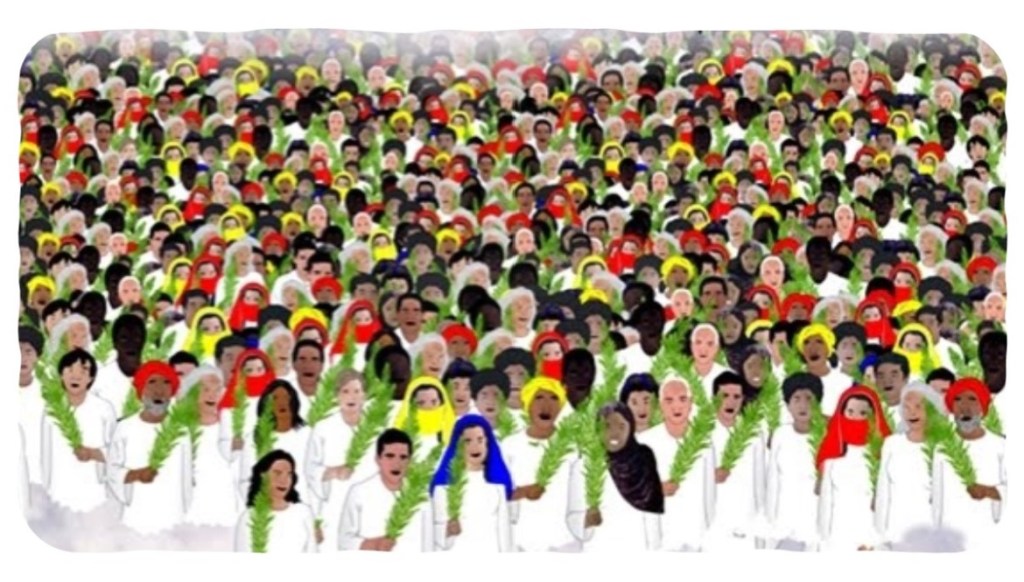
Verse 9: “There before me was a great multitude that no one could count, from every nation, tribe, people and language.”

As we turn to John’s book of Revelation we turn to a vision that gives hope for eternity, offers a picture of the kingdom of God, and calls us to a glorious kingdom here on earth. Our passage today and much of the book of Revelation is a “then, now, and will be” vision.

John sees a “great multitude” gathered in heaven – far too many to count. In this vast crowd there are people “from every nation, tribe, people, and language.” Oh how the religious leaders of yesterday’s text must’ve cringed when they first heard of this vision of heaven! But what a beautiful picture of heaven it is! One day we will be gathered with a representation of all of humanity. To John’s audience this was a reminder that they do not suffer alone. Many all around the world suffer alongside them. To us it is a reminder to work to make our churches and faith communities look more like the actual community all around us.

The scene in our passage is filled with worship. The multitude, the angels, the elders, and the four living creatures all worship God and the Lamb. They joyously offer praise and thanksgiving and adoration. This scene is “church” at its finest and most glorious. Next an elder identifies those in “white robes” as those who have gone through the “great tribulation” – the suffering and persecution and trials of this life. The passage closes by contrasting this life with the life to come. In glory there will be no hunger or thirst, no oppression or suffering. God will “wipe away every tear” and the Lamb will lead us “to the springs of living water.” What hope these words gave to John’s audience. What hope these words give to all who long to one day be redeemed by Jesus Christ. Oh what a glorious and beautiful day that will be. Thanks be to God.

Prayer: Lord God, thank you for the hope that today’s passage gives. Thank you for the seed of what will be. But, God, help us to see that this vision is also a vision for today and an understanding for our time now. As we hold onto our hope for eternity, guide us to expand the kingdom here and now. Use us to satisfy hunger and thirst now. Use us to end oppression and suffering now. Use us to make our churches and communities more like the kingdom to come. Amen.


Leave a comment

Humble Servants

Reading: Matthew 23:1-12

Verse 3b: “But do not do what they do, for they do not practice what they preach.”

In our gospel text Jesus is assessing the state of religion in his day. As we begin with the text we first note that Jesus respects the religious leaders position and authority. They “sit in Moses’ seat” and he encourages the people to “do everything they tell you.” The religious leaders knowledge of the Law or Torah and their teachings from it are solid from Jesus’ perspective. Today you can walk into most churches and you’ll find clergy who know the Bible well and share its truths from the pulpit.

Beginning in the second half of verse 3 Jesus addresses the many issues beyond good theology and solid exposition. Here he warns: “But do not do what they do, for they do not practice what they preach.” It is easy, for example, to preach about loving your neighbor. It is a whole other thing though to actually go outside the church to do this well or to really love the stranger who wanders through the doors. To truly live out the gospel of Jesus Christ is a “heavy load.” Much is required of us for faithful living. It is not easy or without great effort and occasional suffering. It is about being a selfless servant.

This seems to be the religious leaders’ second struggle. They love to be honored and seen and fawned over. They love their titles and places of honor. Starting in verse 8 Jesus addresses this too. He clearly states that there is only one Master, one Father, one Messiah. God is God. We are not. We are brothers and sisters in the faith, humble servants seeking to bring glory and honor to God alone. As we seek to live out our faith today may we be open to the Spirit in us and to Christ still among us in the world. May it be so.

Prayer: Lord God, let us recognize that the greatest commandment is to love. As we root ourselves in our love for you and in your love for us, fill us with your grace, your mercy, your presence. Open our eyes to what you call us to as your children – loving the least, saving the lost, clothing the naked, feeding the hungry, welcoming in the stranger… Lead us to heal this world as we go out as your heart, hands, and feet. Amen.


Leave a comment

A Manner Worthy

Reading: Philippians 1:27-30

Verse 27: “Conduct yourselves in a manner worthy of the gospel of Christ.”

In the second half of our Epistle text, Paul encourages the Philippians and us to represent Christ and one another well. He begins by challenging us all to “conduct yourselves in a manner worthy of the gospel of Christ.” What does it mean to live a life that is “worthy” of Jesus and the gospel? In a general sense it means to live as Christ lived – obedient to God; generous with love, mercy, grace, and forgiveness; and, overflowing with humility and care for the needy.

Paul focuses on 3 more ways in today’s passage. First he calls us all to “stand firm in one spirit.” The unity of spirit was very important in Paul’s day. These early Christians were living in a pagan world as members of a small minority group. Sticking together in body and in spirit was essential to survival. The same is true today for us.

Paul then tells us not to be afraid of those who oppose us. These ‘opponents’ were many in Paul’s day (he was in prison, right?) and there are no less today. To have confidence in our eternal God battles the fear of these temporal threats. Lastly Paul encourages the Philippians and us to step into what has been “granted” to us as a privilege – to suffer for and with Christ. Nothing without cost is worth much. If we are not suffering a bit for our faith, then we aren’t fully conducting ourselves in a manner worthy of Jesus Christ. If we are blending in and living like the world around us, let us return to the actual gospels for a refresher on the life of Jesus.

Prayer: Lord God, help me to be a person of peace and unity. Use me to build connection and community – two things at the heart of faith. Remove any fears that I have and empower me to be bold in my faith. And as John Wesley said, put me to doing, put me to suffering. May it all be for your glory. Amen.


Leave a comment

What Can Anyone Give?

Reading: Matthew 16:24-28

Verse 26: “What can anyone give in exchange for their soul?”

Today’s passage begins with Jesus offering a challenge and an invitation. He states that if one wants to follow him (that’s what happens after we profess him as our Lord and Savior), that one must do two things. First, one must deny self. Second, one must take up their own cross. In the reality of faith, I believe these are often repeated events and practices.

Professing Jesus as Lord is step 1 of denying self. In this confession we are declaring that Jesus is our top priority, that he is the #1, that he occupies the throne of our heart. The flip side is that we are none of these things. This is the beginning of denying self. Making the declaration is the easy part. It is often made in a moment of passion for Christ. We are “on fire.” The much harder and ongoing challenge is keeping the profession as we enter the world. These daily steps are the hardest. The ways, norms, and practices of the world often clash with our faith, causing us to evaluate our choices and decisions one by one in the light of faith.

In the same way, taking up our cross is not a once-in-a-lifetime act. It is not exactly the same as when Jesus took up the actual cross. It is the same in that taking up our cross involves sacrifice and it is on behalf of others. And, oh yes, there is usually also some suffering involved. As with denying self, there is a cost to this act too. One can take up the cross in many ways. Some efforts provide the arc of our faith journey. Think of a missionary in China or of Mother Teresa in India. For most of us, though, they are shorter term. Strung together they reveal the arc of our story of faith. We might stand against an injustice being done. This ends when justice prevails. We might befriend someone who is an outsider or outcast. This ends when our love leads others to love and include this person. We might commit to walking with someone experiencing addiction. This ends with long-term sobriety or recovery. Some of these can be lengthy but not forever.

Taken together these become our journey of faith. Casually speaking, these practices become our lifestyle. Lived out, we experience losing this earthly life and all of its attachments. In turn we gain true life – a life focused ultimately on the gift of eternal life, both for us and for all others. It is a day by day, moment by moment focus. Jesus asks, “What can anyone give in exchange for their soul?” Nothing but a day by day, moment by moment walk of faith. May it be so for you and for me.

Prayer: Lord God, you ask for all of me to be given, to be poured out for you. From the outside it seemed like such an ask. But now on the inside, it feels like the only possible choice, understanding what you did and do for me. Use me this day and every day in loving service to you and to my neighbors. Amen.