pastorjohnb

Thoughts and musings on faith and our mighty God!


Leave a comment

So It Will Be with Us

Reading: Matthew 24-25

Matthew 24:46 – “Happy are those servants whom the master finds fulfilling their responsibilities when he comes.”

Chapter 24 is almost all about the signs of Jesus’ return. The end of chapter 24 and most of chapter 25 is about being ready or prepared for that day. Chapter 25 closes with the consequences of our decisions and actions leading up to that day. The conversation begins outside the temple, where Jesus predicts its destruction. This leads the disciples to ask about the end times when Jesus will return in glory.

Jesus says there will be many things that will happen. There will be false prophets and false christs. There will be war, famine, earthquakes, great suffering, and persecution. Many will fall away. Then the sun and moon will go dark and the planets will shake. Christ will come on the clouds in great splendor and power. The angels will gather the chosen ones. Jesus then reminds us that no one knows the day or hour. It will come upon the earth just as the flood came upon the people of Noah’s day. The message is clear: stay alert, always be prepared for the day.

From 24:45 through 25:30 we find three parables that describe what it looks like to be alert and prepared. In the first parable we read, “Happy are those servants whom the master finds fulfilling their responsibilities when he comes.” The bad or unfaithful servants will be cut to pieces and thrown into hell when the master returns unexpectedly. In the second parable the wise bridesmaids had plenty of oil (faith.) They will enter the wedding (heaven) when the late groom (Christ) arrives. The door will be closed. The foolish or unprepared will hear, “I don’t know you” when they try to get in. In the third parable the faithful who have put their gifts to work will hear, “Come, celebrate with me.” The lazy and evil will be thrown into the “furthest darkness.”

We close with the parable of the sheep and the goats. This summarizes the results of how one lived. The sheep lived for others, feeding the hungry, visiting the prisoners, welcoming the strangers. They did so in the name of Christ. Eternal life is their final reward. The goats ignored the hungry… Their final reward is eternal punishment. So it will be with us.

Prayer: Lord God, how we live day by day matters. Keep us faithful in the small things, attending to all that you place before us, using the gifts and blessings you have given us to bring your kingdom to fruition. Amen.

Leave a comment

Live Amongst Us

Reading: Ezekiel 38-43

Ezekiel 38:23 – “I will display my greatness, show my holiness, and make myself known in the sight of many nations.”

Chapters 38-39 deal with Gog, a representation of the evil empires. Coming from the north, Gog could represent Nebuchadnezzar. Gog gathers many nations to his side. This mighty army comes to Israel, intent on conquering and looting God’s children. God’s anger is aroused and God unleashes nature on them, followed by turning their swords upon one another. God calls on the birds and animals of prey to feast on the horde’s bodies. So vast was the army, it took Israel seven years to bury the bodies. In the end God promises to pour out “my Spirit” upon Israel. With this Spirit within them, God will never again hide God’s face.

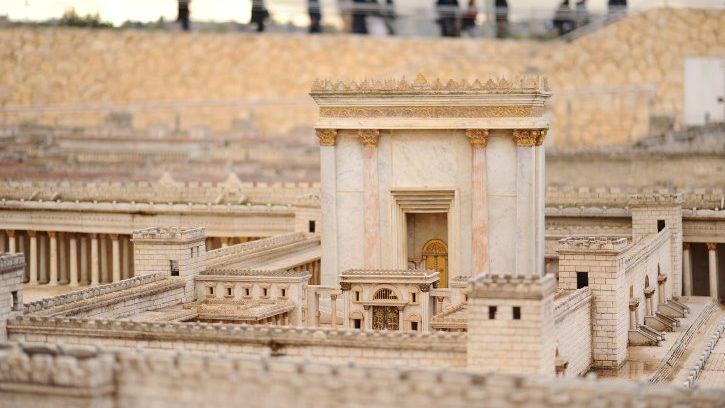
Chapters 40-42 contain the first part of Ezekiel’s temple vision. He is told to pay close attention so he can tell all to Israel. The temple described has some commonalities with Solomon’s temple, but much is different. While a temple will be rebuilt, this temple is never realized in the Bible. Ezekiel’s temple compound is 750 feet by 750 feet. It has three gates, courtyards, chambers, holy places and equipment. The Zadokite clan is set apart as the only Levites to “draw near” to God – to offer sacrifices on the altar. The temple is adorned with winged creatures and palm trees. There are holy chambers, places to store holy things.

The temple is at the center of God’s restoration of Israel, both physically and spiritually. It is a part of the sanctifying process, making Israel into the holy people of God. For Ezekiel and his audience, the temple represented God’s presence with the people. These words and vision bring hope and encouragement to the people living in exile. God longed to live amongst the people of God. God still longs to live amongst us today. May it be so.

Prayer: Lord God, your power and might extend over all things: over Gog and his allies, over today’s idols and temptations, over our selfish hearts. Ezekiel’s temple vision reflects your power and might. But it is still just a building. Just as your presence will fill this visionary temple, fill our hearts with your indwelling spirit, transforming our lives and our hearts. Amen.


Leave a comment

As We Receive Mercy…

Reading: Matthew 18:21-27

Verse 23: “The kingdom of heaven is like a king who wanted to settle accounts with his servants.”

After Jesus’ teaching about how to solve conflicts in the church, Peter wants to define the expectations. On second thought, no, Peter wants to limit the expectations, much like the expert in the law did when he asked Jesus to define his ‘neighbor’ (Luke 10). Yes, Peter is generous in offering to forgive 7 times. He is going way past the current cultural norm of 3. As it was with the parable of the Good Samaritan, in this week’s gospel passage Jesus blows the doors off of somehow trying to limit God’s love, grace, and mercy.

In verse 22 Jesus tells Peter, “I tell you, not 7 times, but 77 times.” Jesus is not, however, playing Peter’s game. He isn’t really setting 77 as the magic number. His point here is simple: quit counting. Counting wrongs is an exercise in patience, not forgiveness. When we keep a count of wrongs against us, we are just asking, ‘How long do I have to put up with this person?!”

Jesus then launches into a parable, beginning with, “The kingdom of heaven is like a king who wanted to settle accounts with his servants.” In the parable the king represents God and we are the servants. The debt is our sin. The first servant owes a HUGE debt. He begs for forgiveness. The king is moved; he forgives the debt. The servant is set free. Now, what if this is really the king’s (God’s) goal in calling in the servants (us)? The king (God) doesn’t want to punish or extract payment. No, the king (God) wants to grant mercy to the servant (us). God desires that as we receive mercy, not 7 or 77 or 7,777 times, that we then, in turn, extend it to others. May it be so for you and for me.

Prayer: Lord God, help me, O font of mercy, to model your heart for mercy, reconciliation, and forgiveness. Above all, you want a relationship with us. You’ll go to almost any length to achieve that. Lead me to do the same, both with you and with all those in my life. Amen.


1 Comment

In Solitude and Prayer

Reading: Hebrews 5: 5-10

Verse 7: “During the days of Jesus’ life on earth, he offered up prayers and petitions… he was heard because of his reverent submission”.

Photo credit: Patrick Fore

Our passage today reminds us of how Jesus was like us and calls us to be like him. In the first verse we are reminded that Jesus did not come as a high priest. Jesus could have been born into the tribe of Levi and could have assumed the role of priest after finishing all his formal training. He would have then served in the temple or maybe in a local synagogue to start out. In this role Jesus would never have gone out to engage the world. He would not have crossed paths with Gentiles and lepers and prostitutes and the many others that he did heal and bring back into community. Most Jews saw themselves as a people set apart from the world and the priests were a group within this people who were even more set apart and isolated.

Jesus was born into the family of a common laborer – a carpenter. After the miraculous birth and exile in Egypt, Jesus was raised as an ordinary kid in a small town. Jesus learned the family business and spent years in the profession. His parents were good Jews and family was where he first found love and belonging. When Jesus began his ministry at about 30 years of age, he had experienced the good and bad, the hard and joyous of life. Once Jesus stepped into the role of Messiah he did not hunker down in the temple, waiting for folks to come hear his great wisdom. His ministry was radical for the time. It remains radical for today. Jesus traveled the country, teaching, healing, preaching, feeding, reconciling… In all he did, Jesus exhibited a love for and devotion to God. If anyone deserved to be the high priest, it was Jesus. Instead, he lived as one of us.

A regular practice of Jesus’ life was solitude and prayer with God. In verse seven we read, “During the days of Jesus’ life on earth, he offered up prayers and petitions… he was heard because of his reverent submission”. In times of need, Jesus turned to God for comfort, strength, peace. This too should be our practice: to turn to God in our times of need. In our moments of need, we too want to know that we are beloved children of God. We too want to know that God cares for us. We too want to rest in his presence, in our place in the family of God. As we seek to live as faithful disciples of Jesus Christ, may we be like Jesus, ever seeking the loving presence of our life-giving God.

Prayer: Lord God, hear our cries, alleviate our pain and suffering. Draw us near when we seek you; assure us of our place of belonging. Lead us to bring all things to you in prayer, guide us to rest in your presence. Walk with us all of our days. Amen.


Leave a comment

Unto Us, To Us

Reading: Isaiah 9: 2-7

Verses 6-7: “For unto us a child is born, to us a son is given… He will reign with righteousness and justice… forever”.

Early in the book of Isaiah the prophet writes to a people living in the darkness and suffering of exile. They are enduring the consequences of their corporate disobedience to God. At the start of chapter nine Isaiah writes, “there will be no more gloom” – the time in exile is coming to an end – and he writes, “in the future he will honor Galilee of the Gentiles” – a region containing Nazareth, hometown of the Lord.

Our passage today begins with these Christmas words: “The people walking in darkness have seen a great light”. The light of the world is coming. Almighty God, born in the flesh, will bring light and holiness into the world, driving away the darkness and evil. In verse four Isaiah again speaks Jesus words, saying, “you have shattered the yoke that burdens them”. The Prince of Peace will give all for humanity, forever breaking the bonds of sin and death, bringing true peace to all who believe.

In verses six and seven we read these words of Isaiah that draw our minds to the Messiah: “For unto us a child is born, to us a son is given… He will reign with righteousness and justice… forever”. Born of the virgin Mary, conceived of the Holy Spirit, the child is for us, given to us – to save, redeem, and restore us and our world, to be our Wonderful Counselor, to die for us, to rise and dwell in us and with us forever. The Everlasting Father, born of the flesh, comes to be a part of our world and our lives… forever! His birth we celebrate today. Thanks be to God for the gift of Light, unto us, for us, forever.

Prayer: God of all the universe, in a humble way you came into our world. You walked among us seeking to do nothing but give of yourself in love. You left this world doing just that once again. And now and forevermore you rule with love and mercy, hope and peace, justice and joy. Thank you for being my Savior. Amen.


Leave a comment

Best of All…

Reading: Jeremiah 31: 11-14

Verse 13: “I will turn their mourning into gladness; I will give them comfort and joy instead of sorrow”.

Verse eleven opens with God’s promise to ransom and redeem his children from “the hand of those stronger than they”. These words remind me of our daily battle with evil and the other lures of the world. Although God is way stronger, in our human weakness sometimes it feels like we are weaker. Paul wrote of this in Romans 7. We too do what we do not want to do and we fail to do what we want to do. We are ever wrestling with sin. The good news for us is that hundreds of years after Jeremiah gave this promise, God did ransom us with Jesus’ life.

Verse twelve turns to the peoples’ response. With shouts of joy the people celebrated the Lord’s bounty. They felt like a “well-watered garden” and they enjoyed the provision of God. Each of us is also blessed. There are so many things that I can count as blessings, but none more important than my relationship with Jesus Christ. As modern day Christians, we are so blessed. We too can join the Israelites in joyfully thanking God for the bounty we receive. In verse thirteen’s opening line dancing follows joy. Go ahead and dance if so inclined!

In the second half of verse thirteen we read, “I will turn their mourning into gladness; I will give them comfort and joy instead of sorrow”. This continues to be God’s promise. In this life we will have our times or even seasons of mourning. God’s promise still remains – to give us comfort and joy. God’s love never fails. It continues to wash over us, even in times of sorrow, when we are willing to receive his love.

As we enter 2020 today, these words of the prophet Jeremiah are great reminders. The general tone reminds me of John Wesley’s dying words: “Best of all, God is with us”. Yes, God is. Thanks be to God.

Prayer: Lord God, as I begin 2020, I rejoice that I am yours and that you are mine. In the coming year, use me as you will. Lead and guide me, strengthen and encourage me. Walk with me into a world in need. Amen.


Leave a comment

Open to Others

Reading: Luke 12: 13-21

Verse 15: “Watch out! Be on your guard against all kinds of greed; a man’s life does not consist in the abundance of his possessions”.

On its most basic level the parable of the rich man is about greed and the negative decisions it can lead to. In the parable a bumper crop triggered the man’s “mine” instincts. He decided he had to build bigger barns to store his new crop. He coveted his grain because in it he saw not only financial security but also a chance to take some time to enjoy life. He was very focused on self.

Possessions and wealth are not the only things we can feel greed over and can seek to covet. This morning I read about a small neighborhood church in a changing community that decided to take a chance and reach out. Instead of holding onto their church, they opened their doors and invited their new immigrant neighbors inside. They invited them in and began praying with them – to find homes and jobs and for comfort to their loneliness. The praying led to relationships and that small church grew as their new friends became brothers and sisters in Christ.

Some churches could see new faces as threats to what they have and know. In many cases immigrants are cast in an “us” and “them” scenario. And immigrants are not the only people groups that can be seen in an “us” and “them” framework. When we create perceived differences between ourselves and another group of people, we are denying that they too were created in the image of God. When we allow greed to put up a barrier between us and our neighbors, we are holding tightly to what we have always known or had and are not allowing God’s love to work in our neighborhood, in our community, in our world, or in our own heart.

The rich man was focused only on self. He could not see all he had to offer his neighbors. His greed prevented him from seeing beyond himself and from experiencing God’s love at work. In the end, what good did all that grain do him? Storing up and holding things for ourselves – goods, money, time, compassion, prayers, empathy, a place at the table – does not make us rich towards God either. May we all learn a little from the rich man and from the church that opened its doors to those outside. May we practice what we learn.

Prayer: Lord God, who is out there today for me to engage? Lead me to share your love with another today. Soften my heart and open my eyes, hands, and feet. Amen.


Leave a comment

All

Reading: Romans 10: 8b-13

Verse 12: “For there is no difference between Jew and Gentile – the same Lord is Lord of all and richly blesses all who call on Him”.

Verse 12 is a pretty amazing statement when one considers who Saul was. As Saul, Paul was raised as an expert in the Law. He was a Pharisee – a person who dedicated his life to carefully following all of the Law. Saul followed the Laws that called for a strict separation between Jew and Gentile. The Jews were the chosen people of God, a group set apart. Gentiles were all non-Jews. This was a large group of people. As the early church began, Saul’s zeal turned upon the Christians, who were Gentiles according to Saul’s world view. Then Saul met Jesus. His heart was changed and his name was too. Paul is the Gentile version of Saul.

All of us are like Saul to some degree. We are raised with and we can learn stereotypes and prejudices or at least thoughts about certain groups, types, or classes of people. For Saul the dividing line was Jew-Gentile. It varies for each of us, but the list is long when put all together: men-women, black-white, American-immigrant, old-young, Republican-Democrat, white-Native American, jock-nerd, Christian-nonbeliever, white collar-blue collar, rural-urban, straight-homosexual, educated-uneducated, progressive-liberal… The list goes on. And on. But no matter who is on our lists, Paul’s truth remains truth because it is God’s truth: “For there is no difference between ____ and ____ – the same Lord is Lord of all and richly blesses all who call on Him”. God created us all and loves us all as His dear children. All does mean all. Anyone we could name. Anyone we could put on the list. All is a pretty inclusive word. God’s love is inclusive.

We each live within God’s extraordinary love. In the Jews’ world at the time of Paul’s writing, the us-them mentality prevented them from sharing God’s love. This same mentality can have the same effect on us today. It should not be so. We read why in verse 13: “Everyone who calls on the name of the Lord will be saved”. Everyone. That’s a big word too. May our love for all people, for everyone, be that big too.

Prayer: Lord of love, when I begin to see things that divide or separate, tear them down. When I begin to see differences, wipe them from my mind and heart. Create in me a pure heart, O God, a heart of love for you and those you love – all people. Amen.


Leave a comment

Measure Out Love

Reading: Luke 6: 32-38

Verse 36: “Be merciful, just as your Father is merciful”.

Jesus continues in our passage today with the same radical love that we saw yesterday. Today He begins by comparing our call to love with the world’s way of love. Jesus points out that even ‘sinners’ love, do good, and lend to those who do the same to them. “What credit is it to you?” Jesus asks over and over. To just do the things the world does has no value in God’s kingdom. Again Jesus reiterates the call to love, do good to, and to lend to our enemies, but adds, “without expecting to get anything back”. This is nearing a godly love. Love them even though you know they will keep on sinning. Love us anyway God, even though you know we’ll fall short.

Why try and love as God loves? Because then we will be sons and daughters of God most high. Jesus reminds us why, saying, “because He is kind to the wicked and ungrateful”. He could just as well have said, “because He loves you”. With our worldly eyes this is hard to see, to understand. But it is the way of God and will be the way of Jesus Christ. In verse 36 Jesus offers another way to look at it: “Be merciful, just as your Father is merciful”. Over and over again, we sin and hurt our relationship with God. Over and over. And over and over God extends mercy and says, “I still love you”. Over and over.

In the last two verses for today, Jesus gives us some examples of why we are to love even our enemies with this radical, all-encompassing love. It takes us back to the ‘golden rule’ of verse 31. But in these examples there are three parties – us, them, and God. Do not judge them and we will not be judged by God. Do not condemn them and we will not be condemned by God. Forgive them and we will be forgiven by God. Give to them and God will give to us. Love matters. It certainly does in our relationship with God so it had better matter in our relationship with others.

The section closes with this line: “For with the measure you use, it will be measured to you”. Powerful. May we measure out lots of love, mercy, and grace today and every day.

Prayer: God of love, may I practice daily what your Son lived out every day. May love be my guide as it was Jesus’ guide. Amen.


1 Comment

Let Us…

Reading: Hebrews 10: 19-25

Verse 21: “Since we have a great high priest over the house of God…”

Jesus opened the way for us – “a new and living way” – to enter into God’s presence. No longer is access limited to the one person chosen by lot to enter on everyone else’s behalf. “Since we have a great high priest over the house of God…” All who call on Jesus Christ as Lord can enter into God’s presence through Jesus.

In today’s reading there are four “Let us…” statements that are responses to the access provided by Jesus, our great high priest. They begin with “let us draw near to God with a sincere heart”. With an assurance that we are cleansed from our sins, we draw close to God. The second is “let us hold unswervingly to the hope we profess”. We hold fast because God, the one who made the promise, is always faithful. The covenant to be our God and to always love us is neverending. We hold fast to our faith because we have the promise of God’s presence and love.

The third statement is “let us consider how we may spur one another on toward love and good deeds”. We begin by loving each other as Jesus first loved us. In this model, we will be people who go out and love others. Our good deeds are the vehicle to express that love. The fourth statement goes along with the third. “Let us encourage one another”. We do so by meeting together regularly – not just for Sunday morning worship but also for Bible study and prayer, for food and fellowship, and one on one to mentor and support.

These four statements are great reminders to us that we are in this together. They were given to a people living under pressure in an increasingly pagan world. This sounds familiar. In our post-Christian world, this day and each day may we cling to these “Let us…” statements. Amen.

Prayer: Lord God, today remind me of your promises and your love. Lead me to draw close in true faith, assured of your love. Help me to meet with and to encourage my brothers and sisters in Christ so that we may encourage one another to be your hands and feet, your salt and light in a lost and hurting world. May it be so this day and every day. Amen.