pastorjohnb

Thoughts and musings on faith and our mighty God!


Leave a comment

A Big Love

Reading: John 13-31-35

John 13:34b – “Just as I have loved you, so you also must love one another.”

Jesus is nearing the cross at this point in John’s gospel. Judas has just left to betray Jesus. Soon, through his death and resurrection Jesus will be glorified. He has spent his life, especially the last three years, glorifying God through how he lived. This process of mutual glorification is a part of the life of a Christian. Our faithful living brings glory to God. This is the building of the kingdom here on earth. In the end, our faithful living will result in our place in God’s glorious heaven.

For Jesus, the return to God’s side is rapidly approaching. He plainly tells the disciples, “I’m with you for a little while longer.” They will want to remain with Jesus, but for now this is not to be. Jesus, however, will remain a part of their lives. In spirit, Jesus will continue to be present to his disciples.

Beginning in verse 34, Jesus tells them how to continue this relationship. Giving what he calls a “new command,” Jesus tells the disciples to love one another. This command to love neighbor has been around for thousands of years. What’s ‘new’ is in the details: “Just as I have loved you, so you also must love one another.” Like Jesus’ “You have heard… but now I say…” statements, this new command takes Leviticus 19:18b to a whole new level. As disciples the call isn’t just to live as the good Samaritan loved. No, the call is to love as Jesus loves: unconditionally, without limit, completely. This is a big love. When we love this way, all will know that we are a disciple of Jesus. May this be the love that we practice always.

Prayer: Lord God, this is not an easy-to-accomplish call. To love others as you love us? That is a deep and rich and layered love. It is a love often with a cost. Lord, work in our hearts, open them wide so that we can practice and live a love that reflects your love. Guide us to be your love lived out in the world. Amen.


Leave a comment

“New” Again

Reading: Ezekiel 47:6-12

Ezekiel 47:9 – “Wherever the river flows, every living thing will thrive.”

As we turn to Ezekiel 47 we are near the end of his vision of the new heaven and earth that began back in chapter 40. At the beginning of chapter 47 Ezekiel returns to the temple, to the east gate. So far in his vision only the glory of God has passed through this gate. Now water flows out of this gate. As the water flows it grows wider and deeper, finally reaching a point where it is impassable.

In verse 6 Ezekiel is led to the edge of the river and is asked what he sees. On both banks Ezekiel sees many trees. He is then told, “Wherever the river flows, every living thing will thrive.” These waters will bring life abundant. What was dead will come to life. All that is touched by the living water will thrive. Provision will come from this living water – fish in great numbers, fruit without end. And the leaves of these trees will bring healing to all people. The words Ezekiel uses, the scene he sets – right from the Genesis account of creation.

This abundant life, this provision, this healing – it is all because the water “comes from the sanctuary.” This stream of life begins physically at the throne of God, yes. Its power, though, comes from the one who sits on the throne. The same God who spoke all of creation into being is the same God who will one day give abundant life as all things are made “new” again. The world will then once again be as God created it to be. Thanks be to God.

Prayer: Lord God, all glory, praise, and honor to you! The love and care shown at the beginning of creation is as strong as ever. We know that at just the right time Christ will return and defeat all evil, all pain, disease, and death, all sorrow, and all division. We will then walk in your light and love in your abundant new creation. We long for this day! Amen.


Leave a comment

Our Great High Priest

Reading: Hebrews 10:19-24

Hebrews 10:19 – “Brothers and sisters, we have confidence that we can enter the Holy of Holies by means of Jesus’ blood.”

Hebrews 10 begins with a description of Christ’s “once-for-all” sacrifice. The author explains that Jesus, through his sacrificial death, put an end to the old sacrificial system. This system was unable to “take away our sins.” In addition, the mechanics of the system prevented a personal connection to God. The priest heard your sin and offered the atoning sacrifice on your behalf. There was also a second barrier to God. The Holy of Holies, the space which held the ark (God’s presence,) was separated off by a huge curtain. The high priest alone entered this most intimate and sacred space just once a year, seeking forgiveness and blessing for the people of God.

Verses 19-24 are a summary of what Christ’s sacrifice means for us. In the first verses we read, “Brothers and sisters, we have confidence that we can enter the Holy of Holies by means of Jesus’ blood.” As Christ breathed his last breath the curtain in the temple was literally torn in two, top to bottom. The physical barrier was removed. Christ opened the way, “a new and living way,” so that we could have a personal relationship with God. Christ is our new “great high priest” that invites us to draw near to God with a genuine, cleansed heart. Forgiveness and cleansing are ours every time we confess and repent of our sins. Jesus’ blood was and is the “once-for-all” sacrifice that stones for our sin. Hebrews also reminds us that we can “hold onto the confession of our hope,” because Jesus is faithful. We have confessed Jesus Christ as our Lord and Savior. It is only in and through him that we can remain faithful too. Thanks be to God.

Prayer: Lord God, thank you for the new covenant, one written on our hearts because Christ’s Spirit dwells in our hearts. This personal and intimate connection is a great gift. You are with us always. Lord, lead and guide us to live out our faith, encouraging one another in love. May this love lead us to be and do good in the world, drawing others into the new and living hope that we have in you. Amen.


Leave a comment

Here and Now

Readings: Luke 17:20-21 and 22:14-20

Luke 17:21 – “Don’t you see it? God’s kingdom is already among you.”

In Luke 17 some Pharisees ask Jesus when God’s kingdom is coming. Maybe they hope Jesus will turn into the kind of Messiah they’re looking for: strong, powerful, able to defeat the Romans. Or maybe they hope that since Jesus claims to be the “Son of Man,” then he’ll be able to tell their when their Messiah will come. Inviting these religious leaders into the present reality, Jesus says, “Don’t you see it? God’s kingdom is already among you.” Open your eyes and hearts, it is here and now.

This can be a question Christians can ponder too. One can think that accepting Jesus will be a cure for all that ails us. One can think that life will only be blessed because we’re following Jesus. No, all of life still happens. Jesus will and does walk with us, bringing peace and hope in the storms, comfort and strength in the trials… In turn, we offer these to others. This is the kingdom of God at work here and now.

Almost a week later, Jesus gathers in Jerusalem with his disciples. It is Passover and they are gathered around the table. Jesus shares two interesting things with the disciples. First, he “earnestly desires” to share this meal with them. Second, he tells them, “I won’t eat it until it is fulfilled in God’s kingdom.” Little did they know, this would be the next day. Jesus then share the bread as his “body… given for you.” Then the cup is shared as the “new covenant… poured out for you.” After Jesus fulfills these words and their promise, completing this act of sacrifice, followers of Christ will remember this gift by celebrating Holy Communion. Each time, in that moment, God’s kingdom is here and now.

Prayer: Lord God, thank you for your presence with us and through us. When we experience or share your light and love, your grace and peace, your hope and strength, the kingdom of God manifests itself here and now. We are reminded of the depth of your light and love… in the sacrifice you made on the cross. When we remember this act, we are made new again, here and now. Thank you for this gift. Amen.


Leave a comment

Communion = Community

Reading: 1st Corinthians 11:23-32

1st Corinthians 11:28 – “Each individual should test himself or herself, and eat from the bread and drink from the cup in that way.”

Photo credit: Geda Zyvatkauskaite

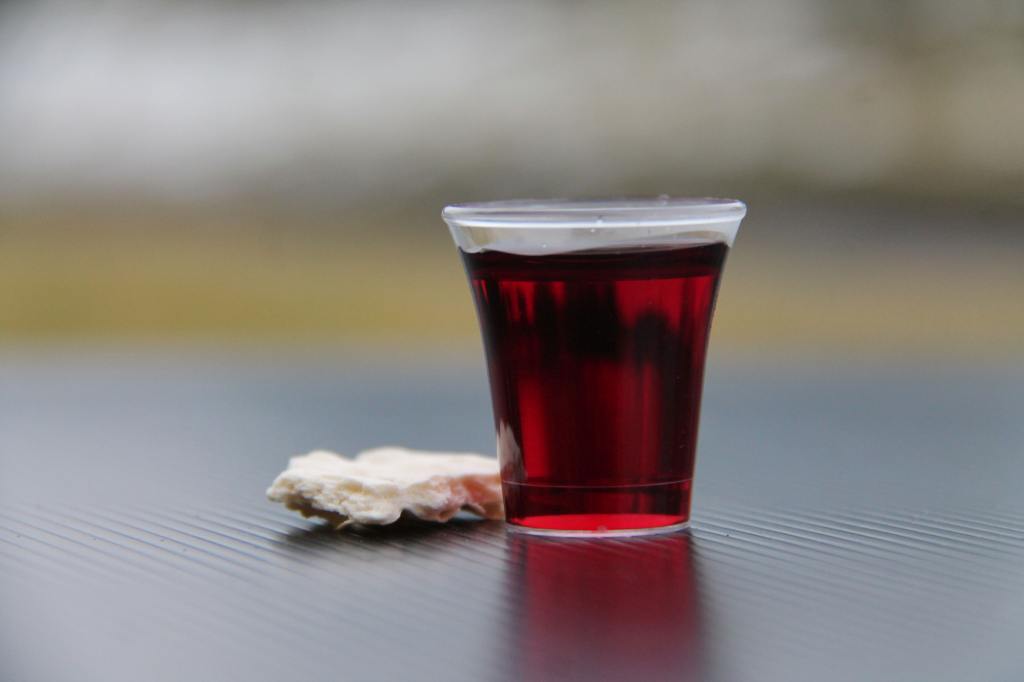
We seek to “stay in love with God” through various means of grace. One of these is Holy Communion. This sacrament first reminds us of Christ’s loving sacrifice on our behalf. The giving of his innocent blood in place of ours made atonement for our sins, paying the price for forgiveness. We approach this gift with a deep sense of awe and reverence.

Sometimes we do something for a while and it becomes just going through the motions. Perhaps you’ve felt that before with something like the Lord’s Prayer. For the church in Corinth, the Lord’s Supper had become one of those things. It was now causing more harm than good. It was creating division in the church. At this point it was more like what we’d call a “love feast” than what we recognize as a communion with its liturgy and formality. In Corinth, it had become a “private meal” with the rich getting drunk and stuffed while the poor were left hungry and thirsty. The church has forgotten that love, sacrifice, service, and community were at the heart of the Lord’s Supper.

Paul addresses this situation by reminding the church that the Lord’s Supper is centered on and celebrates the new covenant made by Jesus Christ. He also reminds them, though, that this communal celebration begins with individual preparation: “Each individual should test himself or herself, and eat from the bread and drink from the cup in that way.” Each person must come before God, humbling confessing and repenting of their sins. This necessary step prepares each to be made “new” again as the blood of the Lamb washes away their sin. To not take this step is to hide or hold onto one’s sin. This brings judgment and condemnation instead of forgiveness and grace.

For each person to come before God, to confess and repent, it levels the playing field. It places us all equally before the table of grace, all sinners redeemed by his blood. In this way, community is restored. It brought one body to the one bread, one blood. That was Paul’s goal. It should be our goal. May it be so.

Prayer: Lord God, draw us to our knees, to the place of confessing and repenting of our sins. Open up our hands and hearts to release all that separates us from you and from one another. As we come clean, thank you for making us clean. Thank you for your great love that washes away our sins and failures. Thank you for your redeeming love. Amen.


Leave a comment

Fill Us, O Lord

Reading: Colossians 2:6-12

Colossians 2:11 – “In him you were also circumcised with a circumcision not administered by human hands… stripping away the old self dominated by sin.”

Paul begins our encouragement for today by imploring the believers to “live… in the same way you received him.” Harkening back to the day they came to faith, Paul implores the believers to keep up the same fire, the same zeal. Paul encourages them to remain rooted in Jesus and to build up their faith, establishing themselves in Christ. This process, Paul writes, will lead to an overflow of thanksgiving and joy. These are good reminders for us too.

Next Paul invites them to be wary about falling back into our being drawn into the ways of the world. Potential dangers include new philosophies and false teachings that are counter to Christ’s teachings. Perhaps if even greater danger is conforming back to their old ways, back to the selfish and sinful ways of the world.

Paul reminds the believers that they have been “filled” with Christ. He reminds them that “In him you were also circumcised with a circumcision not administered by human hands… stripping away the old self dominated by sin.” The physical act of circumcision that sets the Jews apart from the world has become a spiritual act that sets the Christian apart from the world. The old self was “buried” in the waters of baptism. The new self emerged and was “raised up” through faith in Jesus Christ as Lord and Savior. Now the power of God resides in Spirit in the believers.

So what must we do to walk daily with and in the Lord? It goes back to the opening verses. Seek to live “in Christ” – to live as Christ lived, following his example. Pour into your faith – build it up, deepen your roots in Christ. Allow the joy of faith to fill your heart to overflowing – share your faith. May it be so.

Prayer: Lord God, open wide our hearts today and fill us with your love. Open wide our minds today and fill us with your Spirit. Open wide our hands today and fill us with your strength. Then, in all things, use these things, allowing them to flow out of us and into the world, bringing you all the glory and praise. Amen.


Leave a comment

The Battle with Self

Reading: Galatians 5:13-21

Galatians 5:17 – “A person’s selfish desires are set against the Spirit, and the Spirit is set against one’s selfish desires.”

In Galatians 5:13 Paul reminds the believers that they have been “called to freedom.” Having committed themselves to Jesus Christ, they have died to their old self and have been made new in Christ. They were freed from their old ways and from the power of sin and death. Through grace they are forgiven and made right with God – again and again. Paul warns the believers against returning to their selfish ways. Grace was and is not given so that one can indulge and indulge. Instead Paul calls them away from selfishness and into service through love. This call will fulfill the command to love neighbor as self.

Paul then draws a sharp contrast between living in the way of the Lord and living in the ways of the world. These two ways stand in opposition to one another. He puts it this way in verse 17: “A person’s selfish desires are set against the Spirit, and the Spirit is set against one’s selfish desires.” We know from our own life experiences that this is a constant battle. Our inherent selfishness is always calling us to love self. The Spirit is always calling us to love God and other. The Spirit calls us away from doing “whatever you want to do.”

Paul gives us quite the list of things we do when motivated by selfish motives. This list of 16 behaviors reveal many issues in our world today. We see many of these selfish actions on display each day. And, if we’re being honest, there are several on Paul’s list that we struggle with daily. This is why surrender of self is so important. Guided by the Spirit, we will be called to  selflessness instead of selfishness. Living the way of Jesus, we will build the kingdom of God both in this time and place and in our hearts. Doing both, we await our eternal inheritance. May it be so for you and for me.

Prayer: Lord God, we ask for your Spirit presence in the battle between self and the call to love you and neighbor. On our own we struggle so. The impure thoughts, the unkind words, the selfish actions – they rise up so quickly. Counter this, O God, with the power of the Spirit. Moment by moment, call us to your will and ways. Amen.


Leave a comment

Hell? Heaven?

Readings: Psalm 92:5-8, Malachi 4:1-3, Daniel 4:9-11, and 12:1-3

Malachi 4:2 – “The sun of righteousness will rise on those revering my name; healing will be in its wings.”

This week we wrestle with the question of heaven or hell. We begin today in the Old Testament. The rest of the week will be in the New Testament. This “imbalance” is because there is no direct mention of hell in the Hebrew scriptures. There are references to a place we would call “hell,” but this concept did not have a place in Hebrew thought prior to Jesus’ days.

Psalm 92:5-8 is representative of Hebrew thought in the Old Testament. God is awesome. The ignorant, the wicked, the evildoers – while they “seem to blossom,” in the end they will be destroyed. Running throughout the Old Testament is the idea that the good will be rewarded and the evil will be punished.

This idea is echoed in Malachi 4. The prophet writes that the day is coming when the arrogant and evildoers will burn like straw, consuming them. But for those doing good? “The sun of righteousness will rise on those revering my name; healing will be in its wings.” The wicked will be crushed like dust, but the righteous, the godly, they will be filled with joy.

Even foreign kings experience this cycle of punishment and redemption. In Daniel 4, Babylon’s King Nebuchadnezzar calls upon Daniel, the one who has “the breath of the holy gods” in him, to interpret his dream. Daniel, with God’s help, explains the dream. All unfolds exactly as Daniel foretold. In the end, redeemed by God, Nebuchadnezzar worships, magnifies, and glorifies the goodness of God.

Turning to Daniel 12 we find the Old Testament passage that best connects to our understanding of heaven and hell. Speaking of the end times, Daniel writes that those whose names are in the scroll (of life) will be rescued, entering “eternal life,” shining like stars forever. Others – those not in the scroll – they will go to “shame and eternal disgrace.” So it will be.

Prayer: Lord God, lead us today to be people who do good and who seek to live holy and righteous lives that bring you honor and glory. Guard us from the temptations of this world, keeping evil and arrogance far away. In all that we do and say and think may our lives magnify and glorify your name. Amen.


Leave a comment

Come, Lord Jesus!

Reading: Revelation 21-22

Revelation 21:5 – “Then the one seated on the throne said, ‘Look! I’m making all things new.'”

As we conclude our Bible Year reading plan with Revelation 21 and 22, it is a wonderful end to this project and to the words of scripture. These two chapters give us a sneak peak into eternity. God and Jesus Christ are victorious. All evil is no more. Everything focuses on worshipping God and the Lamb.

Chapter 21 begins with the new heaven and earth becoming one as the New Jerusalem comes down from heaven. In this heavenly city, God will once again dwell with “his people.” There will be no tears, no death, no mourning, no pain. The one in the throne declares, “Look! I’m making all things new.” In his fourth spirit-led trance John gets a tour of this new city of God. It is 1,500 miles on each side. It was twelve gates, each made out of a huge pearl, each gate with the name of one of Israel’s twelve tribes on it. The city has twelve foundations, each made of a different previous stone, each bearing the name of one of the twelve apostles. There is no sun or moon. God’s glory is the light and the Lamb is the lamp. The river of life flows from the throne of God. On each bank is a tree of life. The trees bear twelve fruits and the leaves bring healing. God’s servants gather around the throne, worshipping God and the Lamb.

The epilogue begins in 22:6. An angel declares these words “trustworthy and true.” John states that he heard and saw these things. He is told not to seal the scroll because “the time is near.” Jesus, the “root and descendant of David… the bright morning star,” is coming soon. Come, Lord Jesus, come!

Prayer: Lord God, we long for the day. We long to see the new heaven and earth. We long to dwell in your presence. Today we pray, come Lord Jesus. Amen.


Leave a comment

High Priest, Mediator, Perfect Sacrifice

Reading: Hebrews 7-9

Hebrews 9:24 – “Christ didn’t enter the holy place… made by human hands, but into heaven itself, so that he now appears in God’s presence for us.”

The focus of Hebrews 7-9 is to establish Jesus as high priest forever, as the mediator of the new covenant, as the perfect sacrifice for the sins of the world. The writer begins his or her case by looking back to Melchizedek, the priest of God who blessed Abraham. He was not a Levite but remains “a priest for all time.” Yes, earthly priests will collect a tithe and will offer sacrifices again and again. But they die and don’t continue serving. The Levitical priesthood, part of the old covenant, offered sacrifices that “can’t perfect the conscience.” The guilt and the shame and the power of sin, they remain.

Jesus came as the “guarantee of a better covenant.” High priest forever, Jesus is “holy, innocent, incorrupt, separate from sinners, raised high above the heavens.” He offered himself, “once for all,” providing his own blood as the blood necessary for forgiveness. This initiated the second or new covenant. Quoting from Jeremiah 31, the author of Hebrews declares that God revoked the old covenant (written under the Law) and prepared for a new covenant (written on our hearts) and sealed by the blood of Jesus. Unlike the old covenant, Jesus’ blood will “wash our consciences clean,” freeing us to serve the living God. Jesus himself was “the sacrifice without any flaw.”

The mediator of the new covenant, Jesus Christ, offers all who are called the promise of “eternal inheritance.” Leading the way, “Christ didn’t enter the holy place… made by human hands, but into heaven itself, so that he now appears in God’s presence for us.” In heaven, Jesus mediates for us, standing for us in God’s presence. We await Christ’s second coming, when he will save and redeem us and our broken world. In this advent season, we say, come, Lord Jesus, come.

Prayer: Lord God, we are so grateful for the gifts you gave us through the sacrifice of your Son, Jesus Christ. Through his blood we are forgiven and cleansed, sins washed away, made holy in your sight. Christ did what the old covenant never could do. He made a new way, one that opened eternity to all who call on Jesus as Lord and Savior. Thank you for these gifts. Amen.