pastorjohnb

Thoughts and musings on faith and our mighty God!


Leave a comment

Commands

Reading: Exodus 20:1-17

Exodus 20:3 – “You must have no other gods before me.”

Entering the history of Israel, they have been freed from slavery in Egypt for three months. In this time they have tested both God and Moses. They have witnessed amazing miracles as expressions of God’s love for them. The mass of humanity is now at Mount Sinai, where they prepare themselves to receive God’s covenant. On the mountain Moses receives these ten commands from God. Obedience to these commands should be Israel’s response to God’s saving grace.

The first four commands center on our relationship with God. It is from this relationship that all other relationships flow. We shall not have any other god and we shall not make or worship idols. We shall not misuse God’s name. And we shall keep the Sabbath holy. These commands shape our relationship with God and they remind us of God’s proper place in that relationship.

The next six commands come in pretty rapid succession. These commands define our relationships with one another. The first deals with our family, our primary relationship: honor father and mother. The next five expand the circle to the wider world: do not kill, commit adultery, steal, lie, or covet. These seem simple and straightforward. Yet within each command is a degree of interpretation and application. Jesus will flesh out some of these commands in the New Testament.

These commands can be simplified. Jesus summed them up as love God, love neighbor. John Wesley used three simple rules to govern his life. As we can do with the 10 Commandments or with any rule, we can try to limit what it means to love or we can try to limit who our neighbor is. The simple answer is “all.” Love God with all that we are and with all that we do, say, think, and act. Love all people as Christ loved us. May it be so.

Prayer: Lord God, center us first in our relationship with you. May we love you in all possible ways, bringing you all the glory, honor, and praise. From there, Lord, move us on to generously and genuinely love all people. Open our hearts to the width and depth and breadth of your love for us, revealed in Jesus Christ. Then move us to pour that love out into the world. Amen.


Leave a comment

Jesus’ Power

Reading: Matthew 7-8

Matthew 7:14 – “The gate that leads to life is narrow and the road difficult, so few people find it.”

Jesus first addresses our tendency to be judgemental as we begin chapter 7. He asks why we’re concerned with a splinter in our neighbor’s eye when we have a log in our own eye. It is so true. We’ve all been here – again and again and again… His advice? Take care of the log first. Then maybe, just maybe, you can help your neighbor with that splinter.

From this great challenge, Jesus next brings encouragement. Ask, search, and knock and you will receive, find, and have the door opened. God wants to give good things. In the same way, treat others as you wish to be treated. Simple words to hear and comprehend, challenging to live out daily. That’s why Jesus next says, “The gate that leads to life is narrow and the road difficult, so few people find it.” By contrast, the gate to destruction is broad and the road is wide. Many walk this path.

Jesus then teaches about false prophets and false faith. Both are evident by their bad fruit or by their lack of fruit. “Fruit” is the good done in the world. This kind of fruitful faith comes from our foundation. Are we building faith on the bedrock of Jesus Christ or on the shifting sands of the world? On the rock, our faith will not only produce good fruit, it will also withstand the storms of life.

Chapter 8 begins with many healings. Central is the healing of the centurion’s servant. He knows that he is unworthy of having Jesus in his home. He also knows authority when he sees it. He knows Jesus has it. Jesus can say a word and healing will come. Jesus declares he hasn’t seen faith like this in all of Israel. A few are drawn to follow Jesus after the healings, but they have too many worldly concerns to really be a disciple.

The chapter closes with two different reactions to Jesus’ power. After calming the storm (and admonishing the disciples for their weak faith), people are amazed at Jesus’ power. After freeing two men of their demon possession, the townspeople are afraid of his power. They plead with him to leave. Today people have the same reactions when they brush up against Jesus’ power.

Prayer: Lord God, you invite us to love well – ourselves and others. You invite us to bring your healing touch – to ourselves and to others. You offer peace in the storms and relief from worry, doubt, fear – for ourselves and for others. May we know your power today, O God – for ourselves and for others. Amen.


Leave a comment

Trust, Faith… Each Day

Reading: Matthew 6

Matthew 6:24 – “No one can serve two masters.”

Photo credit: Wesual Click

As Jesus continues the Sermon on the Mount he addresses showy religion, prayer, and fasting. To give to the poor or to pray or to fast in ways to be noticed by others – then that recognition will be our only reward. Jesus advises us to do these things in private or in secret. Then our reward will come from God. When we pray, Jesus cautions against “a flow of empty words.” He gives us a simple and humble prayer, one grounded in loving God and neighbor. We know this prayer as “The Lord’s Prayer.”

Jesus then addresses our tendency towards our “treasures.” Today he’d caution us against collecting homes, cars, the latest gadgets, bigger bank accounts… Instead he encourages us to collect treasures in heaven. Some examples of how to do this were given in verses 1-18. In verses 22-24 Jesus connects this struggle into the common Old Testament, Jewish understanding about good/evil, light/dark. In first century Palestine the eye was seen as the window or door to the heart (or soul for us). Jesus clearly believes the best choice is light. He then states, “No one can serve two masters.” God and wealth is the example Jesus gives. While probably the biggest struggle for most of us, there are many other things that we can prioritize over our relationship with God.

Chapter 6 closes with perhaps one of our greatest adversaries in our battle to trust God: worry. We can worry about so many things, big and small. Jesus points to the birds and lilies – examples of parts of creation that God cares wonderfully for. He points out that we are worth much more than these to God. We are told to “desire first and foremost God’s kingdom.” Keep God #1 in your life, Jesus says, and “all these things” will be given to you by God as well. Jesus concludes, “Stop worrying about tomorrow… Each day has enough trouble of its own.” Trust God each day, believing that our “daily bread” will come from our God who loves us.

Prayer: Lord God, you call us to a simple faith, to a day by day walk with you. To focus on the day, to live each moment, we have a chance to notice the opportunities and ways you call us to love completely. To stay in the moment, it focuses our heart on you and in your presence in our lives each day. Help us to live a simple and honest faith today, O God. Amen.


Leave a comment

Building

Reading: Haggai 2:1-9

Verse 3: “Who of you is left who saw this house in its former glory?… How does it look to you now?”

In the story of God’s people, some have returned from exile. Under Ezra and Nehemiah the remnant has rebuilt the walls and gates of Jerusalem. Through the prophet Haggai word comes to begin to rebuild the temple that was also destroyed by the Babylonians.

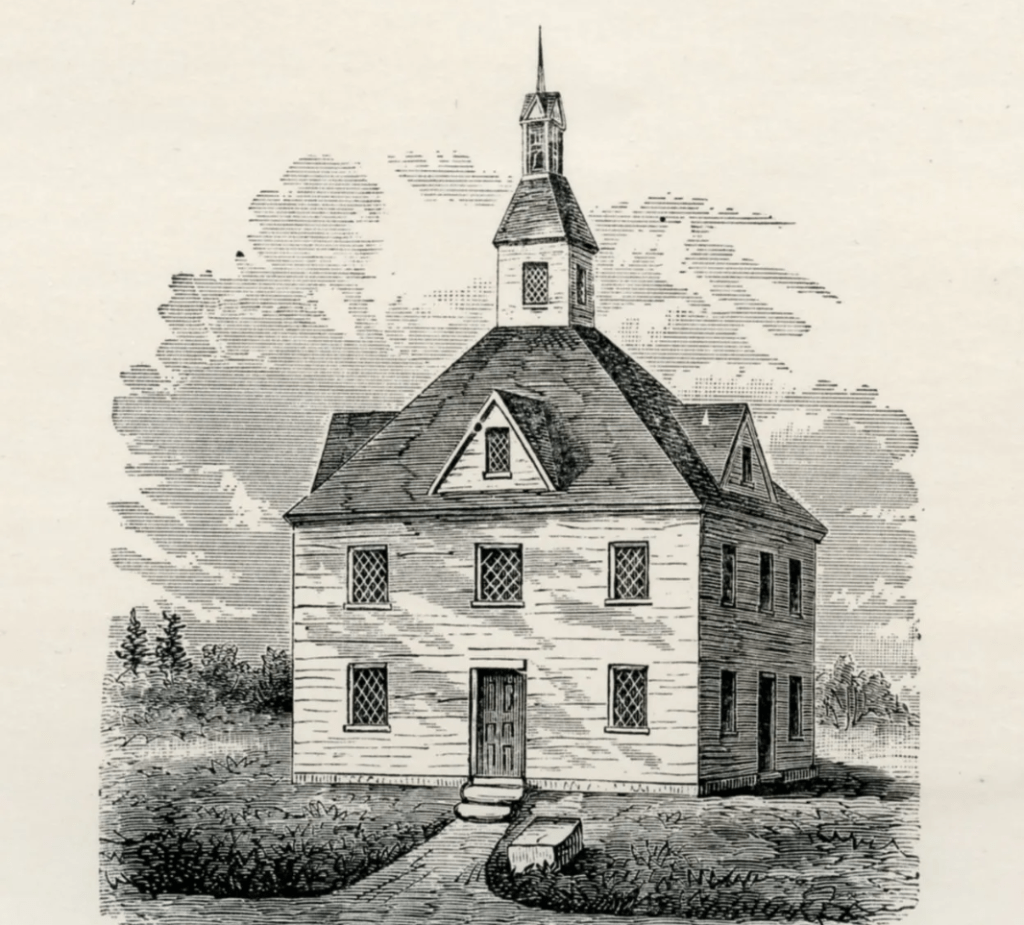
Have you seen pictures or visited any of the grand cathedrals in Europe? Many of these ornate, beautiful, and towering feats took hundreds and hundreds of years to build. And have you ever seen or visited a Puritan or Quaker meeting house? It’s a simple structure with a pitched roof and small steeple. Basic wooden pews fill the sanctuary. When God through Haggai asks, “Who of you is left who saw this house in its former glory?… How does it look to you now?” this is the type of contrast that God is drawing. Soaring cathedral versus simple meeting house, old temple versus the new temple.

But the deeper point in not really about the building. Like the Jews we too can get caught up in that. In verses 4 and 5 God gets to what really matters. Here God says, “Be strong all you people of the land and work. For I am with you… my Spirit remains strong among you. Do not fear.” Enemies and critics all around them, a less than temple taking shape, and God basically says, ‘Don’t worry about all that outside stuff. I am with you. Do not be afraid. The building doesn’t matter. All that noise swirling around outside doesn’t matter. Lean into me, lean into the work I have given you. Trust in me.’

This message is translated to our lives and times by Jesus. We are not tasked with building a physical thing but are tasked with building the kingdom of God. Jesus generally describes our task this way: ‘Go out into the world and make disciples of all peoples. Go and help fill all of those human houses with the glory of God.’ Yes, God is still with us. So may we go forth to build the kingdom of God.

Prayer: Lord God, may my time in your word and in the building equip and encourage me to go out into all the world, seeking to make disciples of Jesus Christ for the transformation of this world. Amen.


Leave a comment

New and Improved

Reading: 2nd Kings 5:1-14

Verse 12: “So he turned and went off in a rage.”

Elisha and Naaman are the main characters in our passage from 2nd Kings 5. Elisha is the prophet in Samaria referred to by the slave girl. He too is confident in God and has a strong faith. Hearing of the king of Israel’s distress over the letter, Elisha sends a message: “Have the man come to me and he will know that there is a prophet in Israel.” Naaman and his entourage are directed to Elisha’s house.

Instead of going out to greet this important general, Elisha sends out a messenger with this simple prescription: “Go, wash yourself seven times in the Jordan…” Naaman, however, expects to be greeted. He expects something showy from the prophet. He has a deeply pressing need – to be healed of his leprosy – and he expects a matching response. Naaman receives none of this. He is insulted and angered by Elisha’s interaction with him. “So he turned and went off in a rage.”

Do you suppose Elisha was peeking out the window the whole time, evaluating how the scene played out? He was patient. Perhaps God told him Naaman needed more than a physical healing. Or maybe it was easy to see that Naaman needed an attitude adjustment. As he’s about to storm off, Naaman’s servants reel him back in. Convinced that he should at least try this simple thing, Naaman finds “his flesh restored.” His skin “became like that of a young boy.” Naaman isn’t just healed. He is new and improved. He is healthier than he could have ever hoped for. I suppose Elisha smiled broadly as he watched Naaman’s reaction to God at work in his life. How would you react if you were Naaman?

Prayer: Lord God, thank you for the reminder that you are a God who does more than. More than we expect. More than we can imagine. More than we deserve. More than we could ever earn. Thank you for your abundant and generous love that makes us new and improved. Amen.


Leave a comment

A Simple Faith

Reading: 2nd Kings 5:1-14

Verse 3: “If only my master would see the prophet who is in Samaria! He would cure him of his leprosy.”

As we begin the first of two days in 2nd Kings 5 let us focus on the supporting characters. Tomorrow we’ll look at the main characters: Naaman and Elisha. Verse 1 sets the scene. Naaman is a great and powerful man, an army commander from Aram. He is highly regarded by the king of Aram. But Naaman has leprosy, a skin disease.

The main supporting character is a slave girl from Israel. She was taken captive, possibly in a raid led by Naaman. She surveys his condition and declares, “If only my master would see the prophet who is in Samaria! He would cure him of his leprosy.” What an honest and strong faith she has! Just go and see the prophet and be healed. Her declaration leads Naaman to the king, who says, “By all means, go.” He sends a letter along to the king of Israel, expecting Naaman to be healed. This is a lot of trust to place in the faith of a simple slave girl.

The king of Israel receives the letter and tears his robes. He fears that the king of Aram is trying to pick a fight by asking him to do the impossible. What a contrast to the faith of a simple slave girl. Elisha intercedes and Naaman is sent to Elisha. A servant of Elisha – not the prophet himself – comes out and gives instructions. Angry and insulted, Naaman is ready to go home mad. But his servants intervene, calling him to trust in this simple slave girl’s faith. Naaman submits and he is healed. He in made clean.

What a great healing comes from the contagious faith of a simple slave girl! In this big old world most of us are not a Naaman or an Elisha. Yet we can practice a powerful faith, one that trusts in the power of God and invites others to do the same. May it be so.

Prayer: Lord God, in my heart I know that you can do anything. Help me today to reflect that in my words, actions, and thoughts. Doing so, may others come to know you too. Amen.


Leave a comment

Really That Simple

Reading: Galatians 5:1 and 13-21

Verse 14: “The entire law is summed up in a single command: ‘Love your neighbor as yourself.'”

Paul begins our passage today with a word of encouragement: “Christ has set us free. Stand firm.” No longer living under the Law, Paul has found freedom in Christ. Yes, he still wrestles with sin, as we all do, but he has been freed from the guilt and shame. No longer remaining stuck there, Paul has been freed to follow Jesus Christ and to live captive to Christ. No longer hindered by that old “yoke of slavery” to the Law, Paul stands firm in his faith in Jesus Christ and invites us to join him.

The freedom Paul finds is not a “you can do anything you want” freedom but a freedom lived within the bounds of Christ’s words and example. Paul identifies the filter for determining this line in verse 14. Here he reminds us: “The entire law is summed up in a single command: ‘Love your neighbor as yourself.'” Is he speaking of the old Jewish Law or of the new law of Jesus Christ? Or is it both? I believe it is both. Jesus himself said that he did not come to abolish the Law but to fulfill it (Matthew 5). He fulfilled it by being God’s love lived out in the world. Doing so, Jesus was led by God or the Spirit, as Paul refers to in verses 16-18. Led by the Spirit, Christ was not captive to the desires of the sinful nature. We too can claim this Holy Spirit power and the freedom it brings.

In verse 19-21 Paul gives quite the list of “acts of the sinful nature.” Even though quite the list, it is quite incomplete. That maybe being a given, the sins on Paul’s list and on any other list we can generate come down to following the single command given in verse 14. If we truly love our neighbor more than self, we will not sin against them or against God. It’s really that simple: love unconditionally and fully.

Prayer: Lord God, help me to see with your eyes of love. This is where so many of my relationships and my interactions begin, with what I see. So let me see all as you see them, as a beloved child of God. Then lead me to love them – all of them – in a way that they come to better know your love. Amen.


Leave a comment

In Christ

Reading: 2nd Corinthians 5: 16-17

Verse 17: “If anyone is in Christ, he is a new creation; the old has gone, the new has come”.

Our verses for today begin with Paul inviting us to look beyond the world and its points of view. Too often we see as the world sees. People of faith can be just like the world in terms of how we define ourselves and others. We too easily see and understand ourselves and others through terms like race, class, gender, occupation, ethnicity, age, and so on. Too often terms like these lead to judging another’s worth and value – all us relative to how we see or define ourselves. Jesus did not see or understand the world and the people he encountered this way. Why should we think it OK to do so?

Who we are and how we see and understand ourselves is part of our sacredness. God created all of us, knit us together in love. Our worth and our value is rooted in this holy creation. Each created by God, each made in the image of our God – this is how we should see and understand ourselves and others. No worldly terms or constructs should in any way lessen how we see and understand and love ourselves and one another.

Early in the history of the church a deadly disease spread through many communities. Out of fear of dying themselves, many people placed loved ones out in the street to die. It was those early Christians who took the sick into their homes to care for them, to love on them. The early church did not care that they were pagans or Jews or that they were rich or poor or anything else. Jesus had instructed them to care for the least of these. How far some of us have gotten from such simple instructions.

As followers of Jesus Christ may we reclaim the vision and love of the one we say we follow. Loving and caring for all we meet and encounter, may we see and understand each as created by God, each as beloved by God. Doing so we live into these words: “If anyone is in Christ, he is a new creation; the old has gone, the new has come”. In Christ may we transform ourselves, the church, and the world into a more loving, caring, and just place.

Prayer: Lord God, guide me this day to love as Jesus Christ loved. Grant me eyes to see all as you see them – created in love by you. Seeing as you see, may I live out your love in the world each day. Amen.


Leave a comment

The Divine Heart

Reading: Luke 1: 47-55

Verses 52-54: “He has… lifted up the humble… filled the hungry… remembering to be merciful”.

As we read this beautiful song offered up by Mary, I can’t but wonder if the baby in her womb and connected to her heart heard these words and began to internalize them. As a young man Jesus would have been raised by this faithful soul. He would have been taught the faith by Mary and Joseph, learning of how God loved the people and of his great mercy towards them. In her song Mary also personalizes these aspects of God – “called me blessed”… “done great things for me”. In her song Mary glorified both the God of Israel and the God of her heart.

Towards the end of the song Mary recognizes God’s preference for the lowly and meek, for the simple and ordinary. Mary’s God is one who “scatters the proud” and “brings down rulers”. In Jesus’ ministry we certainly see evidence of these actions being lived out and we hear of their completion in his return. In verses 52 through 54 Mary glorifies her God who “lifted up the humble… filled the hungry… remembering to be merciful”. Again, Jesus will live out the heart of his mother and the heart of his God as he ministers to the poor, the lost, the broken, the least, the sinners.

The divine heart clearly connects to and values and loves those who are suffering, those on the fringes, those without power or voice. Just as Mary sings, the divine heart has always loved and cared for such as these. You and I were created with this spark of the divine within us. We hear it beating in Mary’s song and we feel it beating in our own hearts. May we live it out each day.

Prayer: God of the outcast and marginalized, help me to draw close to those you love. Lead me to be your hands and feet and voice in our hurting world. Use me as part of your desire to bring healing and hope. Amen.


2 Comments

Pray, Listen

Reading: 2nd Samuel 7: 1-11 and 16

Verse 2: “Here I am, living in a palace of cedar, while the ark of God remains in a tent”.

At this point in his story, David is at a good place. He has conquered all of his enemies. He has established Jerusalem as the capital. He has a beautiful home made of expensive wood. Life is good. David calls in his advisor, the prophet Nathan, and says to him, “Here I am, living in a palace of cedar, while the ark of God remains in a tent”. Nathan thinks it a splendid idea to build God a big fancy home. But before David can even begin to line up all the workers and start gathering up all the materials, God reigns him in.

God begins with a question. He asks David, “Are you the one”? God reminds them that he has not had a house, well, ever. God once had a garden… But God has never once even asked for a house. A house is, after all, a human construct. God is perfectly content with a tent. It is adequate. It is simple. It is humble. In this season, it reminds me of the manger.

David does something here in today’s passage that I can do too. I can set my plans out before God’s plans. This happens one of two times and both are equally dangerous. Like with David, when things are going well, I can strike off with my own grand idea for ministry or service. On the other end of the spectrum, when things are going really bad, I can try quick fixes, much like firing darts at the dartboard while blindfolded. In both cases I fail to do what David failed to do: pray. Include God at the planning and thinking stages instead of at the point that the ship is sinking. Too often our plans can be formed and executed without God’s help and guidance. Usually these end with God reigning me back in, with me learning another hard lesson. Step one: pray.

As I read and pondered this passage this morning, at first I thought, ‘If only I had a Nathan’, one sent by God to guide me, to help me, to lead me, to walk with me. And then I realized that I do. The Holy Spirit is my personal connection to God. Thinking back on my hard lessons, I can see when I ignored the quiet whisper, when I shoved back against the gentle nudge. Step two is to listen, to hear.

To pray and to listen are two key steps on our walk of faith. Both align us and keep us in tune with God. May all we do and say and think begin with these two steps: pray and listen. May it be so.

Prayer: Lord God, thank you for this reminder today. In my too frequent battles with pride and wanting to be in control, reminders of your ways are always needed. Thank you for the reminder today. Amen.